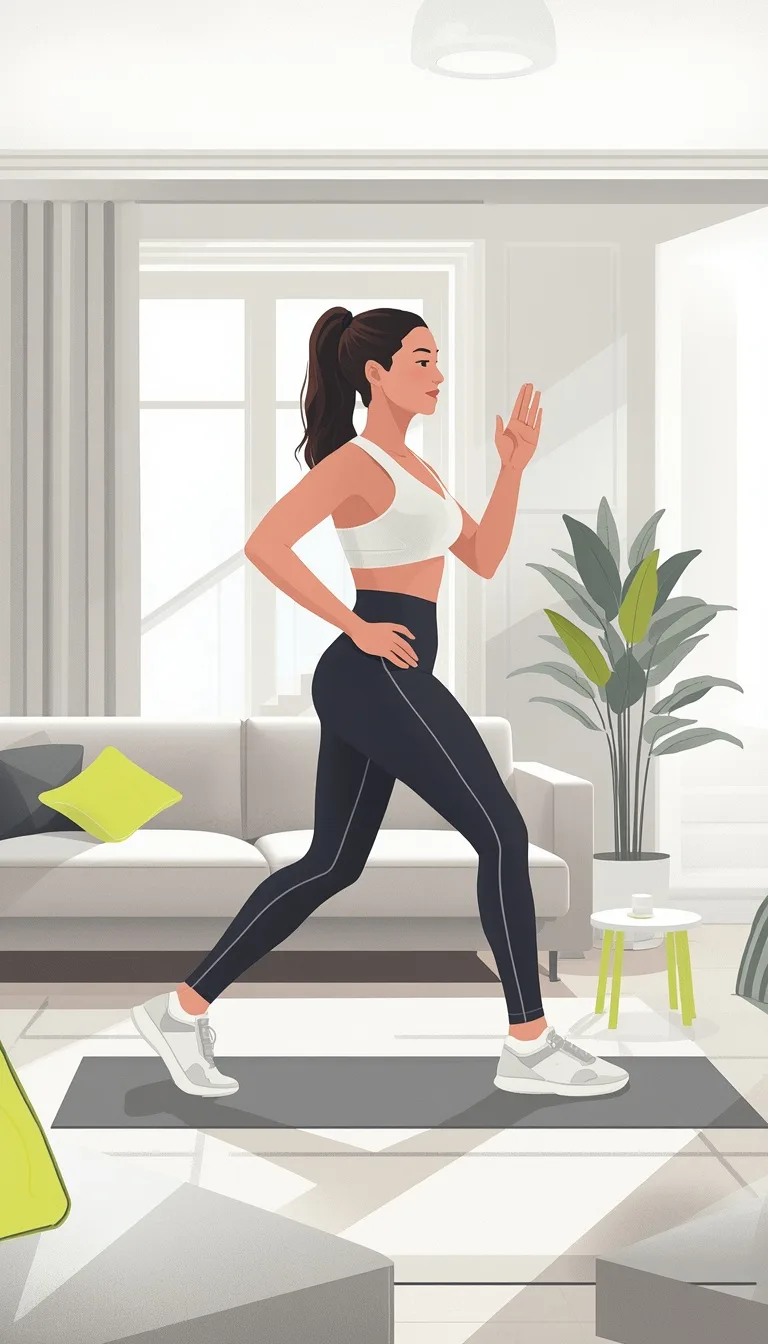
You don’t need running shoes, a treadmill, or a single jump to get your heart working. If you’re new to exercise, coming back after a long break, or simply want something kinder to your joints, you can build real cardio fitness with simple moves done on the spot in your living room.
This guide gives you three ready-to-use Beginner Cardio Workout (5, 10, and 20 minutes), swaps for sore knees, small spaces, or balance concerns, a plain-English way to judge your effort, and a four-week plan that builds up gradually. Everything here is designed so you can press start today, with no equipment and no prior fitness experience. If this is your very first workout at home, you may also want to read what to do on your first day working out at home before you begin.
What Low-Impact Cardio Actually Means
“Low impact” describes how your body meets the floor, not how hard you work. In a low-impact move, at least one foot stays in contact with the ground at all times. There’s no landing from a jump and no repeated pounding like you get when running. That reduces the stress on your knees, hips, ankles, and lower back.
It does not mean easy. A slow march can feel gentle, while a brisk march with high knees and pumping arms can leave you breathing hard. You decide the difficulty by changing your speed, your range of motion, and how much your arms are involved. That flexibility is exactly why low-impact cardio suits beginners: the same four movements can be a light warm-up on day one and a proper workout a month later.
Cardio (also called aerobic exercise) simply means rhythmic movement that raises your heart rate and breathing for a sustained period. Regular cardio is linked with better heart and lung health, more energy through the day, and improved mood and sleep. You don’t need to chase intensity to get those benefits. Consistency matters far more than any single hard session.
Who This Routine Is For
This plan works well if you:
- Have never followed an exercise routine, or haven’t exercised in a long time
- Want a no-running, no-jumping option
- Prefer short workouts you can fit around work, family, or study
- Live in an apartment or have limited space
- Don’t own any equipment
- Are returning after a break and want to ease back in
You don’t need to be fit to start. You just need to choose a version of each move that feels comfortable and repeatable. If you’re unsure about starting because of a health condition, injury, or pregnancy, check with a healthcare professional first.
Before You Start: Setup
You need very little:
- Space: A clear area about the size of a yoga mat. Move any coffee tables, cords, or loose rugs out of the way.
- Shoes: Comfortable, supportive shoes make a difference on hard floors. If you’re on carpet or a mat, you can go barefoot if that’s comfortable for you.
- Water: Keep a glass or bottle within reach.
- Support: If balance is a concern, set up beside a counter or sturdy chair you can touch.
- Timer: Use your phone or any clock. A music playlist with a steady beat can also help you keep a rhythm.
Wear clothes you can move freely in, and avoid exercising right after a large meal.
The Four Moves
All three workouts use the same four movements, so you only need to learn them once.
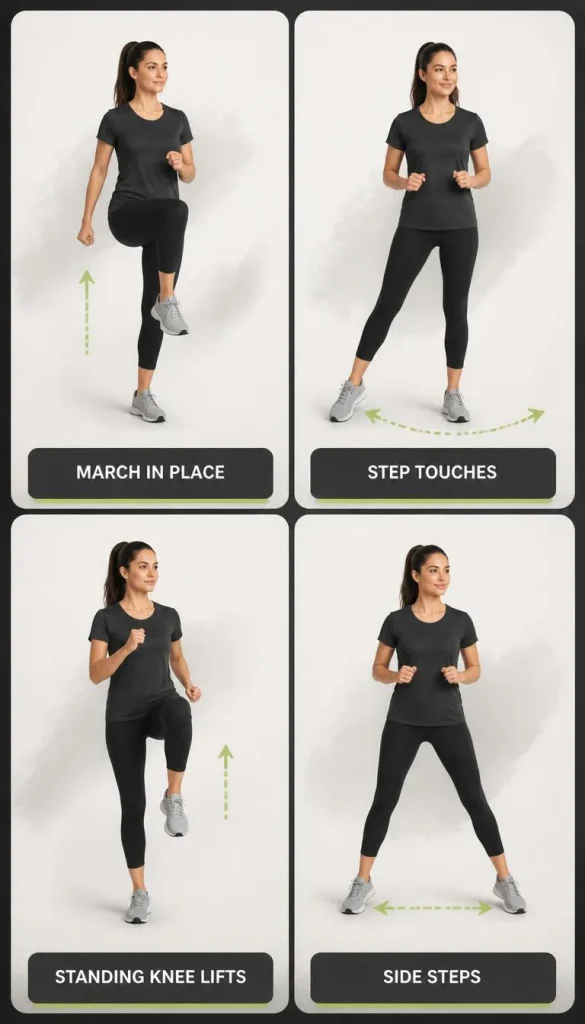
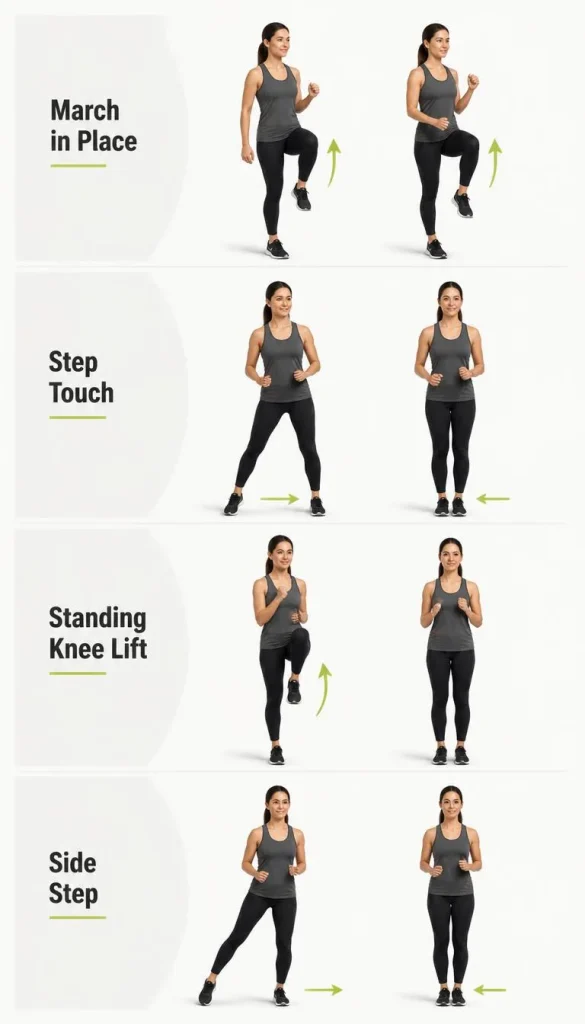
1. March in Place
Stand tall with your feet about hip-width apart and your shoulders relaxed. Lift one foot, lower it, then lift the other, swinging your arms naturally like you’re walking briskly.
- Easier: Take small steps, keep your knees low, and slow the pace. Hold a counter if needed.
- Harder: Speed up, lift your knees higher, and drive your arms more actively.
2. Step Touches
Start with your feet together. Step your right foot out to the side, bring your left foot in to meet it, then step your left foot out and bring the right in. Keep a smooth, side-to-side rhythm and let your arms swing gently.
- Easier: Shorten the steps and slow down.
- Harder: Take wider steps, move faster, or add arm movements like reaching up and out.
3. Standing Knee Lifts
Stand tall and lift your right knee toward hip height, lower it with control, then lift your left. Keep your chest up and avoid leaning backward.
- Easier: Lift your knees only partway, to about mid-shin height, and slow the tempo.
- Harder: Lift higher, speed up, or tap the opposite elbow to the rising knee.
4. Side Steps
Step to your right two or three times, then step back to the left. Keep your knees slightly soft rather than locked and your feet pointing forward.
- Easier: Take small steps and move slowly.
- Harder: Take wider steps and quicken the pace, keeping every step controlled.
A good rule for all four moves: if your form gets sloppy, slow down. Controlled movement beats fast, wobbly movement every time.
The Intensity Guide: How Hard Should It Feel?
You don’t need a heart rate monitor. Use a simple 1 to 10 effort scale, where 1 is sitting on the couch and 10 is an all-out sprint.
| Level | Effort score | What it feels like |
|---|---|---|
| Easy | 3 to 4 | Breathing slightly faster than normal. You could chat comfortably or even sing. |
| Moderate | 5 to 6 | You feel warm and your breathing is heavier. You can speak in full sentences but couldn’t sing. |
| Hard | 7 or higher | You can only say a few words at a time. Not recommended for beginners yet. |
The Talk Test
The easiest check is the talk test. At moderate intensity, your heart rate and breathing go up, but you can still hold a conversation. If you can only gasp a few words between breaths, you’re working harder than a beginner session needs. If you could comfortably sing, you can nudge the pace up a little.
The CDC also notes that intensity is relative to the individual. What counts as moderate for you may look different from someone else, so ignore comparisons and go by how you feel.
Which Level to Use When
- Week 1: Stay mostly at easy (3 to 4). Your goal is to learn the moves and build the habit.
- Weeks 2 to 3: Mix easy and moderate (4 to 5).
- Week 4: Spend most of your main work at moderate (5 to 6), with easy effort for warm-up and cool-down.
Finishing a session feeling like you could have done a little more is a good sign. It means you’ll want to come back.
The 5-Minute Workout
Use this on your busiest days, your very first session, or whenever you only have a few minutes. Each move runs for one continuous minute.
- Minute 1: Easy march. Small steps and relaxed arms (effort 3).
- Minute 2: Step touches. Find a smooth side-to-side rhythm (effort 4).
- Minute 3: Knee lifts. Lift to a comfortable height (effort 4 to 5).
- Minute 4: Side steps. Slightly wider steps and a steady pace (effort 4 to 5).
- Minute 5: Slow march. Let your breathing settle (effort 2 to 3).
Tips: If one minute of any move feels like too much, do 30 seconds and march gently for the other 30. There’s no prize for pushing through discomfort. Five easy minutes done regularly are worth more than one exhausting session you dread repeating.
The 10-Minute Workout
This version adds a proper warm-up, two rounds of the main circuit, and a cool-down.
Warm-up (2 minutes): March slowly for the first minute, then add small arm swings and a few shoulder rolls in the second.
Main circuit (6 minutes): Complete two rounds. In each round, do each move for 40 seconds, using about 5 seconds to switch between moves.
- March, faster than your warm-up
- Step touches
- Knee lifts
- Side steps
Each round takes roughly three minutes. If you need to rest between rounds, march slowly for 20 to 30 seconds and sip some water.
Cool-down (2 minutes): March slowly, take several deep breaths, then do gentle stretches. Hold a calf stretch and a standing thigh stretch for about 20 seconds per side.
Target effort: 4 to 6 during the circuit.
The 20-Minute Workout
This is your longer session once the 10-minute version feels comfortable. The arm movements raise your heart rate without adding any impact.
Warm-up (3 minutes): Easy march, then add shoulder rolls and gentle side-to-side sways.
Circuit 1 (4 minutes): One minute each of march, step touches, knee lifts, and side steps at a steady pace (effort 5).
Recovery (1 minute): Slow march while your breathing settles.
Circuit 2 (4 minutes): The same four moves, with your arms working harder:
- March with alternating forward punches
- Step touches with both arms reaching overhead
- Knee lifts, tapping the opposite elbow to the rising knee
- Side steps with a big, relaxed arm swing
Recovery (1 minute): Slow march.
Circuit 3 (4 minutes): Repeat Circuit 1, slightly faster than before, aiming for effort 5 to 6.
Cool-down (3 minutes): Slow march for a minute, then stretch your calves, thighs, chest, and shoulders for about 20 seconds each.
Total time: 3 + 4 + 1 + 4 + 1 + 4 + 3 = 20 minutes.
If you can’t complete all 20 minutes at first, stop after Circuit 2 and do your cool-down. That’s still a solid session.
Low-Impact Substitutions
Every body is different, and every home is too. If a move doesn’t suit you today, swap it for something that does. You’ll still get the cardio benefit.
| Situation | What to try |
|---|---|
| Sore or sensitive knees | Keep knee lifts low (mid-shin height), take shorter steps, and slow the tempo. Avoid deep or wide stepping. |
| Balance concerns | Work beside a counter or sturdy chair and rest a hand on it. March instead of lifting knees high. |
| Very small space | Replace side steps with step touches. Keep marching in place and add arm movements for extra effort. |
| Can’t stand for long | Do a seated version: march your legs while sitting tall, tap your toes, and add the punches and overhead reaches. |
| Noisy floors or neighbors | Step softly and work on a rug or exercise mat. |
| Lower back discomfort | Keep your torso upright, shorten your steps, and skip high knee lifts. |
| Feeling very tired that day | Do the 5-minute version at effort 3. A light day still counts. |
| Want more challenge, still no impact | Move faster, lift higher, add arm work, shorten your rests, or add one more round. |
A seated option, step by step: Sit tall on the front half of a sturdy chair. March your feet for one minute, tap your toes forward for one minute, then do alternating punches for one minute, finishing with overhead reaches. Repeat the cycle. It’s a legitimate cardio workout, not a lesser one.
Your Four-Week Progression
The most reliable way to build fitness is to do a little more over time, rather than a lot more all at once. Aim for three sessions per week, with a rest day or an easy walk between sessions. Move to the next week only when the current week feels manageable. Repeating a week is perfectly fine and often smart.
| Week | Workouts | Sessions per week | Target effort |
|---|---|---|---|
| 1 | 5-minute workout | 3 | Easy (3 to 4) |
| 2 | 10-minute workout | 3 | Easy to moderate (4 to 5) |
| 3 | 10-minute workout twice, 20-minute workout once | 3 | Moderate (5) |
| 4 | 20-minute workout twice, 10-minute workout once | 3 | Moderate (5 to 6) |
Week 1: Learn the Moves
Do the 5-minute workout three times this week. Focus on form and rhythm rather than speed. Notice which moves feel natural and which need a swap. By the end of the week, the sequence should feel familiar.
Week 2: Add Time
Move up to the 10-minute workout. If the jump feels big, do two 5-minute sessions in one day (for example, morning and evening) and build toward one continuous 10-minute session.
Week 3: Introduce the Longer Session
Do the 10-minute workout twice and try the 20-minute workout once, keeping the effort at easy to moderate. If you can’t finish all 20 minutes, stop at Circuit 2.
Week 4: Build Consistency
Do the 20-minute workout twice and the 10-minute workout once. By now you’ll be doing around 50 minutes of cardio per week. Compare how you feel to Week 1. Many people notice they recover faster, breathe more easily during the same moves, and need fewer breaks.
What Comes Next
After four weeks, you can extend your sessions, add a fourth day, or mix in other activities like walking, cycling, or swimming. The CDC’s general recommendation for adults is at least 150 minutes of moderate-intensity aerobic activity per week, plus muscle-strengthening on at least two days. Treat that as a longer-term target, not a first-week requirement. For help planning your weekly routine, see how often beginners should work out at home.
What to Do on Non-Workout Days
You don’t need to be fully inactive between sessions, and you don’t need a structured workout either. Light daily movement supports your progress and helps you recover:
- A 10 to 15 minute walk
- Taking the stairs when you can
- Household chores and gardening
- Short movement breaks if you sit for long periods
- Light stretching in the evening
The point is to move more and sit less across your week, not to exhaust yourself every day.
Common Beginner Mistakes
Starting too hard
An aggressive first session can leave you sore and discouraged. Start easier than you think you need to.
Assuming low impact means no effort
You can get a legitimately challenging workout without jumping. Use the intensity guide to make sure you’re working at an appropriate level for the week.
Skipping the warm-up and cool-down
Two or three minutes at each end prepare your body for effort and help your breathing and heart rate return to normal.
Chasing 150 minutes right away
The weekly guideline is a destination. If you’re currently inactive, reaching it takes time, and that’s expected.
Ignoring recovery
Rest days are when your body adapts. Feeling a little more tired early on is normal, but persistent exhaustion or aching is a signal to scale back.
Comparing yourself to others
Your moderate may look nothing like someone else’s. Judge effort by your own breathing and the talk test.
Quitting after one missed day
Missing a session doesn’t undo your progress. Just do the next one.
Combining Cardio With Strength Training
Cardio is only one part of a balanced routine. Once you’re comfortable with this plan, add two short strength sessions per week using bodyweight moves like squats to a chair, wall push-ups, and glute bridges. A simple weekly pattern looks like this:
- Monday: Cardio
- Tuesday: Strength
- Wednesday: Easy walk or rest
- Thursday: Cardio
- Friday: Strength
- Saturday: Cardio or a recreational activity
- Sunday: Rest
For a no-equipment strength option, try the bodyweight-only workout for fat loss.
A Realistic Word on Weight Loss
Regular cardio adds to the energy your body uses and can support weight management as part of a bigger picture. But weight loss depends on many things, including your eating patterns, your total daily activity, sleep, and individual differences, so no single workout type guarantees results. Think of this routine as a way to build a sustainable habit and improve your fitness, with any weight changes as a possible side effect rather than the only measure of success.
Better markers of progress include how much easier the workouts feel, how quickly you recover, your energy levels, and how consistently you show up.
When to Stop or Check With a Doctor
Listen to your body. Stop exercising and seek medical help if you experience:
- Chest pain or pressure
- Severe shortness of breath
- Dizziness, lightheadedness, or fainting
- Sharp or unusual pain in a joint or muscle
- Any symptom that feels unusual or alarming for you
If you have a chronic condition, a past injury, or any health concern, talk to a healthcare professional before beginning a new exercise program. They can tell you what kind and amount of activity is appropriate for you.
Frequently Asked Questions
Is this workout really suitable for someone who has never exercised?
Yes. The moves are simple, the starting version is only five minutes, and you control the intensity at every step. Begin at the lowest effort level and progress only when you feel ready.
Can I do these workouts every day?
You can do gentle movement daily, but you don’t need to repeat the structured workout every day. Three sessions per week with rest or light activity in between is a sensible start for most beginners.
Do I need any equipment?
No. Clear floor space and comfortable shoes are enough. A chair or counter helps if you want balance support.
How long should a beginner cardio session be?
Five to ten minutes is a reasonable starting point if you’re currently inactive. Build toward 20 minutes and beyond over several weeks.
Is this enough cardio for health?
It’s a strong starting point. Over time, many adults aim for the recommended 150 minutes per week of moderate-intensity activity, which you can reach by gradually adding sessions or minutes. Walking and other activities you enjoy count too.
What if I get bored?
Change the music, swap the order of the moves, or practice with a friend or family member. You can also vary the arm movements or try new low-impact moves like heel digs, seated marching, or gentle dance steps.
What should I do once I’ve finished the four weeks?
Extend your sessions, add a fourth day, or add strength training. If you want a structured plan for the next stage, the 1-month beginner fitness plan is a natural follow-up.
The Bottom Line
You don’t need to run, jump, or buy anything to start building cardio fitness. Marching, step touches, knee lifts, and side steps, done at an effort that suits you today, are a perfectly good foundation. Begin with the 5-minute workout, move up to 10 and then 20 minutes as it gets easier, and use the intensity guide to stay in a comfortable range.
The goal of your first week isn’t to finish exhausted. It’s to finish feeling like you’ll want to do it again. Consistency is what turns a few minutes of movement into a lasting habit.
Sources and Further Reading
- CDC: What Counts as Physical Activity for Adults covers moderate intensity, the talk test, and muscle-strengthening activity.
- CDC: Physical Activity and Your Weight and Health explains how activity contributes to energy expenditure.
- Physical Activity Guidelines for Americans (ODPHP) provides the federal evidence-based guidelines for adults.
- NIDDK: Tips for Starting Physical Activity offers advice on beginning gradually and mixing aerobic and strengthening activity.
Health disclaimer: This article is general educational information, not individualized medical advice. If you have a medical condition, injury, or concerns about starting exercise, speak with a qualified healthcare professional before beginning.