If you’ve ever done the same workout for weeks and wondered why your results stalled, the missing piece is usually progressive overload. It’s the single most important concept in strength training, and also one of the most over-explained — buried under percentage charts, RPE scales, and spreadsheets that make a simple idea feel like a math class.
This guide (What Is Progressive Overload?) strips that away. You’ll learn exactly what progressive overload means, why your body needs it to keep changing, and — more usefully — six concrete ways to apply it without calculating a single percentage of your one-rep max.
Quick Takeaway
Progressive overload means gradually asking your muscles to do a little more over time than they’re used to — a bit more weight, a few more reps, slightly less rest, or better control of the movement. Your body adapts to the demands placed on it, so if those demands never increase, neither does your strength or muscle. You don’t need a formula to apply this. You need a way to notice when last week’s workout has gotten easier, and a simple way to make the next one slightly harder.
What Progressive Overload Actually Means
Progressive overload is the gradual increase of stress placed on your body during exercise, over time, so your muscles, connective tissue, and nervous system keep adapting rather than plateauing. It’s the mechanism behind essentially all strength and muscle gain — without it, your body has no reason to change, because it’s already capable of handling what you’re asking of it.
Think of it like this: the first time you carry a heavy bag of groceries up three flights of stairs, your legs feel it. Do that same trip daily for a month, and it stops being hard — your body adapted to handle that specific demand efficiently. If you want to keep seeing a training effect from stair climbing, you’d need to add more weight, more flights, or more frequent trips. That’s progressive overload, and it’s the same principle whether you’re talking about grocery bags or barbells.
The American College of Sports Medicine’s position stand on resistance training for healthy adults describes this as progressively increasing training stimulus — through load, volume, or other variables — as the body adapts, which is exactly the mechanism this guide breaks down into practical options below.
Why It Matters More Than Any Specific Workout
A lot of beginner frustration comes from a mismatch in expectations: people assume that doing a workout program is what produces results, when it’s actually the progression within that program that does the work. Two people can follow the exact same beginner routine — but the person who adds a small amount of difficulty every week or two will keep improving, while the person repeating identical workouts will plateau within a matter of weeks once their body has fully adapted to that specific stimulus.
This is also why progressive overload matters just as much during a fat-loss phase as it does when building muscle. If you’re specifically trying to preserve strength and muscle while losing fat, continuing to apply progressive overload — even in a scaled-back way — is one of the clearest signals telling your body to hold onto muscle tissue rather than let it go along with fat. This is covered in more depth in FitVibe’s guide to losing fat without losing muscle, but the short version is: progression doesn’t pause just because calories are reduced.
Six Ways to Apply Progressive Overload (No Math Required)
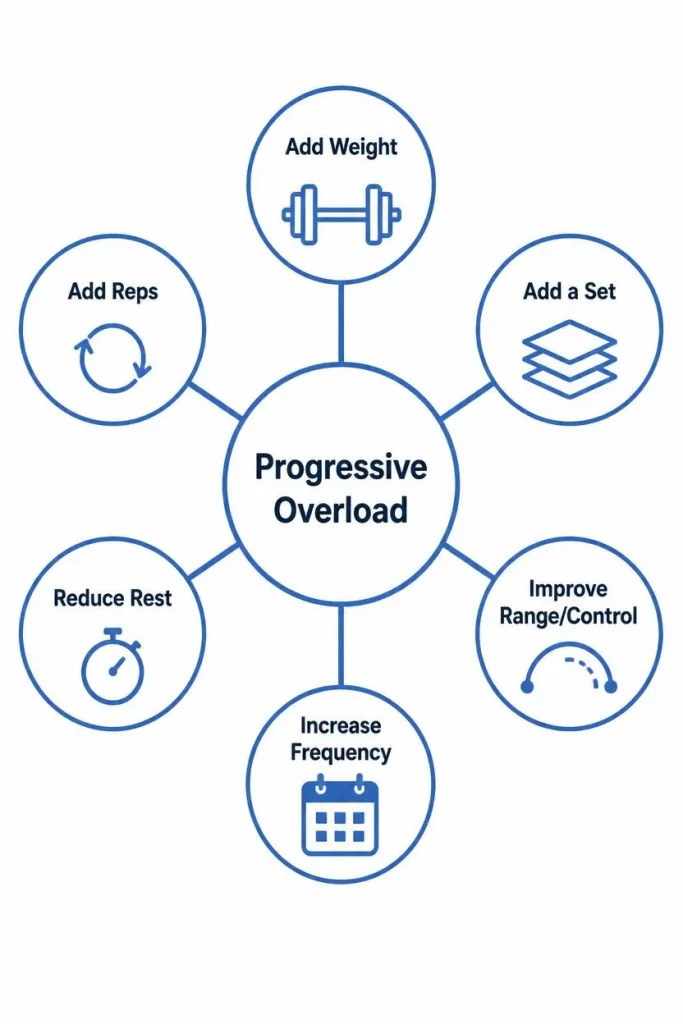
You don’t need to calculate a percentage of anything to progressively overload a muscle. Here are six practical levers, any one of which counts as genuine progression on its own.
1. Add a Little Weight
The most familiar method: use a slightly heavier dumbbell, resistance band, or barbell load than last time. “Slightly” is doing a lot of work in that sentence — a small, manageable jump (think the next dumbbell size up, or an extra plate increment) is far more sustainable than trying to leap several sizes at once.
What this looks like in practice: If you did goblet squats with a 15 lb dumbbell for 10 reps last week and it felt manageable with 2–3 reps still left in the tank, try the 20 lb dumbbell next session.
2. Do a Few More Reps
If the weight stays the same but you push from 8 reps to 10, then 12, over a couple of weeks, that’s genuine progressive overload — you’re asking the same muscle to do more total work.
What this looks like in practice: Push-ups at 3 sets of 8 one week, 3 sets of 10 the next, 3 sets of 12 after that — all before you’d need to think about a harder push-up variation.
3. Add an Extra Set
Instead of changing weight or reps, simply do one more set of the same exercise at the same difficulty. More total sets means more total training volume, which is itself a valid form of progression — particularly useful when you’re not ready to add weight or reps yet but want to keep moving forward.
What this looks like in practice: Going from 2 sets of bodyweight lunges to 3 sets, while keeping reps and form exactly the same.
4. Reduce Rest Time Between Sets
Shortening your rest periods (while keeping the same weight and reps) increases the overall intensity of a session, because your muscles have less recovery time between efforts. This is a particularly useful lever when you’re short on time or have hit a point where adding weight doesn’t feel appropriate yet.
What this looks like in practice: Resting 90 seconds between sets for the first few weeks, then trimming that to 60 seconds once the exercise starts to feel too comfortable.
5. Improve Your Range of Motion or Control
This one gets skipped constantly, but it’s genuine progressive overload: a squat that goes deeper, a push-up with a fuller chest-to-floor range, or a slower, more controlled lowering phase (the “eccentric”) all increase the actual work your muscles are doing, even without touching the weight or rep count.
What this looks like in practice: Spending week one of a new movement focused purely on hitting full range of motion with control, before worrying about adding load at all. This is often the right starting point for true beginners — see FitVibe’s beginner strength training guide for how to sequence this alongside your first few weeks of training.
6. Train the Movement More Often
Going from training a particular movement pattern once a week to twice a week — without necessarily changing anything else about the workout — increases the total weekly stimulus on that muscle group, which is its own form of progressive overload at the weekly level rather than the single-session level.
What this looks like in practice: Moving from one full-body session per week to two, keeping each individual session’s difficulty roughly the same at first.
A Simple Comparison: Which Lever Should You Use First?
| Method | Best For | Why |
|---|---|---|
| Add weight | Once form is solid and reps feel too easy | The most direct way to increase strength over time |
| Add reps | Early weeks, before adding external load | Builds work capacity and confidence with a movement |
| Add a set | When you want more volume without more intensity | Lower risk of form breakdown than adding weight too soon |
| Reduce rest | Time-constrained sessions, or plateaued weight progress | Increases intensity without touching load |
| Improve range/control | The very first few sessions with a new exercise | Ensures the exercise is actually training the intended muscles well |
| Increase frequency | When one weekly session consistently feels “stale” | Raises total weekly volume gradually |
A sensible beginner sequence is usually: perfect your range of motion and control first, build up reps and sets over the following weeks, and only start adding meaningful external weight once a movement feels technically solid — not before.
A Four-Week Example: Bodyweight Squat to Loaded Squat
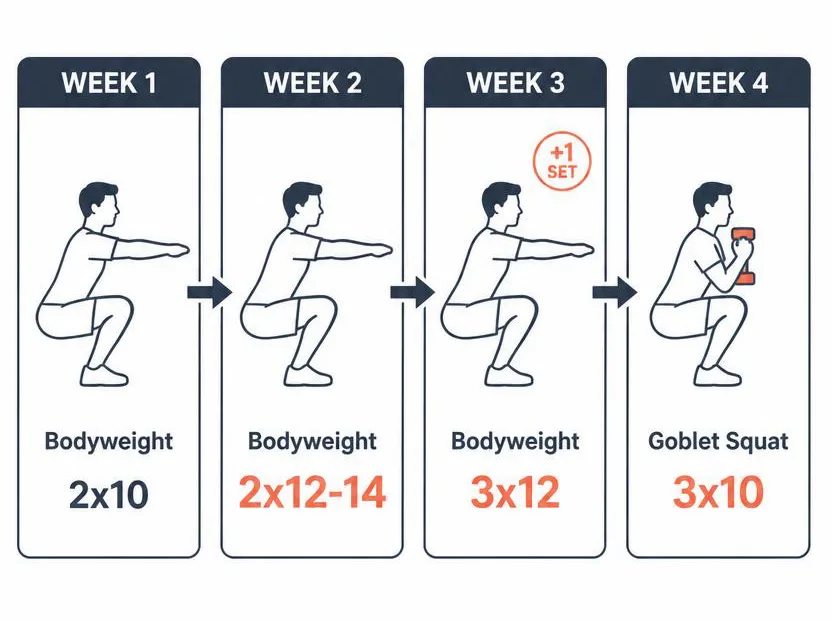
Here’s what applying several of these levers looks like strung together over a month, without needing to calculate anything:
| Week | Focus | Example |
|---|---|---|
| 1 | Range of motion and control | Bodyweight squat, 2 sets x 10 reps, slow and controlled |
| 2 | Add reps | Bodyweight squat, 2 sets x 12–14 reps |
| 3 | Add a set | Bodyweight squat, 3 sets x 12 reps |
| 4 | Add light external load | Goblet squat with a light dumbbell, 3 sets x 10 reps |
Notice that only one of these four weeks actually involves adding weight — the other three weeks use the other levers entirely. That’s the point: progressive overload isn’t synonymous with “lift heavier,” even though that’s the version most people picture first.
How to Tell When It’s Time to Progress
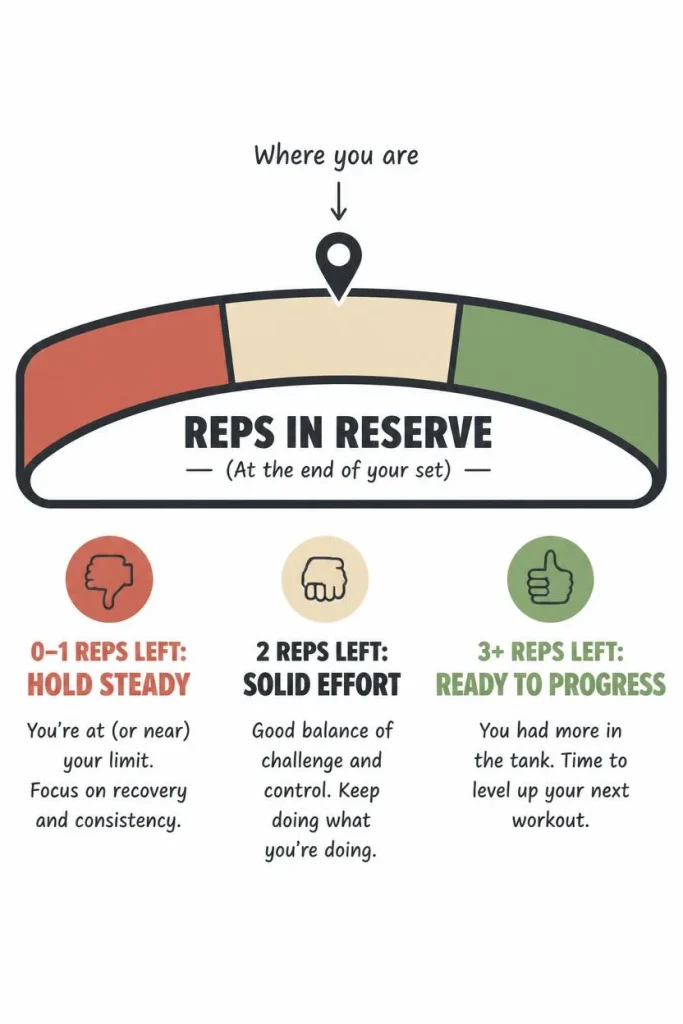
You don’t need a precise formula for this either. A useful, low-effort signal: if you comfortably complete all your planned sets and reps with good form and feel like you could have done a few more repetitions, that’s a reasonable sign you’re ready to apply one of the six levers above at your next session.
A simple way some coaches describe this is “reps in reserve” — an informal estimate of how many more clean reps you could have done at the end of a set. If you’re consistently finishing sets with 3 or more reps in reserve, there’s room to progress. If you’re finishing with 0–1 reps in reserve and form is starting to break down, that’s a sign to hold at your current level for another session or two rather than push further immediately.
Common Mistakes with Progressive Overload
| Mistake | Why It’s a Problem | Better Approach |
|---|---|---|
| Increasing weight and reps and sets all at once | Compounds fatigue and raises injury risk, and makes it unclear which change actually worked | Change one variable at a time |
| Chasing weekly progress on every single exercise | Not every lift needs to progress every week; this leads to burnout or form breakdown | Expect some exercises to progress faster than others — that’s normal |
| Treating soreness as the goal | Soreness isn’t a reliable measure of a good or productive session | Judge progress by performance and control, not how sore you feel afterward |
| Sacrificing form to hit a heavier number | Defeats the purpose — the muscle isn’t getting a true overload if a different muscle or momentum is doing the work | Keep form standards consistent as the non-negotiable baseline for any progression |
| Assuming no progress this week means failure | Some weeks, especially under stress, poor sleep, or a busy schedule, simply call for maintenance | Maintaining your current level during a hard week is still a legitimate training outcome |
| Never progressing at all | Sticking with the exact same workout indefinitely eventually stops producing change | Revisit your routine every 1–2 weeks and apply at least one of the six levers above |
How This Fits Into a Broader Beginner Plan
Progressive overload isn’t a standalone workout — it’s a principle you apply within whatever structured routine you’re already following. If you’re just getting started, FitVibe’s 1-month beginner fitness plan lays out a full week-by-week structure that already builds this kind of progression in; this guide is meant to explain the “why” behind that structure so the logic makes sense as you move through it, rather than just following instructions blindly.
If you’re returning to training after time away rather than starting fresh, the same six levers still apply — but the starting point and pace look different, since your body is re-adapting rather than adapting for the first time. FitVibe’s guide on returning to exercise after 3+ months away walks through a phased reintroduction that uses these same progression principles at a more conservative pace.
Supporting Progressive Overload With Nutrition and Recovery
Progressive overload creates the stimulus for adaptation, but the actual adaptation — the muscle repair and strength gain — happens afterward, during recovery. Two things matter most here, and neither requires a complicated plan:
- Protein intake gives your body the raw material to repair and build the muscle tissue you’ve just trained. You don’t need an extreme intake to support general strength progress, but consistently under-eating protein will blunt your results regardless of how well you apply the six levers above. A protein-forward start to the day, like FitVibe’s high-protein breakfast for muscle gain, is a practical way to build this in without overhauling every meal.
- Sleep and rest days are when most of the actual adaptation occurs. Progressively overloading a muscle that never gets adequate recovery tends to produce fatigue and stalled progress rather than strength gains — the stimulus and the recovery need to be balanced, not just the stimulus alone.
Frequently Asked Questions
How often should I increase the difficulty of my workouts? There’s no fixed universal schedule, but many beginners find that revisiting each exercise every 1–2 weeks — checking whether it still feels appropriately challenging — works well. Some exercises may be ready to progress weekly; others might need two or three weeks at the same level before you add difficulty.
Do I need to progress every single exercise at every session? No. It’s common and expected for different exercises to progress at different rates. Trying to force weekly progress on everything at once is a common way people either plateau from fatigue or get hurt.
What if I can’t add any more weight at home? Several of the six levers above — more reps, an extra set, less rest, better range of motion, more frequent training — don’t require any additional equipment at all. Bodyweight training can progress for a long time using these methods before external load becomes necessary.
Is progressive overload only for building muscle? No. It’s also the mechanism behind general strength gains, bone density improvements, and maintaining muscle during a fat-loss phase. The CDC’s muscle-strengthening activity guidelines recommend working all major muscle groups regularly specifically because consistent resistance training — applied progressively — supports broader long-term health, not just aesthetics.
How do I know if I’m overdoing progression too fast? Watch for consistent form breakdown, joint discomfort rather than muscle fatigue, or soreness that doesn’t resolve within a few days. Any of these are signs to hold at your current level rather than push further.
Can beginners apply progressive overload from day one? Yes, but in the early weeks it’s usually best applied through improved range of motion and control, and modest increases in reps or sets, rather than external load — this builds a technical foundation that makes later weight-based progression safer and more effective.
Final Thoughts
Progressive overload doesn’t require spreadsheets, percentages, or a deep knowledge of exercise science — it requires paying attention to how your last session felt and making one small, deliberate change before your next one. Add a bit more weight, a couple more reps, an extra set, a shorter rest period, better control of the movement, or an extra session in the week. Any one of these, applied consistently over weeks and months, is what actually turns a beginner routine into real, lasting progress.