Starting a fitness routine can feel harder than the workouts themselves. There are endless exercise programs, conflicting advice, and plenty of pressure to do more than you actually need.
A better starting point is a simple 1-month beginner fitness plan that gradually introduces strength training, aerobic activity, mobility, and recovery without making exercise another full-time commitment.
This four-week plan is designed for adults who are new to structured exercise, returning after a long break, or looking for a manageable routine they can do at home with little or no equipment.
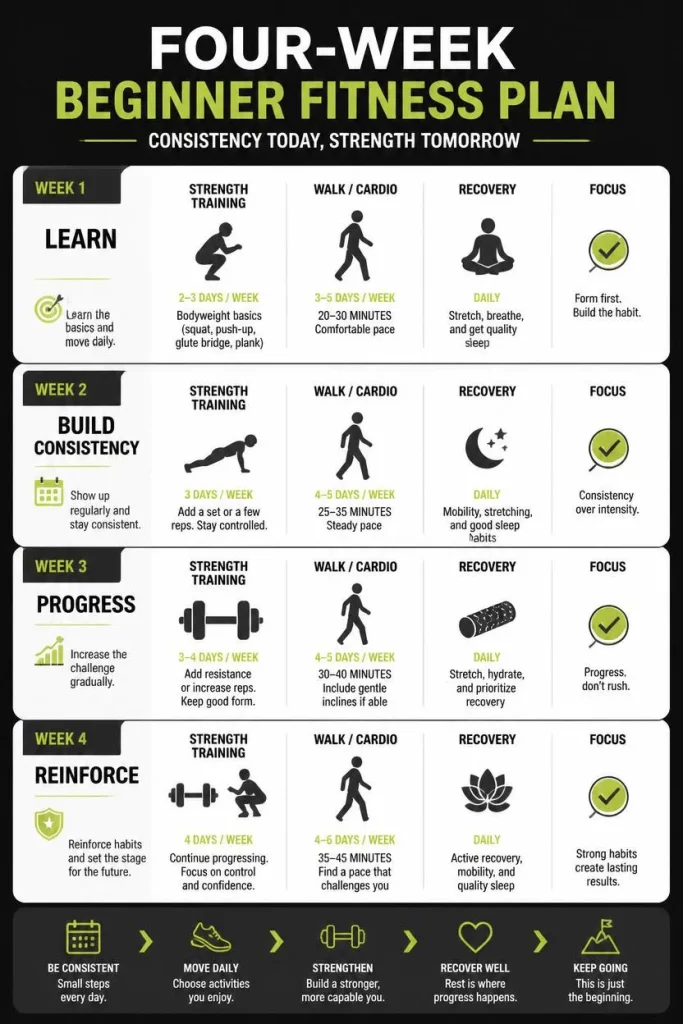
You will start by learning basic movement patterns, build consistency during Week 2, gradually increase the challenge in Week 3, and use Week 4 to reinforce a routine you can realistically continue.
The goal isn’t to finish the month exhausted.
The goal is to finish the month with a fitness routine you can actually keep.
Quick Answer: What Should a Beginner Do for One Month?
For most healthy adults, a useful beginner routine can combine:
- 2–3 full-body strength sessions per week
- Regular walking or another form of aerobic activity
- Short mobility or recovery sessions
- At least one complete rest day each week
- Gradual progression rather than maximum effort
Current U.S. physical-activity guidance recommends that adults work toward at least 150 minutes of moderate-intensity aerobic activity per week, or 75 minutes of vigorous activity, together with muscle-strengthening activity on at least two days per week. You can spread aerobic activity across the week rather than doing it all in one session. CDC: Adult Activity Guidelines
You do not have to reach that target immediately if you are currently inactive. The CDC notes that some physical activity is better than none, and activity can be increased gradually. CDC: Adding Physical Activity as an Adult
The purpose of this first month is to build the habit and gradually increase your activity.
Your 4-Week Beginner Fitness Plan at a Glance
Instead of trying to change everything at once, each week has a specific purpose.
| Week | Main goal |
|---|---|
| Week 1 | Learn the movements and establish a routine |
| Week 2 | Build consistency and add a second workout variation |
| Week 3 | Gradually increase the training challenge |
| Week 4 | Reinforce the routine and prepare for the next month |
Your basic weekly target
Strength: 2–3 sessions
Cardio: Walking or another enjoyable aerobic activity
Mobility: Short sessions as needed
Recovery: At least one complete rest day
Equipment: None required; resistance bands or dumbbells are optional
The schedule is intentionally flexible. Missing one workout does not mean you need to double the next session.
Before You Start
You do not need a home gym to begin.
A beginner can perform most of this plan with:
- A small amount of open floor space
- Comfortable clothing
- Supportive footwear when appropriate
- A sturdy chair or stable surface for selected exercises
- A mat if floor exercises are more comfortable
Optional equipment
You can add equipment as you become more comfortable:
- Resistance bands
- Light dumbbells
- Exercise mat
- Stable workout bench
Before every session, clear the area around you and make sure any equipment you use is stable and undamaged.
Printable 4-Week Beginner Fitness Schedule
Use this section as your simple month-at-a-glance checklist.
Because wide tables can become difficult to read on phones, the schedule is deliberately separated by week.
Week 1 — Learn
| Day | Plan |
|---|---|
| Monday | ☐ Full-Body Workout A |
| Tuesday | ☐ 15–30 minute easy walk |
| Wednesday | ☐ Recovery / mobility |
| Thursday | ☐ Full-Body Workout A |
| Friday | ☐ Easy walk |
| Saturday | ☐ Optional light activity |
| Sunday | ☐ Rest |
Week 1 goal: Learn the movements without trying to exhaust yourself.
Week 2 — Build the Habit
| Day | Plan |
|---|---|
| Monday | ☐ Full-Body Workout A |
| Tuesday | ☐ 20–30 minute walk |
| Wednesday | ☐ Full-Body Workout B |
| Thursday | ☐ Recovery / easy movement |
| Friday | ☐ Full-Body Workout A |
| Saturday | ☐ Easy walk or recreational activity |
| Sunday | ☐ Rest |
Week 2 goal: Make exercise a predictable part of your week.
If three strength sessions feel like too much, use Monday and Friday only.
Week 3 — Progress Gradually
| Day | Plan |
|---|---|
| Monday | ☐ Full-Body Workout A |
| Tuesday | ☐ 25–35 minute brisk walk |
| Wednesday | ☐ Full-Body Workout B |
| Thursday | ☐ Recovery / mobility |
| Friday | ☐ Full-Body Workout A |
| Saturday | ☐ Walk or enjoyable aerobic activity |
| Sunday | ☐ Rest |
Week 3 goal: Add a small amount of challenge without sacrificing technique.
Week 4 — Reinforce the Routine
| Day | Plan |
|---|---|
| Monday | ☐ Full-body strength |
| Tuesday | ☐ Walk / aerobic activity |
| Wednesday | ☐ Full-body strength |
| Thursday | ☐ Recovery / mobility |
| Friday | ☐ Full-body strength |
| Saturday | ☐ Optional enjoyable activity |
| Sunday | ☐ Rest |
Week 4 goal: Determine which parts of the routine you can realistically continue next month.
Week 1: Learn the Movement Patterns
The first week is not about proving how fit you are.
It is about learning basic movement patterns, discovering how your body responds to exercise, and establishing a schedule you can repeat.
Start conservatively.
You can always increase the challenge later.
Week 1 Schedule
Follow the printable Week 1 schedule above.
If two strength sessions already feel demanding, do not add another hard workout simply because Saturday is available.
Recovery is part of the program.
Full-Body Workout A
Warm-up
Start with approximately five minutes of easy movement.
For example:
- Walk around the room
- March gently in place
- Move your arms through a comfortable range
- Perform several controlled bodyweight squats
- Take a few easy breaths and gradually increase your movement
The warm-up should prepare you for exercise rather than tire you out.
Workout
| Exercise | Starting amount |
|---|---|
| Chair squat or bodyweight squat | 6–10 reps |
| Wall push-up | 6–10 reps |
| Glute bridge | 8–12 reps |
| Supported reverse lunge or split squat | 6–8 each side |
| Bird dog | 6–8 each side |
| Standing calf raise | 8–12 reps |
Perform 1–2 sets of each exercise.
Rest as needed.
Your first priority is controlled movement.
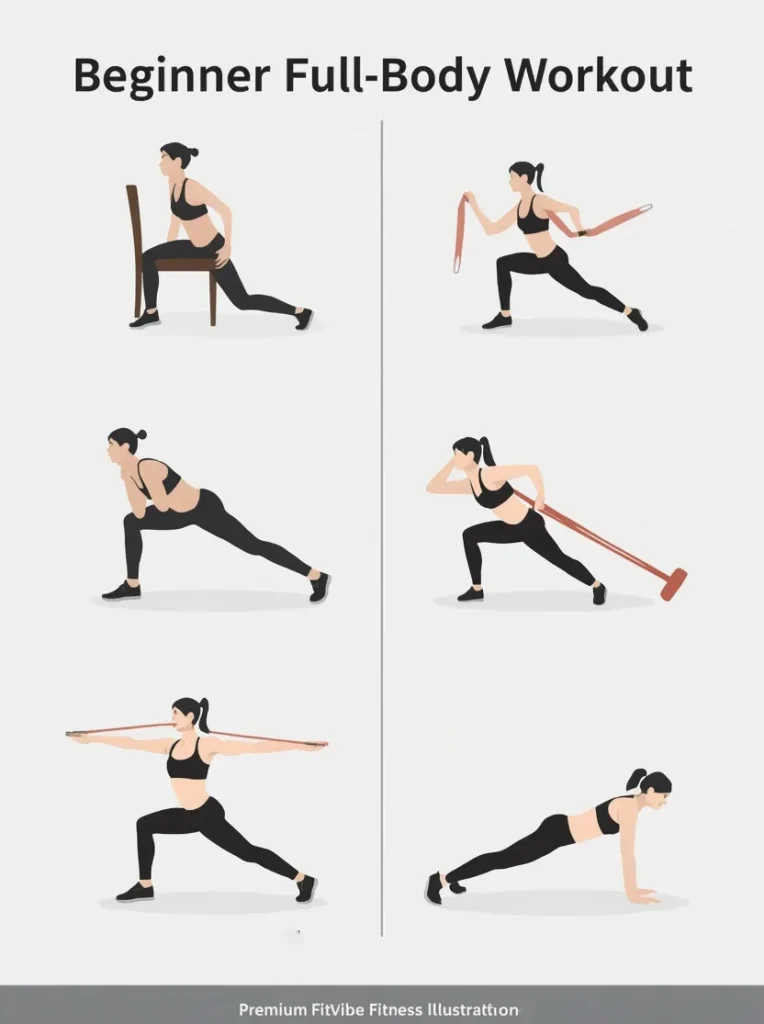
For additional beginner-friendly strength-exercise references, the NHS provides examples of bodyweight and resistance exercises that can be performed at home. NHS: Strength and Flexibility Exercises
Beginner Substitutions
You do not have to perform the hardest version of an exercise.
Choose a variation that allows you to maintain control.
| Planned exercise | Easier substitution |
|---|---|
| Bodyweight squat | Chair squat |
| Wall or incline push-up | Higher wall position |
| Reverse lunge | Supported split squat |
| Glute bridge | Smaller range of motion |
| Bird dog | Move one limb at a time |
| Plank | Elevated plank |
| Dead bug | Move one limb at a time |
| Dumbbell row | Resistance-band row or supported variation |
| Romanian deadlift | Bodyweight hip-hinge drill |
A substitution is not a failure.
It is simply a way to match the exercise to your current ability.
Equipment and No-Equipment Versions
This plan can be completed without dedicated workout equipment.
No-equipment version
Use:
- Chair squats
- Wall push-ups
- Glute bridges
- Supported split squats
- Bird dogs
- Calf raises
- Hip-hinge drills
- Bodyweight core exercises
A sturdy chair or wall can provide useful support.
Equipment version
If you have resistance bands or dumbbells, you can gradually increase the challenge.
Examples:
Bodyweight squat → goblet squat
Wall push-up → incline push-up
Hip hinge → dumbbell Romanian deadlift
Bodyweight pulling alternative → resistance-band row
Bodyweight lower-body exercise → resistance-band or dumbbell variation
Equipment is an option, not a requirement.
Week 2: Build the Habit
During Week 2, the objective changes from simply learning the movements to making exercise a predictable part of your week.
You can keep the basic exercises while adding a small amount of volume or introducing a third strength session if you feel comfortable.
Do not increase everything at once.
Full-Body Workout B
| Exercise | Starting amount |
|---|---|
| Sit-to-stand or squat | 8–12 reps |
| Incline push-up | 6–10 reps |
| Hip hinge | 8–12 reps |
| Resistance-band or supported dumbbell row | 8–12 reps |
| Glute bridge | 10–12 reps |
| Dead bug | 6–10 each side |
Perform 1–2 sets.
If you have no resistance band or dumbbells, use a bodyweight alternative rather than skipping the workout.
Week 3: Increase the Challenge
By Week 3, the basic movements should feel more familiar.
This is where you can introduce modest progression.
Progression does not mean suddenly using heavy weights.
You might:
- Add a few repetitions
- Add one set
- Use a slightly stronger resistance band
- Use a light dumbbell
- Increase your range of motion
- Use a more challenging exercise variation
- Perform the movement with greater control
The right progression is the smallest change that makes the exercise meaningfully more challenging while preserving good technique.
Week 3 Workout A
| Exercise | Target |
|---|---|
| Squat or goblet squat | 8–12 reps |
| Incline or modified push-up | 8–12 reps |
| Dumbbell Romanian deadlift or hip hinge | 8–12 reps |
| Reverse lunge or split squat | 6–10 each side |
| Band or dumbbell row | 8–12 reps |
| Dead bug or plank variation | Controlled reps / short hold |
Aim for approximately 2 sets.
If you can complete every repetition easily with excellent control, a modest increase in resistance or difficulty may be appropriate.
If your technique deteriorates, reduce the difficulty.
Week 4: Build a Routine You Can Keep
The fourth week is not a final exam.
You do not need to finish the month by performing an extreme workout, following a restrictive diet, or trying to achieve a dramatic physical transformation.
Instead, Week 4 should help you answer one important question:
What type of fitness routine can I realistically continue next month?
Continue using the Week 3 exercises while gradually improving technique and resistance.
If three strength sessions are too demanding, reduce the volume to two.
The best program is the one you can perform consistently.
How Hard Should a Beginner Train?
A common mistake is assuming every workout should leave you exhausted.
It should not.
During most beginner sessions, focus on:
- Controlled repetitions
- Consistent breathing
- Stable body positioning
- Good exercise technique
- A manageable level of effort
- Finishing the session without feeling completely depleted
Use a simple 1–10 effort scale
| Effort | What it feels like |
|---|---|
| 1–2/10 | Very easy |
| 3–4/10 | Easy |
| 5–6/10 | Moderate and manageable |
| 7/10 | Challenging but controlled |
| 8–10/10 | Very hard to maximal |
For most beginners, much of the strength training in this program can sit around 5–7/10 effort.
You should feel that the exercise is working, but you should still be able to maintain reasonable technique.
A useful strength-training rule
Finish most sets feeling that you could probably perform another 2–4 controlled repetitions.
You do not need to train to absolute failure.
If you have to rush repetitions, lose your positioning, hold your breath excessively, or compensate with another part of your body, make the exercise easier.
How to Progress During the Month
Use this five-step progression model.
Step 1: Learn
Start with an exercise variation you can perform with reasonable control.
Step 2: Repeat
Perform the movement consistently across several sessions.
Step 3: Improve
Work on:
- Range of motion
- Balance
- Control
- Breathing
- Technique
Step 4: Add a Small Challenge
Increase one variable when appropriate:
- Repetitions
- Sets
- Resistance
- Range of motion
- Exercise difficulty
Step 5: Repeat
Give yourself time to adapt before making another major change.
Example progression
Wall push-up → incline push-up → lower incline → modified floor push-up
Another example:
Bodyweight squat → goblet squat → slightly heavier goblet squat
This approach makes progression predictable without requiring a completely different workout every week.
Practical Progression Rules
Use these rules throughout the four weeks.
Rule 1: Technique comes first
Never increase difficulty simply because the calendar says you should.
Rule 2: Increase repetitions before making a major jump
For example:
6 reps → 8 reps → 10 reps → 12 reps
Rule 3: Add a set when appropriate
If you can comfortably perform the prescribed repetitions, adding a set may be more appropriate than making the exercise dramatically harder.
Rule 4: Increase resistance gradually
When using dumbbells or bands, use the smallest practical increase.
Rule 5: Change one major variable at a time
Do not simultaneously increase:
- Weight
- Sets
- Repetitions
- Exercise difficulty
- Training frequency
Rule 6: Technique controls progression
If your form becomes noticeably worse, return to the previous variation or reduce the workload.
Progress is not simply doing more. It is doing more while maintaining control.
For additional general guidance on strength training, the NHS recommends muscle-strengthening activities on at least two days per week and emphasizes starting gradually and building up over time. NHS: How to Improve Your Strength and Flexibility
What About Cardio During the 1-Month Plan?
Cardio does not have to mean running.
Beginner-friendly options include:
- Brisk walking
- Cycling
- Swimming
- Dancing
- Hiking
- Low-impact cardio workouts
- Recreational sports
Choose an activity you can realistically repeat.
For general health, adults should work toward 150 minutes of moderate-intensity aerobic activity per week, or an equivalent combination of moderate and vigorous activity. CDC: What Counts as Physical Activity for Adults
The Talk Test
During moderate-intensity activity, you should generally be breathing harder but still able to speak.
A useful rule of thumb is that you should be able to talk but not sing during moderate-intensity activity. During vigorous activity, you may only be able to say a few words before pausing for a breath. CDC: Measuring Physical Activity Intensity
You do not need to turn every walk into a race.
A Busy-Adult Version of the Plan
Not everyone can dedicate an hour to exercise.
If your schedule is tight, divide activity into shorter sessions.
For example:
Morning: 15-minute strength session
Lunch break: 10-minute walk
Evening: 10–15-minute walk
Short sessions still contribute to your overall activity. The CDC notes that weekly aerobic activity can be spread across the week and broken into smaller periods rather than completed in one continuous session. CDC: Adding Physical Activity as an Adult
The important thing is to make the routine fit your life instead of designing a schedule that works only under perfect circumstances.
What Should You Eat During a Beginner Fitness Plan?
A one-month fitness plan does not require a crash diet.
Instead, build meals around practical, nutritious foods.
Protein
Include a protein-rich food at meals, such as:
- Eggs
- Fish
- Chicken
- Greek yogurt or other yogurt
- Milk
- Lentils
- Beans
- Tofu
- Other suitable protein foods
Protein can support muscle maintenance and recovery when combined with resistance training.
If you’re also trying to increase protein while keeping meals practical, see How Much Protein Do You Need a Day? A Simple Guide for Beginners.
Carbohydrates
Choose carbohydrate sources that fit your preferences and activity level, such as:
- Rice
- Oats
- Potatoes
- Whole-grain bread
- Fruits
- Other minimally processed carbohydrate foods
Carbohydrates can provide useful energy for exercise.
Vegetables and Fruit
Try to include a variety of vegetables and fruits across your meals.
Different foods provide different combinations of fiber, vitamins, minerals and other nutrients.
Healthy Fats
Examples include:
- Nuts
- Seeds
- Avocado
- Fish
- Olive oil and other unsaturated-fat sources
You do not need to eliminate an entire food group simply because you started exercising.
If Your Goal Is Fat Loss
A beginner fitness plan can support fat-loss efforts, but exercise should not be presented as a guaranteed fat-loss solution.
Physical activity increases energy expenditure, while changes in body weight are influenced by overall energy intake and expenditure along with other individual factors.
For a sustainable approach:
- Avoid crash diets.
- Do not try to eliminate all carbohydrates.
- Prioritize protein-rich foods.
- Eat plenty of vegetables and fruit.
- Choose mostly nutritious, minimally processed foods.
- Eat enough to support your activity.
- Pay attention to your overall eating pattern.
- Focus on habits you can maintain after the first month.
What about belly fat?
You cannot selectively choose where your body loses fat.
Exercises can strengthen your abdominal muscles, but they cannot force your body to remove fat specifically from your stomach.
A combination of appropriate nutrition, regular activity and resistance training can support changes in overall body composition over time.
Avoid programs promising that a particular exercise will specifically burn belly fat.
For a broader evidence-based look at sustainable fat-loss habits, see How to Lose Belly Fat: A Practical Guide to Sustainable Fat Loss.
Recovery Is Part of the Plan
Beginners sometimes focus entirely on workouts and forget that recovery is part of training.
Give attention to:
- Sleep
- Rest days
- Hydration
- Adequate food
- Manageable training volume
- Gradual progression
You do not need to feel sore after every workout for the session to have been useful.
If you are unusually tired for several days, consistently losing exercise performance, or experiencing persistent pain, reduce the training demand and consider getting appropriate professional guidance.
What If You Miss a Workout?
Missing a workout does not ruin the plan.
Do not try to make up for it by doubling your next workout.
Instead, use this simple decision guide.
Missed one workout
Continue with the next scheduled session.
Example:
You miss Monday’s Workout A.
Do not perform two workouts on Tuesday.
Complete Tuesday’s planned activity and continue normally.
Missed two or three workouts
Return to the next scheduled workout.
You do not need to squeeze all the missed sessions into the remaining days.
Missed several days because you were sick or unusually tired
Do not immediately return at full intensity.
Start with an easier session and see how you feel.
Missed an entire week
Return at approximately the same level you were using before the break.
If you feel noticeably less conditioned, reduce the repetitions, sets, or exercise difficulty temporarily.
Feeling exhausted on a workout day?
Use the easier version.
For example:
Normal workout → fewer sets → fewer repetitions → easier exercise variation
A shorter workout is often more useful than abandoning the routine completely.
The rule to remember
Never punish yourself for missing a workout. Resume the routine.
Consistency over months matters far more than one missed session.
Beginner Substitution Guide
When an exercise does not feel appropriate, use the closest easier variation.
| If the planned exercise is… | Try this instead |
|---|---|
| Bodyweight squat | Chair squat |
| Incline push-up | Higher incline or wall push-up |
| Reverse lunge | Supported split squat |
| Plank | Elevated plank |
| Full bird dog | One limb at a time |
| Full dead bug | One limb at a time |
| Dumbbell Romanian deadlift | Bodyweight hip hinge |
| Dumbbell row | Resistance-band row |
| Full-range movement | Smaller comfortable range |
The goal is to preserve the movement pattern, not force yourself to perform a particular exercise.
Your Weekly Check-In
A two-minute weekly review can help you adjust the program before small problems become major obstacles.
Week 1 Check-In
Strength workouts completed: ___ / 2
Walking/cardio sessions: ___
Energy:
☐ Low
☐ Okay
☐ Good
☐ Excellent
Which exercise felt easiest?
Which exercise felt most difficult?
Did I experience pain or unusual symptoms?
☐ No
☐ Yes
What should I adjust next week?
Week 2 Check-In
Strength workouts completed: ___ / 2–3
Walking/cardio sessions: ___
Are the exercises becoming more comfortable?
☐ Not yet
☐ A little
☐ Definitely
Which movement improved the most?
Did I recover adequately between sessions?
☐ Yes
☐ Sometimes
☐ No
Plan for Week 3:
☐ Keep the same level
☐ Add a few repetitions
☐ Add a set
☐ Increase resistance slightly
☐ Stay at the easier variation
Week 3 Check-In
Strength workouts completed: ___ / 3
How challenging were the workouts?
☐ Too easy
☐ Manageable
☐ Challenging
☐ Too difficult
Did my technique remain controlled?
☐ Yes
☐ Sometimes
☐ No
Am I ready for a small progression?
☐ Yes
☐ No
What will I progress?
☐ Repetitions
☐ Sets
☐ Resistance
☐ Exercise variation
☐ Nothing yet
Week 4 Check-In
Before moving into your next month, review:
Strength sessions completed: ___
Cardio/walking sessions: ___
My biggest improvement was:
Exercises I enjoyed:
Exercises I want to replace:
My recovery was:
☐ Poor
☐ Fair
☐ Good
☐ Very good
My next-month goal is:
☐ Improve strength
☐ Improve endurance
☐ Build consistency
☐ Increase resistance
☐ Become more active
☐ Continue the same routine
The most important question
Can I realistically continue this routine next month?
☐ Yes
☐ Yes, with some adjustments
☐ No — I need a simpler plan
A successful first month is not measured only by body weight or appearance.
Learning the movements, completing sessions consistently, improving exercise control and creating a routine you can maintain are all meaningful forms of progress.
Common Beginner Mistakes
| Mistake | Better approach |
|---|---|
| Exercising hard every day | Alternate harder and easier days |
| Changing workouts constantly | Repeat fundamental movements |
| Starting with advanced exercises | Use beginner variations |
| Training only when motivated | Put workouts on your schedule |
| Trying to make up missed workouts | Resume the normal schedule |
| Following an extreme diet | Build sustainable eating habits |
| Ignoring technique | Control the movement first |
| Expecting dramatic changes in 30 days | Measure consistency and performance |
Your 30-Day Beginner Fitness Checklist
Use this as a simple monthly tracker.
Before Starting
☐ Choose realistic workout days.
☐ Decide where you will exercise.
☐ Prepare basic equipment if needed.
☐ Choose your preferred walking or cardio activity.
☐ Take note of your starting fitness level.
Each Week
☐ Complete planned strength sessions.
☐ Get regular aerobic movement.
☐ Include recovery days.
☐ Drink enough fluids for your needs.
☐ Eat regular, balanced meals.
☐ Complete the weekly check-in.
☐ Adjust the difficulty if necessary.
At the End of the Month
☐ How many workouts did I complete?
☐ Are the exercises becoming easier?
☐ Has my technique improved?
☐ Can I walk or perform cardio more comfortably?
☐ Which workouts fit my schedule best?
☐ Which exercises did I enjoy?
☐ What should I continue next month?
☐ What should I change?
These questions are more useful than judging the month entirely by the number on a scale.
When Should You Change the Plan?
After four weeks, you have several options.
If the plan felt difficult
Repeat the same level for another few weeks.
You do not have to progress simply because the calendar changed.
If it felt manageable
Gradually increase:
- Resistance
- Repetitions
- Sets
- Exercise difficulty
- Walking duration
Choose one change at a time.
If you enjoyed the routine
Keep the basic structure and gradually add variety.
If you disliked the workouts
Change the activity rather than abandoning exercise altogether.
You might prefer:
- Walking
- Cycling
- Dumbbell training
- Group classes
- Swimming
- Recreational sports
- Gym-based resistance training
There is no requirement to use one particular exercise format.
Frequently Asked Questions
Can a beginner get fit in one month?
A month is enough time to establish a structured exercise routine and begin improving exercise capacity, strength, movement skill and consistency.
The amount of physical change varies considerably between individuals.
Think of this month as the first stage of a longer fitness routine, not a deadline for a particular physical transformation.
How many days a week should a beginner exercise?
Two or three structured strength sessions per week can provide a practical starting point, supplemented by walking or another form of aerobic activity.
Your exact schedule should reflect your current fitness, available time and ability to recover.
Can I do this beginner fitness plan at home?
Yes.
Most of the exercises can be performed at home using bodyweight alone.
Resistance bands and dumbbells provide additional progression options but are not required.
Do I need to work out every day?
No.
Recovery days are useful, particularly when you are new to structured exercise.
You can still perform easy walking or normal daily movement on non-strength days.
Should I exercise in the morning or evening?
Choose the time you can consistently maintain.
A 30-minute workout that you regularly complete is more useful than a theoretically ideal workout time that does not fit your schedule.
Can I lose belly fat with this plan?
You cannot selectively choose where your body loses fat.
A fitness routine can support overall physical activity and, alongside appropriate nutrition, may contribute to changes in body weight and body composition over time.
Strength exercises can strengthen your abdominal muscles, but they do not specifically remove abdominal fat.
What if I have never exercised before?
Start with the easiest appropriate version of each movement.
Focus on learning technique rather than trying to match someone else’s repetitions or resistance.
If you have been inactive for a long period, have a chronic health condition, have a significant physical limitation, or have concerns about beginning exercise, seek appropriate professional advice before substantially increasing your activity.
Safety: Know When to Scale Back
Most adults can benefit from regular physical activity, but the appropriate starting point differs between individuals.
If you have a chronic health condition, disability, significant physical limitation or another concern about exercising, discuss suitable activities and intensity with a healthcare professional or qualified exercise professional. The CDC also recommends discussing appropriate activity with a healthcare professional when chronic health conditions are present. CDC: Physical Activity for People With Chronic Conditions
During exercise, stop and seek appropriate medical attention if you experience concerning symptoms such as:
- Chest pain
- Fainting
- Severe dizziness
- Significant pain
- Unusual or severe shortness of breath
The NHS also advises stopping exercise if you feel pain or become unwell and seeking appropriate professional advice when you are unsure whether an exercise is suitable. NHS: Strength and Flex Exercise Safety
For everyone else, the basic principle is simple:
Start at a level you can control, then progress gradually.
The Bottom Line
A successful 1-month beginner fitness plan does not need to be complicated.
For the next four weeks, focus on four things:
- Strength train 2–3 times per week.
- Move regularly through walking or another form of aerobic activity.
- Increase the challenge gradually rather than suddenly.
- Build a routine you can continue after Day 30.
The biggest mistake would be treating the end of the month as the end of the process.
Instead, use these four weeks to discover which exercises, schedule and activities fit your life.
Then carry the parts that worked into the next month.
Save This 1-Month Beginner Fitness Plan
Week 1: Learn the movements
Week 2: Build consistency
Week 3: Add a small amount of progression
Week 4: Reinforce the routine
Strength: 2–3 sessions per week
Aerobic activity: Walking or another activity you enjoy
Recovery: At least one complete rest day plus easier days as needed
Equipment: None required; bands or dumbbells optional
Main goal: Build a routine you can maintain
Your first month does not need to be perfect.
It needs to be repeatable.