Starting a home workout routine can feel surprisingly complicated. Should you exercise every day? Is three days enough? Do you need separate cardio and strength days? And how much rest should a beginner take?
For most beginners, the answer is simpler than it seems: start with a manageable number of workouts each week, build consistency, and increase your activity gradually.
A practical starting point is 2–3 structured home workouts per week, with rest or lighter activity between harder sessions. As your fitness, confidence, and recovery improve, you can gradually add more activity.
For overall health, adults are generally advised to accumulate at least 150 minutes of moderate-intensity aerobic activity per week, or 75 minutes of vigorous activity, plus muscle-strengthening activity on at least 2 days per week. You do not have to achieve those targets immediately if you are starting from a low activity level. Beginning with smaller amounts and progressing over time is a reasonable approach.
Quick Answer: How Often Should Beginners Work Out?
For someone new to exercise, a simple weekly structure could look like this:
| Experience | Structured Workouts | Other Activity |
|---|---|---|
| Completely new to exercise | 2 days/week | Easy walking or normal daily movement |
| Beginner building consistency | 3 days/week | Walking, mobility or light activity |
| Comfortable beginner | 3–4 days/week | Cardio, walking and active recovery |
| More experienced | 4+ days/week | Planned strength and aerobic activity |
These are practical starting points, not strict rules. Your ideal frequency depends on your current fitness, workout intensity, schedule, recovery, age, and health status.
The goal is not to exercise as often as possible. The goal is to create a routine you can repeat consistently.
Why 2–3 Days a Week Is a Good Starting Point
Beginners often make one of two mistakes: doing too little to establish a routine or doing too much too soon.
A two- or three-day schedule provides enough opportunities to practice fundamental movements without requiring you to exercise every day.
For example, you might perform full-body strength workouts on Monday, Wednesday, and Friday. On the days between them, you could walk, perform gentle mobility work, or simply recover.
This approach also gives you time to learn proper technique.
When you’re new to exercises such as squats, lunges, push-ups, rows, and hip hinges, the quality of movement matters more than trying to complete a huge number of repetitions.
A simple beginner principle
Start with less than you think you can sustain, then build from there.
If three workouts every week feels manageable, continue. If two workouts are all you can consistently fit into your schedule, start with two.
Consistency is more useful than creating a demanding plan that you abandon after a couple of weeks.
How Much Exercise Do Adults Actually Need?
The recommended amount of physical activity is broader than “how many workouts should I do?”
For adults aged 18–64, the World Health Organization recommends:
- 150–300 minutes of moderate-intensity aerobic activity per week, or
- 75–150 minutes of vigorous-intensity aerobic activity per week, or an equivalent combination.
- Muscle-strengthening activities involving the major muscle groups on at least 2 days per week.
The CDC gives similar guidance and emphasizes that the weekly activity can be divided across several days rather than completed in one long session.
Importantly, these are overall adult activity guidelines, not a requirement that every beginner immediately complete the full amount.
If you currently do very little physical activity, starting with smaller amounts and gradually increasing duration, frequency, and intensity is appropriate. WHO specifically recommends a gradual increase for inactive people.
What Should a Beginner Do During Those Workouts?
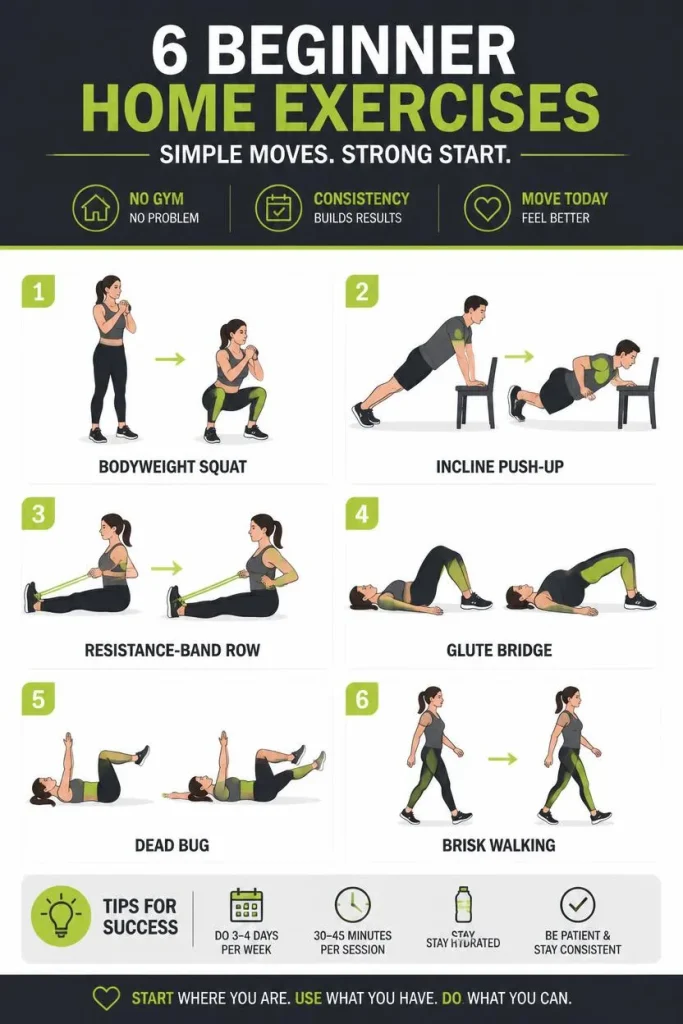
A home workout does not need to be complicated.
A beginner can build a useful full-body session around a few fundamental movement patterns.
Lower body
Examples include:
- Bodyweight squats
- Reverse lunges
- Glute bridges
- Step-ups
Upper body
Examples include:
- Wall push-ups
- Incline push-ups
- Modified push-ups
- Resistance-band rows
Core
Examples include:
- Dead bugs
- Bird dogs
- Planks
- Side planks
Light cardiovascular work
Examples include:
- Brisk walking
- Marching in place
- Step-ups
- Low-impact aerobic routines
- Cycling
You do not need expensive equipment to begin. Bodyweight exercises, resistance bands, and other simple home-based options can be effective ways to perform resistance training. The American College of Sports Medicine’s 2026 resistance-training guidance also emphasizes choosing a routine that fits your schedule and notes that home-based training and inexpensive equipment can be effective.
A Simple 3-Day Beginner Home Workout Schedule
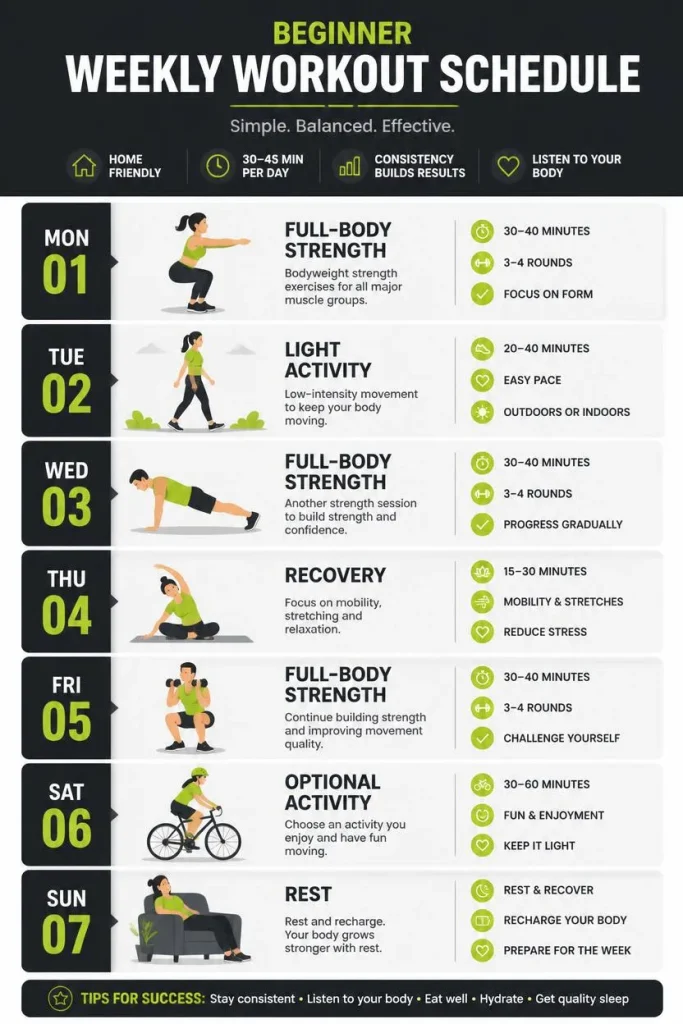
If you can exercise three days per week, a full-body approach is straightforward.
| Day | Workout | Focus |
|---|---|---|
| Monday | Full-body strength | Squat, push, pull, core |
| Tuesday | Light activity | Walking or mobility |
| Wednesday | Full-body strength | Lower + upper body |
| Thursday | Recovery | Easy movement |
| Friday | Full-body strength | Full-body practice |
| Saturday | Optional activity | Walking, cycling or mobility |
| Sunday | Rest | Recovery |
The exact exercises can change depending on your equipment and ability.
The important part is the structure: strength training is separated by recovery days, while lighter movement can continue throughout the week.
What If You Can Only Work Out Twice a Week?
Two workouts per week can still be a useful starting point.
In fact, the current ACSM resistance-training guidance emphasizes that consistency matters more than creating a complicated program, and recommends training all major muscle groups at least twice per week for adults seeking resistance-training benefits.
A two-day schedule could look like:
Tuesday: Full-body workout
Saturday: Full-body workout
On the other days, add walking or other comfortable physical activity if your schedule allows.
If you later find that two sessions feel easy to maintain, you can consider adding a third workout.
What If You Want to Work Out Every Day?
Daily movement is not necessarily a problem. Daily hard workouts are a different matter.
You don’t need every day to be a challenging strength-training session.
A better approach is to vary the demands placed on your body.
For example:
- Monday: Strength
- Tuesday: Walking
- Wednesday: Strength
- Thursday: Mobility or easy walking
- Friday: Strength
- Saturday: Optional recreational activity
- Sunday: Rest or gentle movement
This allows you to be active frequently without treating every day as a hard workout.
Remember that the weekly recommendations concern total physical activity, not a requirement to perform a formal workout every day.
How Long Should a Beginner Home Workout Last?
There is no single workout duration that every beginner needs.
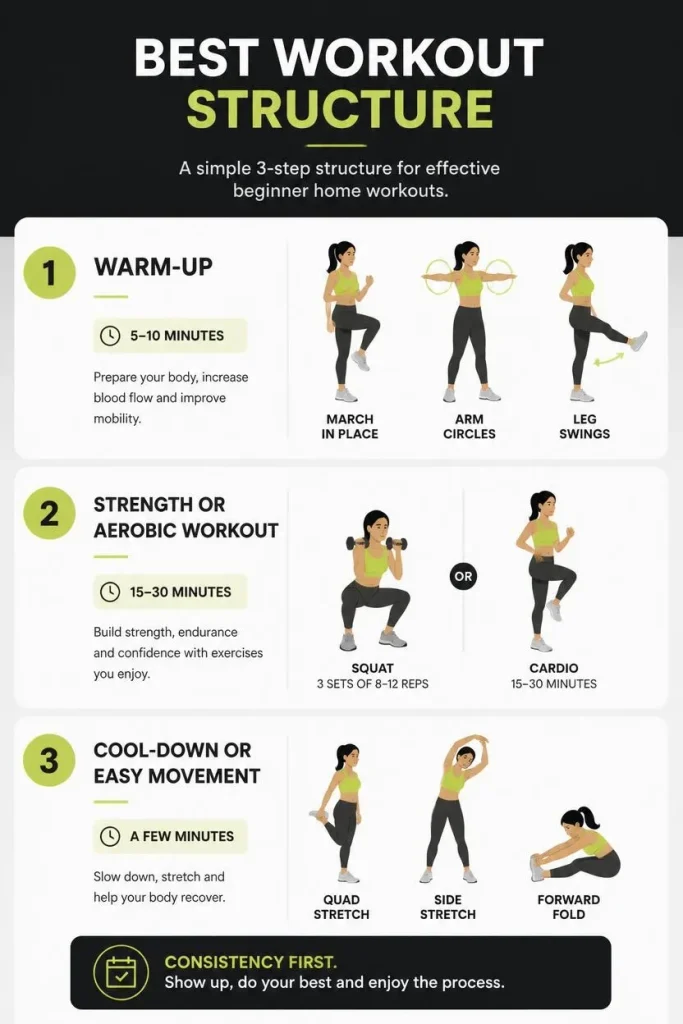
A practical session might include:
- Warm-up: 5–10 minutes
- Strength or aerobic workout: 15–30 minutes
- Cool-down or easy movement: a few minutes
The session can be shorter while you are learning.
The important distinction is between workout duration and weekly activity volume. A short home workout combined with walking and other daily movement can contribute to your overall activity.
CDC guidance also notes that adults can spread their weekly activity across the week and break it into smaller chunks.
How to Know When You Are Ready to Exercise More Often
You do not need to increase your workout frequency simply because a calendar says you should.
Look for signs that your current routine is becoming manageable.
You may be ready to progress when:
- The exercises feel more controlled.
- Your current sessions no longer feel unusually demanding.
- You recover comfortably between workouts.
- Your technique remains consistent.
- You can complete your planned sessions without repeatedly feeling exhausted.
- Your schedule has room for another session without sacrificing recovery.
When you increase your activity, change one variable at a time when practical. For example, you could add a small amount of walking before adding another demanding workout.
Beginner Progression: Frequency, Volume, and Intensity
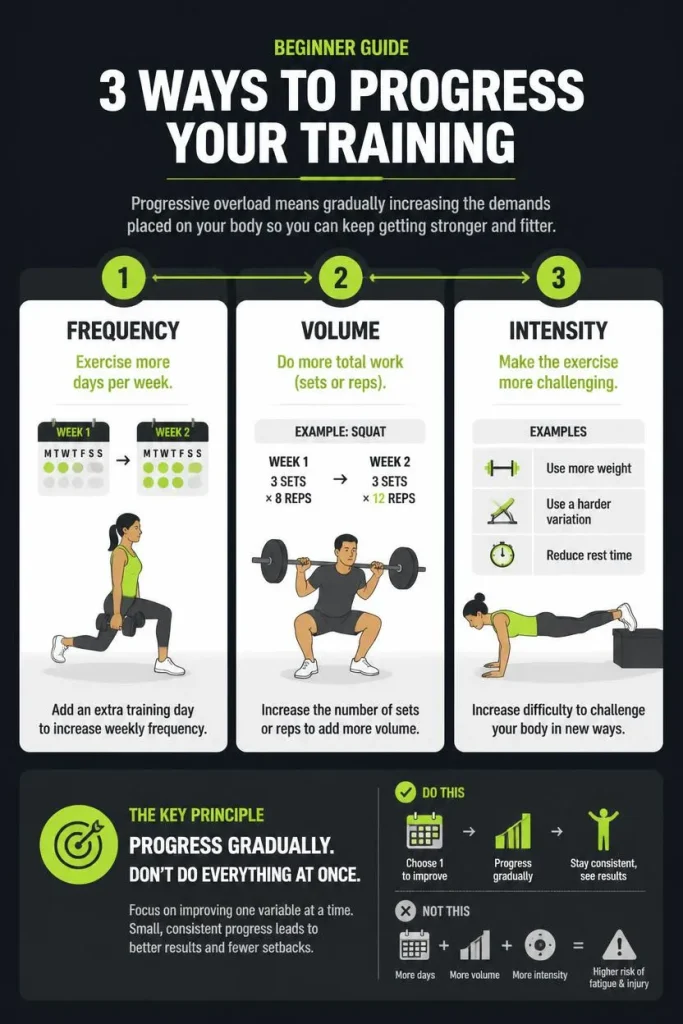
There are several ways to make exercise more challenging:
Frequency: exercising more days per week.
Volume: doing more total work, such as additional sets or repetitions.
Intensity: making an exercise more demanding.
You do not need to increase all three at once.
For example, suppose you begin with two 20-minute strength workouts each week. After several weeks, you could add a third session rather than immediately doubling the workout length and intensity.
This gradual approach is easier to manage and gives you an opportunity to see how your body responds.
Common Beginner Mistakes
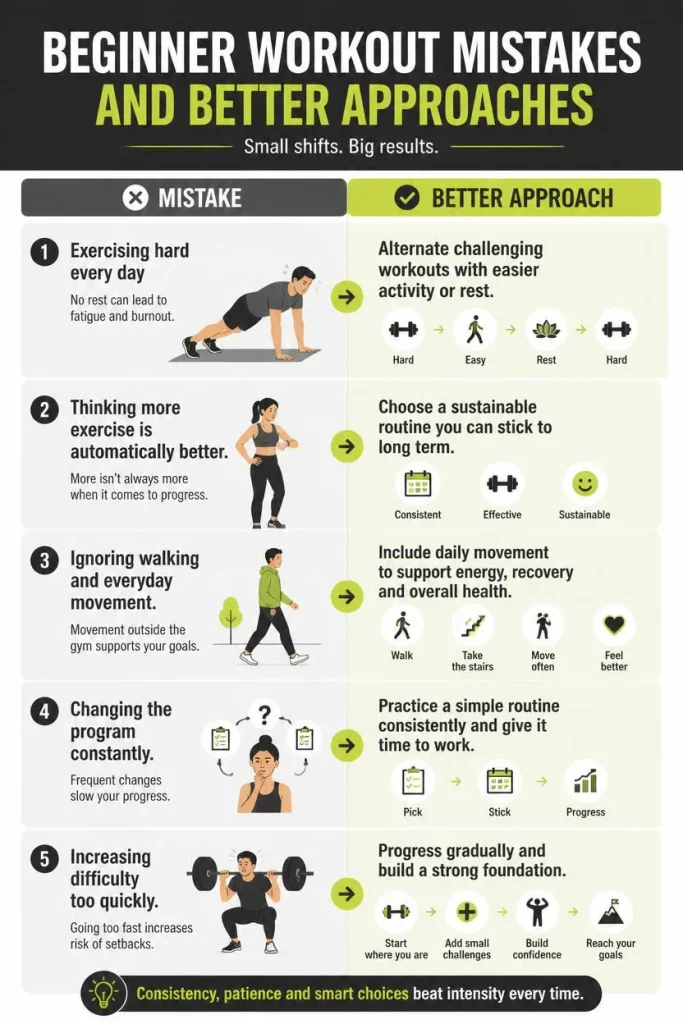
1. Exercising hard every day
Why it can be a problem: Your body needs time to recover from challenging sessions, particularly when you’re not accustomed to exercise.
Better approach: Alternate demanding workouts with easier activity or rest.
2. Thinking more exercise is automatically better
Why it can be a problem: A very demanding routine may be difficult to maintain.
Better approach: Build a schedule that fits your actual life.
3. Ignoring walking and everyday movement
Why it can be a problem: You may think that only formal workouts count.
Better approach: Remember that walking, cycling, transportation, household activities, and other movement can contribute to overall physical activity.
4. Changing the program constantly
Why it can be a problem: Beginners need time to practice movement patterns and develop consistency.
Better approach: Keep a simple routine long enough to become familiar with it before making frequent changes.
5. Increasing difficulty too quickly
Why it can be a problem: Suddenly increasing training demands can make exercise unnecessarily difficult and may interfere with recovery.
Better approach: Progress gradually.
6. Treating soreness as the goal
Muscle soreness is not the main objective of a workout.
A productive beginner session should help you practice movements, build capacity, and establish a sustainable routine rather than leave you unable to move comfortably afterward.
A Beginner’s Weekly Workout Checklist
Use this as a simple weekly reference:
- Schedule 2–3 realistic workout sessions.
- Include full-body strength work at least twice when possible.
- Add walking or other aerobic activity.
- Practice controlled exercise technique.
- Leave room for recovery.
- Increase activity gradually.
- Keep track of workouts completed rather than chasing perfection.
- Adjust the routine when your schedule changes.
What If You Have Very Little Time?
You do not need a perfect hour-long workout to begin.
A busy beginner could use short sessions built around several movements:
Example 20-minute session
- 3 minutes: easy warm-up
- 4 minutes: squatting movement
- 4 minutes: pushing movement
- 4 minutes: pulling or upper-back movement
- 3 minutes: core exercises
- 2 minutes: easy cool-down
The exact format is flexible.
You could also divide activity across the day. For example, a short home strength session in the morning and a brisk walk later can both contribute to your overall activity.
The CDC specifically notes that activity can be spread throughout the week and broken into smaller portions.
How Many Rest Days Does a Beginner Need?
There is no universal number of rest days because recovery depends on the workout, fitness level, age, sleep, stress, and other individual factors.
However, beginners generally benefit from avoiding consecutive days of hard training for the same muscle groups while they are still adapting to exercise.
If you train three days per week with full-body workouts, a Monday-Wednesday-Friday schedule naturally provides recovery days between sessions.
On recovery days, you can choose:
- Easy walking
- Gentle mobility
- Light stretching
- Normal daily activities
- Complete rest when needed
Recovery should be part of your plan rather than something you only consider after becoming excessively tired.
When Should You Adjust Your Schedule?
Your workout frequency may need to change when your circumstances change.
For example:
Busy work week:
Reduce your planned sessions temporarily rather than abandoning exercise completely.
Travel:
Use bodyweight exercises and walking.
Returning after a long break:
Start with less volume and rebuild gradually.
Feeling unusually fatigued:
Consider reducing workout intensity or taking additional recovery time.
Progressing well:
Gradually add activity rather than making a sudden jump.
A flexible routine is often easier to maintain than a rigid seven-day plan.
Safety: When to Stop or Seek Guidance
Exercise is appropriate for most people, but individual circumstances matter.
If you have a chronic health condition, disability, significant limitations, or concerns about whether vigorous exercise is appropriate for you, discuss suitable types and amounts of activity with a healthcare professional or qualified exercise professional. CDC guidance specifically recommends consultation for people with chronic conditions or disabilities and for some inactive adults considering vigorous activity.
During exercise, stop and seek appropriate medical advice if you experience concerning symptoms such as significant pain, dizziness, fainting, chest discomfort, or unusual shortness of breath.
You do not need to push through symptoms simply to complete a workout.
Frequently Asked Questions
Is working out 3 days a week enough for a beginner?
Three days per week can be a practical starting schedule for a beginner, particularly when those sessions include full-body strength training. Additional walking or aerobic activity can help build toward overall weekly activity recommendations.
Can I work out at home every day?
You can be physically active every day, but every day does not need to be a hard workout. Alternating strength training with walking, mobility, lighter activity, and rest can create a more manageable routine.
Should beginners do cardio or strength training first?
For a balanced routine, include both over the course of the week. Strength training helps develop muscular fitness, while walking and other aerobic activities contribute to cardiovascular fitness and overall physical activity.
How many days should a beginner lift weights at home?
For adults, current guidance supports muscle-strengthening activity involving the major muscle groups on at least 2 days per week. Beginners can use bodyweight exercises, resistance bands, dumbbells, or other appropriate resistance.
Is a 20-minute home workout useful?
Yes. A 20-minute session can be a practical way to start building exercise consistency. It can also be combined with walking and other movement throughout the week.
Should I exercise if I am sore?
Mild muscle soreness does not necessarily mean you need complete rest, but you should avoid pushing through significant pain or exercising a muscle group aggressively when it has not recovered. Choose lighter movement or another activity if needed.
What is the biggest mistake beginners make?
One common mistake is trying to progress too quickly. A sustainable routine that you can repeat week after week is more useful than an ambitious schedule that you cannot maintain.
The Bottom Line
For most beginners, 2–3 structured home workouts per week is a sensible place to start.
Focus on full-body movements, learn good technique, allow recovery between challenging sessions, and gradually increase your activity as your fitness improves.
Over time, aim to build toward the broader adult activity recommendations: 150–300 minutes of moderate aerobic activity per week, or the vigorous equivalent, plus muscle-strengthening activity on at least 2 days per week.
You do not need to achieve everything immediately.
Start with a schedule you can realistically repeat next week. Then repeat it again.
Save This Guide: Beginner Home Workout Formula
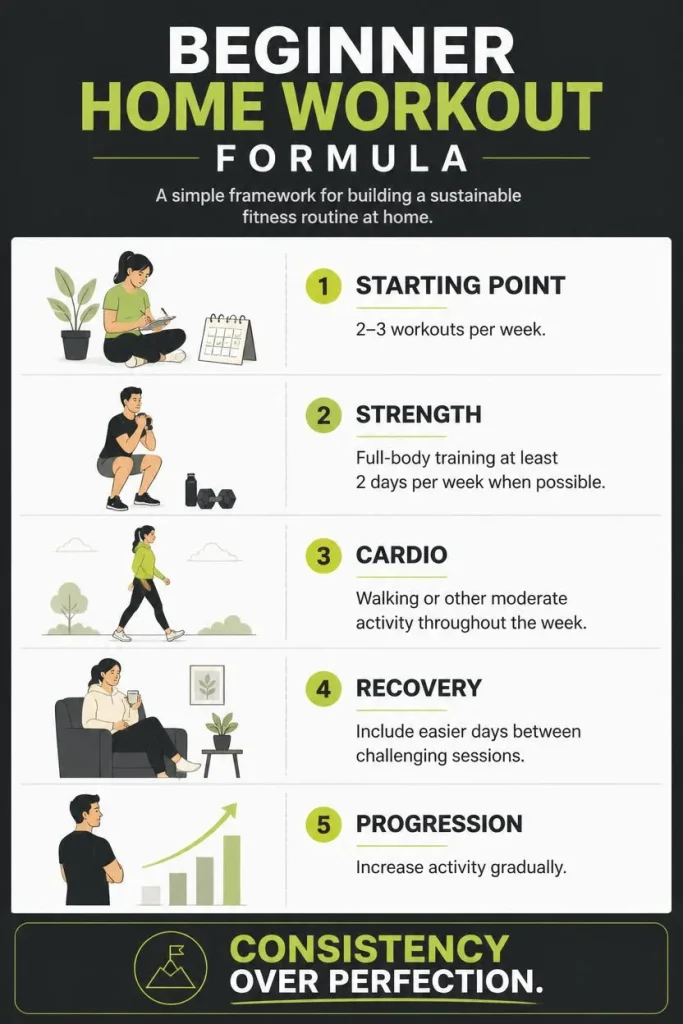
Starting point: 2–3 workouts/week
Strength: Full body, at least 2 days/week when possible
Cardio: Walking or other moderate activity throughout the week
Recovery: Include easier days between challenging sessions
Progression: Increase gradually
Priority: Consistency over perfection
The best beginner workout schedule is one that fits your life well enough to become a habit.
Sources & Further Reading
- World Health Organization — Physical Activity: World Health Organization — Physical Activity
- Centers for Disease Control and Prevention — Adult Activity: An Overview: CDC — Adult Activity: An Overview
- American College of Sports Medicine — Resistance Training Position Stand: CSM — Resistance Training Guidelines Update