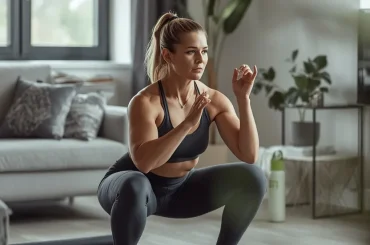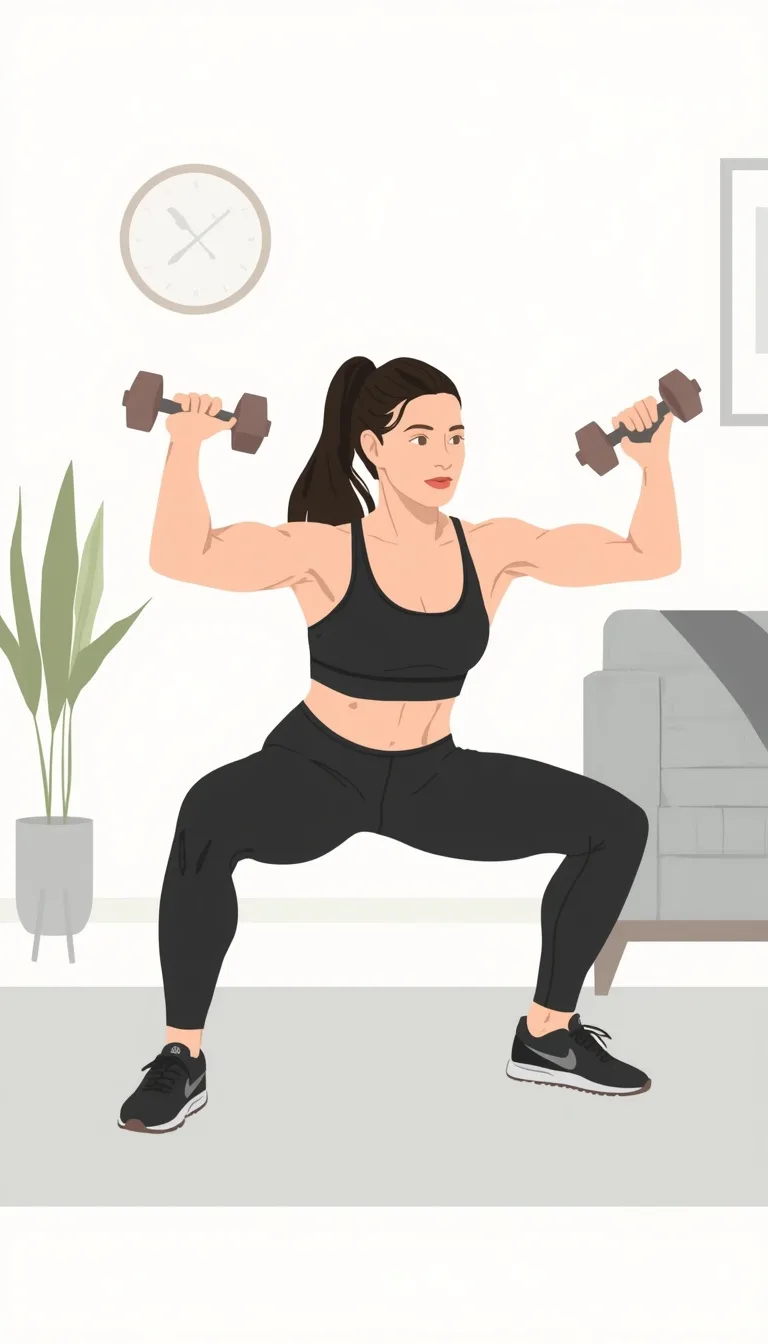
Finding time to exercise can be difficult when your schedule is already full. You may not have an hour for the gym, but that does not mean you need to skip strength training altogether.
This 20-minute full body workout for women combines simple strength exercises with a short warm-up and cool-down. It can be done at home with a pair of light-to-moderate dumbbells, and beginner-friendly modifications make it easier to adjust the workout to your current fitness level.
The goal is not to finish as many repetitions as possible. The goal is to move with control, train the major muscle groups, and build a routine you can realistically repeat.
If you’re completely new to home exercise, you may also want to read FitVibe’s guide on what to do on your first day working out at home before starting.
Quick Answer: Is 20 Minutes Enough for a Full-Body Workout?
Yes. A 20-minute workout can be a practical way to fit strength training into a busy schedule.
This routine uses:
- 5 minutes of warm-up
- 12 minutes of full-body circuit training
- 3 minutes of cool-down
- 6 exercises covering the legs, glutes, chest, back, shoulders, arms, and core
The workout uses a 40-seconds-work / 20-seconds-rest format during the main circuit.
Twenty minutes should not be viewed as a complete replacement for all weekly physical activity. Current CDC guidance recommends that adults accumulate at least 150 minutes of moderate-intensity aerobic activity each week and perform muscle-strengthening activities on at least 2 days per week. Physical activity can also be divided into smaller periods throughout the week.
That makes a short workout like this useful as one part of a broader weekly activity routine.
The 20-Minute Full Body Workout at a Glance
| Section | Time | What You’ll Do |
|---|---|---|
| Warm-up | 5 minutes | Prepare your body for exercise |
| Main circuit | 12 minutes | 6 full-body strength exercises |
| Cool-down | 3 minutes | Gentle stretching and recovery |
| Total | 20 minutes | Complete beginner-friendly session |
Equipment
You need:
- A pair of light-to-moderate dumbbells
- An exercise mat or comfortable floor surface
- Enough space to move safely
- A timer
You can also perform several of these movements with body weight if you don’t have dumbbells.
In fact, you do not need a gym to perform effective resistance training. The American College of Sports Medicine’s 2026 resistance-training guidance notes that bodyweight exercises, resistance bands, and home-based training can all be effective options.
5-Minute Warm-Up
Spend five minutes gradually increasing your movement before starting the main circuit.
1. March in Place — 1 Minute
Stand tall and march at a comfortable pace.
Focus on:
- Moving your arms naturally
- Keeping your chest lifted
- Gradually increasing your pace
If you’re comfortable, make the movement slightly more dynamic during the final 20–30 seconds.
2. Arm Circles — 1 Minute
Extend your arms out to the sides.
Perform controlled circles:
- 30 seconds forward
- 30 seconds backward
Keep the movement comfortable rather than forcing a large range of motion.
3. Side-to-Side Lunges — 1 Minute
Step to one side and gently bend the working knee while keeping the other leg relatively straight.
Alternate sides at a controlled pace.
If this feels unfamiliar, reduce the depth of the movement.
4. Standing Torso Twists — 1 Minute
Stand with your feet approximately hip-width apart.
Rotate your torso gently from side to side while keeping the movement controlled.
Avoid aggressively twisting through your lower back.
5. Bodyweight Squats — 1 Minute
Perform slow, comfortable squats.
Use this final minute to rehearse the movement you’ll use in the main workout.
12-Minute Full-Body Workout Circuit
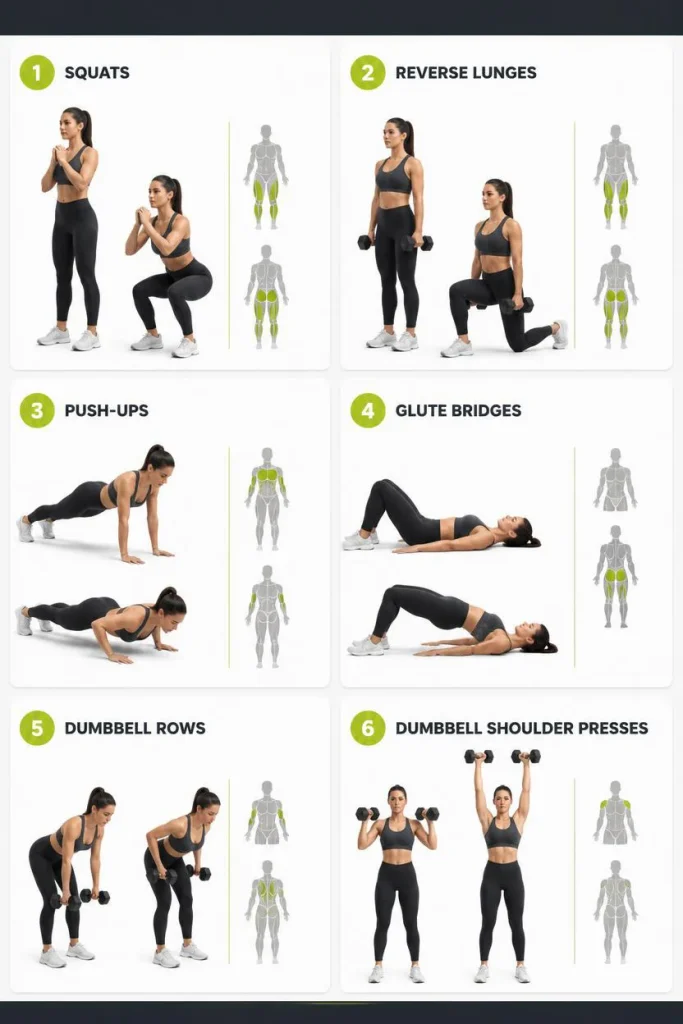
The main workout contains six exercises.
Perform each exercise for:
40 seconds work → 20 seconds rest
Complete the six exercises for two rounds.
That gives you 12 minutes of circuit work.
If you’re completely new to exercise, you can begin with shorter work periods and longer rest periods. You don’t need to force the full 40 seconds immediately.
1. Squats
Primary muscles: Quads and glutes
Stand with your feet approximately shoulder-width apart.
- Brace your midsection.
- Push your hips back.
- Bend your knees and lower under control.
- Keep your chest comfortably lifted.
- Push through your feet to stand.
Beginner modification
Use a sturdy chair behind you as a depth reference. Lower toward the chair without collapsing onto it, then stand.
Progression
Once bodyweight squats become comfortable, hold a light dumbbell close to your chest.
2. Reverse Lunges
Primary muscles: Legs and glutes
Start standing with your feet together or approximately hip-width apart.
- Step one foot backward.
- Lower your body under control.
- Keep the front foot stable.
- Push through the front foot to return to standing.
- Alternate legs.
Beginner modification
Hold onto a wall or sturdy support if balance is challenging.
You can also reduce the depth of the lunge.
Progression
Hold light dumbbells once you can perform the movement comfortably without losing control.
3. Push-Ups
Primary muscles: Chest, shoulders and triceps
Place your hands slightly wider than shoulder-width apart.
- Keep your body in a controlled straight line.
- Brace your core.
- Bend your elbows and lower your chest.
- Push through your hands to return to the starting position.
Beginner modification
Perform push-ups from your knees or use an elevated surface such as a sturdy bench or countertop.
The elevated version is often a useful way to learn the movement before progressing toward floor push-ups.
Bodyweight movements such as push-ups are recognized as muscle-strengthening activities in the U.S. Physical Activity Guidelines.
4. Glute Bridges
Primary muscles: Glutes and hamstrings
Lie on your back with your knees bent and feet flat on the floor.
- Position your feet comfortably under your knees.
- Brace your abdominal muscles.
- Press through your feet.
- Lift your hips.
- Pause briefly at the top.
- Lower slowly.
Try not to overarch your lower back.
Beginner modification
Use a smaller range of motion and focus on controlling the movement.
Progression
Place a light dumbbell across your hips once the bodyweight version becomes easy.
5. Dumbbell Rows
Primary muscles: Back and biceps
Hold a dumbbell in each hand.
- Hinge forward from your hips.
- Keep your back in a comfortable neutral position.
- Let the dumbbells hang beneath your shoulders.
- Pull your elbows toward your ribs.
- Lower the weights slowly.
Keep your neck relaxed rather than looking excessively upward.
Beginner modification
Use lighter dumbbells and concentrate on controlled repetitions.
If you do not have dumbbells, a resistance band or another suitable home-based resistance option can also be used.
Progression
Gradually increase the resistance when you can perform the movement with consistent technique.
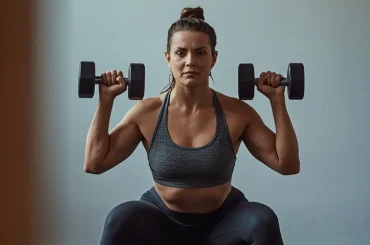
6. Shoulder Presses
Primary muscles: Shoulders and triceps
Start with the dumbbells around shoulder height.
- Brace your core.
- Press both dumbbells upward.
- Avoid excessively arching your lower back.
- Lower the weights under control.
- Repeat.
Beginner modification
Use lighter dumbbells or perform alternating presses.
If overhead pressing is uncomfortable for your shoulders, stop and choose a pain-free alternative rather than forcing the movement.
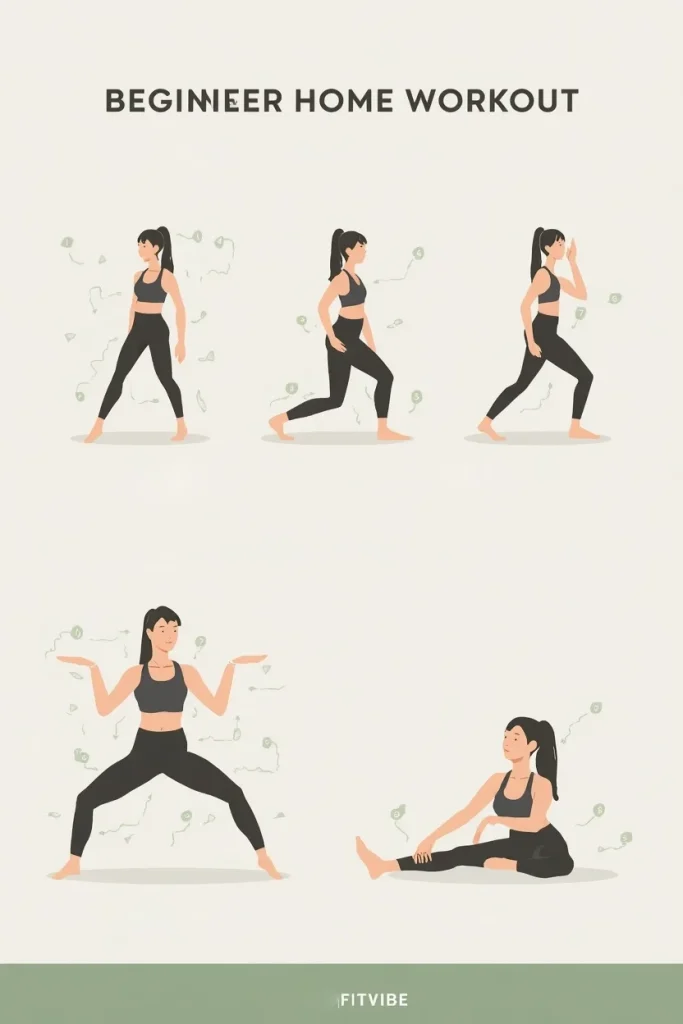
3-Minute Cool-Down
After the circuit, gradually bring your activity level down.
Chest Stretch — 1 Minute
Use a comfortable doorway or standing chest stretch.
Avoid forcing the stretch.
Hamstring Stretch — 1 Minute
Sit or stand and gently stretch the back of your thighs.
Keep the movement comfortable rather than trying to reach a particular flexibility target.
Child’s Pose — 1 Minute
Move into a comfortable child’s-pose position and breathe slowly.
If this position isn’t comfortable for your knees, hips, back, or shoulders, choose another gentle recovery position.
How Often Should Women Do This 20-Minute Workout?
For a beginner, 2–3 full-body strength sessions per week can be a practical starting structure, with recovery or lighter activity between sessions.
For example:
| Day | Activity |
|---|---|
| Monday | 20-minute full-body workout |
| Tuesday | Walking or light activity |
| Wednesday | Rest or easy movement |
| Thursday | 20-minute full-body workout |
| Friday | Walking or light activity |
| Saturday | Optional workout or recreational activity |
| Sunday | Rest |
The exact schedule can be adjusted around your lifestyle.
Current U.S. physical-activity guidance recommends muscle-strengthening activity on at least two days per week, while aerobic activity can be accumulated throughout the week.
If you’re just starting, consistency matters more than trying to train every day.
For a more structured progression, FitVibe’s 1-Month Beginner Fitness Plan provides a four-week approach combining strength training, aerobic activity, mobility, and recovery.
How to Make the Workout Easier
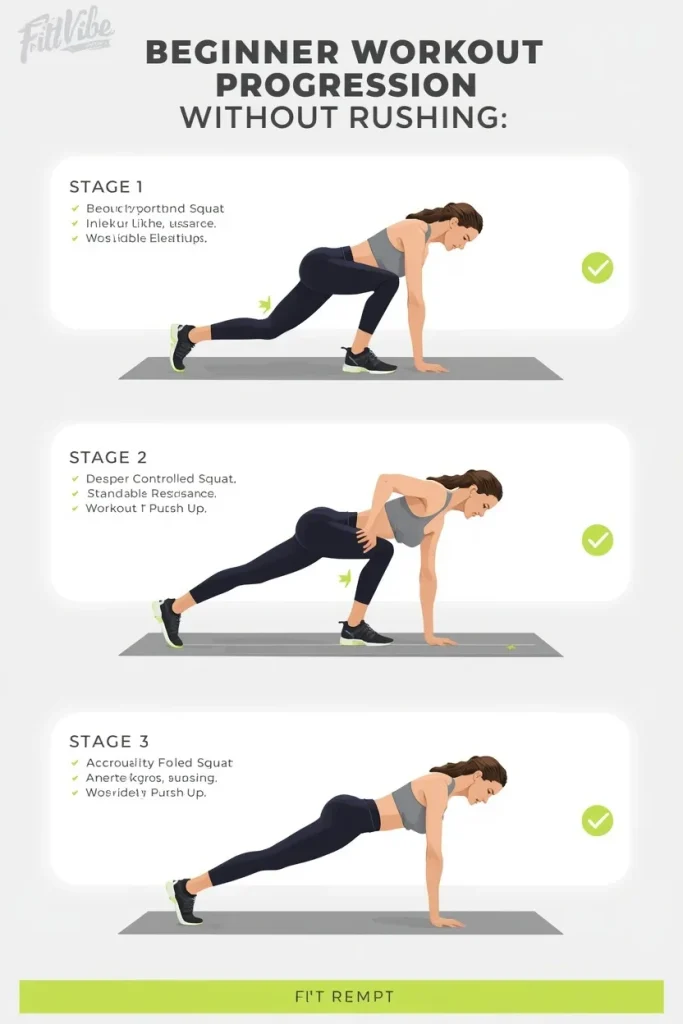
You don’t have to perform the routine exactly as shown in the infographic.
Make the workout easier by:
- Using body weight instead of dumbbells
- Performing fewer repetitions
- Reducing the range of motion
- Using wall or incline push-ups
- Holding onto support during lunges
- Taking longer rest periods
- Completing one round instead of two initially
The objective is to find a level that allows you to maintain reasonable control.
If you’re returning to exercise after a long break, gradually increasing your activity is preferable to immediately trying to match a more experienced exerciser.
The CDC also recommends choosing activities appropriate to your abilities and building activity gradually.
How to Progress the Workout
Once the workout starts feeling manageable, don’t assume you need an entirely new routine.
Instead, change one variable at a time.
You could:
- Increase the number of controlled repetitions.
- Increase the dumbbell weight slightly.
- Reduce rest periods modestly.
- Increase the range of motion where appropriate.
- Improve your exercise technique.
- Progress from an easier variation to a more challenging variation.
- Add another round when you’re ready.
This approach aligns with current resistance-training guidance emphasizing consistency, individualization, and gradual progression rather than unnecessary complexity.
You can also alternate this routine with FitVibe’s 30-Minute Full Body Workout at Home when you have more time available.
Can This Workout Help With Fat Loss?
It can contribute to an active lifestyle, but a 20-minute workout should not be presented as a standalone fat-loss solution.
Physical activity increases the amount of energy your body uses, while body-weight change is also influenced by food intake and other individual factors. The CDC notes that physical activity and dietary intake both play roles in weight management.
If fat loss is one of your goals, think about the bigger picture:
- Regular strength training
- Walking and other aerobic activity
- A sustainable eating pattern
- Adequate recovery
- Consistent sleep
- A routine you can maintain
For a more detailed discussion, see FitVibe’s guide on how to lose weight without extreme dieting.
That article also explains why strength training can be incorporated into a sustainable fat-loss approach rather than relying entirely on cardio or restrictive eating.
Common Mistakes to Avoid
| Mistake | Why It Can Be a Problem | Better Approach |
|---|---|---|
| Rushing every repetition | Technique can deteriorate | Use controlled movements |
| Choosing weights that are too heavy | Makes good technique harder | Start lighter and progress |
| Skipping the warm-up | Leaves less preparation before training | Keep the five-minute warm-up |
| Treating every session as a test | Can make consistency difficult | Train at a manageable effort |
| Ignoring pain | Could aggravate an existing problem | Stop and modify the movement |
| Progressing too quickly | Makes recovery more difficult | Increase difficulty gradually |
| Doing only one type of exercise | Limits the muscles and movement patterns trained | Use a balanced full-body routine |
What If You Don’t Have Dumbbells?
You can still perform this workout.
Try:
- Bodyweight squats
- Reverse lunges without weights
- Incline or knee push-ups
- Bodyweight glute bridges
- Backpack rows using an appropriately loaded backpack
- Bodyweight shoulder-training alternatives that are comfortable for you
You don’t need expensive equipment to begin resistance training. ACSM’s 2026 guidance specifically recognizes bodyweight and home-based resistance training as viable options.
If you’re looking for a completely equipment-free alternative, see FitVibe’s Bodyweight-Only Workout for Fat Loss.
Is This Workout Suitable for Complete Beginners?
The exercises can be modified for beginners, but the appropriate difficulty depends on your current fitness level, movement experience, health status, and any injuries or limitations you may have.
A beginner could start by:
- Using no weights
- Performing one round
- Taking longer rests
- Using incline push-ups
- Reducing lunge depth
- Practicing each movement before starting the timer
You don’t need to make the workout harder simply because the timer says 40 seconds.
Good technique and a manageable workload are more useful starting points than forcing yourself to keep moving when form has deteriorated.
When Should You Stop or Modify the Workout?
Exercise should feel challenging without requiring you to ignore concerning symptoms.
Stop the exercise if you experience:
- Significant or sharp pain
- Chest pain
- Severe or unusual shortness of breath
- Fainting or feeling close to fainting
- Severe dizziness
- Symptoms that feel unusual for you
If you have a chronic health condition, disability, injury, or another health concern that may affect exercise, speak with an appropriately qualified healthcare professional about the type and amount of activity that is appropriate for you. The CDC specifically recommends individualized medical guidance for people with certain chronic conditions and circumstances.
Frequently Asked Questions
Can I really complete a full-body workout in 20 minutes?
Yes. This routine uses a short warm-up, 12 minutes of circuit training, and a three-minute cool-down. The workout is designed to cover several major muscle groups efficiently.
How many days per week should I do this workout?
For beginners, two or three non-consecutive sessions per week can be a practical starting point. Your total weekly routine should also include appropriate aerobic activity and recovery.
Do I need dumbbells?
No. Dumbbells add resistance, but many of the exercises can be performed using body weight or other suitable home-based resistance options.
Is this workout good for weight loss?
It can contribute to your overall physical activity, but no single workout guarantees fat loss. Sustainable eating habits, total activity, recovery, and individual factors also matter.
What should I do if 40 seconds is too difficult?
Reduce the work period and increase your rest. For example, you could begin with 20–30 seconds of work and 30–40 seconds of rest.
Can I do this workout every day?
You don’t need to. Full-body strength sessions should be balanced with recovery and other forms of movement. A consistent schedule with rest or lighter activity between strength sessions is often more practical for beginners.
What if I only have 10 minutes?
Complete one round of the main circuit and use a shorter warm-up and cool-down appropriate to your situation. A shorter session can still be useful when the alternative is doing nothing.
For another approach to short workouts, you can also explore FitVibe’s bodyweight-only home workout.
A Simple Weekly Plan
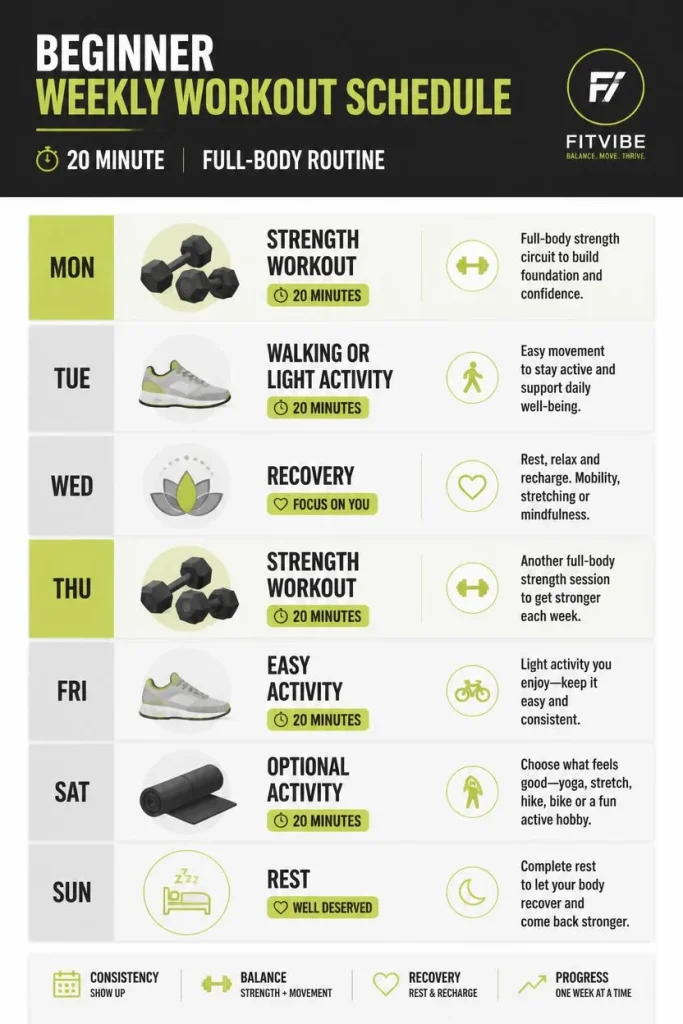
If you’re unsure how to fit this workout into your week, start here:
Monday: 20-minute full-body workout
Tuesday: 15–30 minute walk or light activity
Wednesday: Rest
Thursday: 20-minute full-body workout
Friday: Easy walking or recreational activity
Saturday: Optional cardio, walking, or another enjoyable activity
Sunday: Rest
As your fitness improves, you can gradually increase your overall weekly activity.
For general health, adults are advised to aim for at least 150 minutes of moderate-intensity aerobic activity each week along with muscle-strengthening activity on at least two days.
You do not need to achieve the entire target immediately. Start where you are and build gradually.
Save This 20-Minute Workout
Warm-up — 5 minutes
- March in place — 1 minute
- Arm circles — 1 minute
- Side-to-side lunges — 1 minute
- Standing torso twists — 1 minute
- Bodyweight squats — 1 minute
Main workout — 12 minutes
Complete 2 rounds:
- Squats — 40 sec
- Reverse lunges — 40 sec
- Push-ups — 40 sec
- Glute bridges — 40 sec
- Dumbbell rows — 40 sec
- Shoulder presses — 40 sec
Rest 20 seconds between exercises.
Cool-down — 3 minutes
- Chest stretch — 1 minute
- Hamstring stretch — 1 minute
- Child’s pose — 1 minute
Beginner rule: Reduce the work period or use easier exercise variations whenever necessary.
Progression rule: Gradually increase resistance, repetitions, range of motion, or total work as the routine becomes easier.
Final Takeaway
A useful workout doesn’t have to be long or complicated.
This 20-minute full-body routine gives you a simple structure for training your major muscle groups at home while leaving plenty of room for walking, recovery, and other activities throughout the week.
Start with a version you can perform confidently. Then build gradually.
The most useful routine is one that fits your schedule well enough that you can keep doing it.
Sources & Further Reading
The following sources are integrated into the article above and are also useful references for readers who want to explore the guidance in more detail:
- CDC — What Counts as Physical Activity for Adults — Explains aerobic and muscle-strengthening activity, including bodyweight exercises.
- CDC — Physical Activity and Your Weight and Health — Explains the relationship between physical activity, energy expenditure, eating patterns, and weight management.
- American College of Sports Medicine — 5 Things to Know About Creating an Effective Resistance Training Plan — 2026 resistance-training guidance covering consistency, individualization, gradual progression, and home-based resistance training.
- Physical Activity Guidelines for Americans — U.S. Department of Health and Human Services — Foundational federal guidance on aerobic and muscle-strengthening activity.