Starting a Build a Healthy workout Routine at home can feel surprisingly difficult. You may have the space, a mat, and a few minutes available, but still wonder: What exercises should I do? How long should I work out? Should I push myself hard on day one?
The good news is that your first home workout does not need to be intense or complicated. The goal is to learn the basic movements, establish a comfortable routine, and finish feeling like you could do it again.
For beginners first day working out, starting gradually is more useful than trying to make the first session your hardest workout. Current U.S. physical-activity guidance recommends that adults build toward at least 150 minutes of moderate-intensity aerobic activity per week plus muscle-strengthening activity on at least two days, but you do not need to reach those amounts on your first day. Some activity is better than none, and activity can be increased progressively.
Quick Answer: What Should You Do on Your First Day?
Keep your first workout simple.
A practical first session can look like this:
- Prepare a safe workout area.
- Warm up for 5–7 minutes.
- Practice 5–6 basic full-body movements.
- Do one or two comfortable sets of each exercise.
- Rest when needed rather than rushing.
- Finish with a few minutes of easy movement and gentle mobility.
- Write down what you did so your next workout has a starting point.
You do not need to train until you are exhausted. Your first day is about creating a foundation you can build on.
Before Your First Home Workout
A little preparation can make the session safer and easier to repeat.
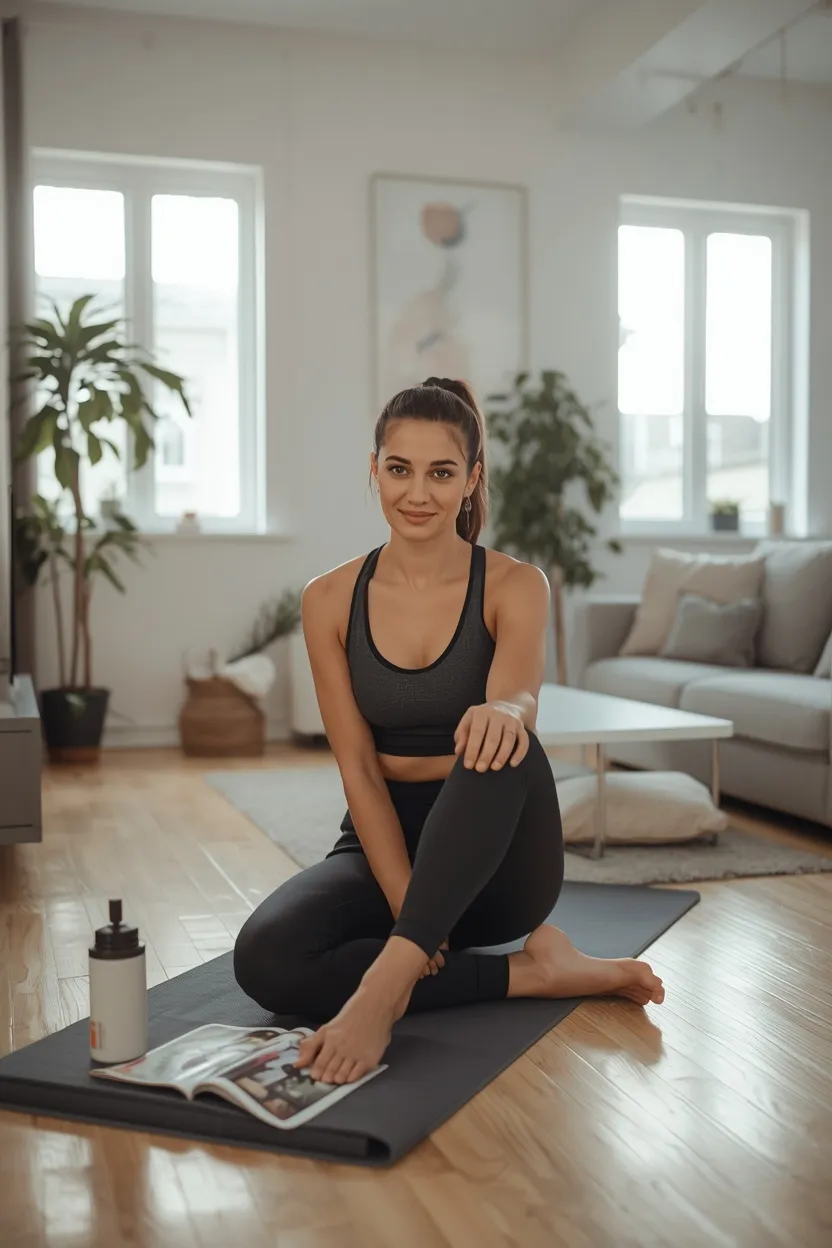
Choose a clear workout area
You do not need a home gym. You need enough room to move your arms and legs without hitting furniture, walls, pets, or other obstacles.
Check that:
- The floor is stable and reasonably non-slip.
- There are no loose cables nearby.
- Furniture is not likely to move during an exercise.
- You have enough room to lie down if your routine includes floor exercises.
- Your phone, water bottle, and towel are within easy reach but outside the movement area.
If you are using a chair for support, choose a sturdy chair that does not roll.
Wear comfortable clothing
Wear clothing that allows your hips, knees, shoulders, and arms to move freely.
For most beginner home workouts, specialized clothing is unnecessary. Comfortable footwear can be useful for standing exercises, although the appropriate choice depends on the exercise and your flooring.
Decide how much time you actually have
Do not automatically schedule an hour because you think a “real workout” has to be long.
For a first session, 20–30 minutes is enough to learn the basics. If you have less time, you can shorten the workout rather than skipping it entirely.
A routine that fits your schedule is more useful than an ambitious routine you cannot maintain. The American College of Sports Medicine’s 2026 resistance-training guidance similarly emphasizes consistency and matching training to an individual’s schedule and goals.
Your First-Day Home Workout
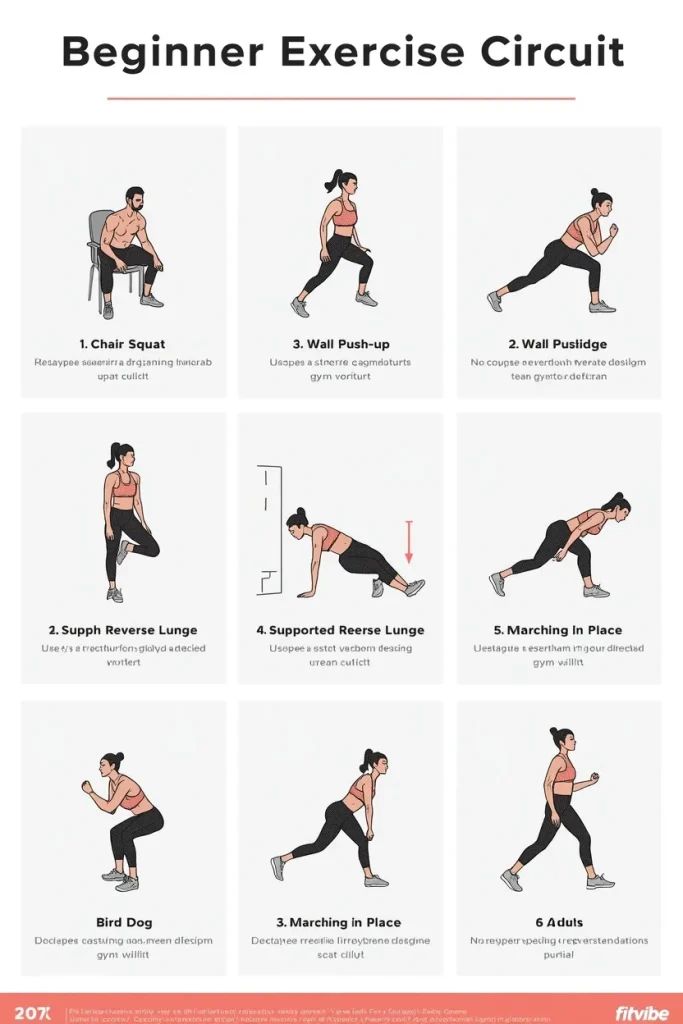
The following routine is designed as a simple introduction to full-body movement. It requires no specialized equipment.
| Exercise | Starting amount | Main movement |
|---|---|---|
| March in place | 60–90 seconds | Warm-up |
| Chair squat | 8–10 reps | Squat |
| Wall push-up | 8–10 reps | Push |
| Glute bridge | 8–12 reps | Hip extension |
| Supported reverse lunge | 5–8 each side | Single-leg movement |
| Bird dog | 5–8 each side | Core/stability |
| Easy walk or march | 2–5 minutes | Cool-down |
For your first session, one set of each exercise is enough. If everything feels comfortable and your technique remains controlled, you can repeat the circuit once.
The numbers above are a starting point, not a requirement. Your appropriate workload depends on your current fitness, experience, mobility, and health.
Step 1: Warm Up for 5–7 Minutes
Do not jump immediately into difficult exercises.
Start with easy movements that gradually raise your body temperature and allow you to practice the movement patterns you will use during the workout.
Try:
- Marching in place
- Shoulder circles
- Gentle arm swings
- Easy bodyweight squats
- Hip movements
- Ankle movements
- Slow alternating knee lifts
The warm-up should feel easy to moderate rather than exhausting.
A simple 5-minute warm-up
| Time | Movement |
|---|---|
| 1 minute | Easy marching |
| 1 minute | Arm circles and swings |
| 1 minute | Gentle bodyweight squats |
| 1 minute | Alternating knee lifts |
| 1 minute | Easy full-body movement |
You can adjust the movements according to your abilities.
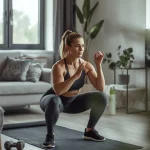
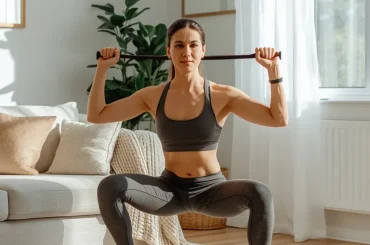
Step 2: Learn the Chair Squat
The squat is one of the most useful movements to learn at the beginning because it trains your legs and hips while also teaching you how to control your body through a basic sitting-and-standing pattern.
How to do it
- Stand in front of a sturdy chair.
- Place your feet around hip- to shoulder-width apart.
- Brace your midsection gently.
- Push your hips back as if you are going to sit.
- Bend your knees and lower under control.
- Lightly touch the chair with your hips if comfortable.
- Push through your feet to stand.
Start with 8–10 controlled repetitions.
Beginner modification
If the movement feels difficult, use a higher chair or reduce the depth of the squat.
If your knees, hips, or back hurt during the movement, stop and reassess your technique rather than forcing more repetitions.
Step 3: Try Wall Push-Ups
Traditional floor push-ups can be challenging when you are new to strength training. A wall push-up provides an easier way to practice the pushing movement.
How to do it
- Stand facing a wall.
- Place your palms against the wall around chest height.
- Walk your feet backward slightly.
- Keep your body relatively straight.
- Bend your elbows and bring your chest toward the wall.
- Push yourself away from the wall.
Try 8–10 repetitions with controlled movement.
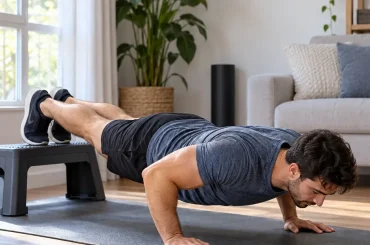
As you become stronger, you can progress from a wall to a higher stable surface and eventually to a lower surface or floor push-up.
The key is not to rush the progression.
Step 4: Add Glute Bridges
Glute bridges train the muscles around the hips and back of the legs while keeping the exercise relatively simple.
How to do it
- Lie on your back.
- Bend your knees.
- Place your feet flat on the floor.
- Keep your arms comfortably beside you.
- Tighten your abdominal muscles gently.
- Press through your feet.
- Raise your hips until your body forms a comfortable line from shoulders toward knees.
- Pause briefly.
- Lower slowly.
Start with 8–12 repetitions.
Do not force your hips as high as possible. A controlled movement is more important than maximum height.
Step 5: Practice a Supported Reverse Lunge
Single-leg exercises require more balance, so use a wall, countertop, or sturdy chair for support.
How to do it
- Stand tall while holding the support lightly.
- Step one foot backward.
- Lower your body under control.
- Push through the front foot to return to the starting position.
- Repeat on the other side.
Start with 5–8 repetitions per side.
If this feels unstable, replace it with another set of chair squats. You do not have to perform every exercise on your first day.
Step 6: Finish With Bird Dogs
The bird dog introduces controlled core and stability work without requiring heavy resistance.
How to do it
- Start on your hands and knees.
- Position your hands beneath your shoulders.
- Position your knees beneath your hips.
- Gently brace your midsection.
- Extend one arm and the opposite leg.
- Pause briefly.
- Return them to the starting position.
- Switch sides.
Start with 5–8 controlled repetitions per side.
The goal is to keep your torso relatively stable rather than lifting your arm and leg as high as possible.
How Hard Should Your First Workout Feel?
This is one of the most important questions for a beginner.
Your first workout should challenge you without making you feel like you have to survive it.
A useful approach is to finish most exercises feeling that you could have performed several more controlled repetitions.
You should be able to focus on:
- Breathing
- Posture
- Range of motion
- Controlled movement
- Stable joints
- Good technique
You do not need to train to complete exhaustion.
Current ACSM guidance emphasizes that complicated training techniques are not required for most healthy adults and that consistency matters greatly. It also notes that bodyweight exercises and home-based training can be effective options.
How Much Rest Should You Take?
Rest whenever you need it.
For a beginner circuit, roughly 30–90 seconds between exercises can be a reasonable starting point, but there is no need to watch the clock rigidly.
Take longer if:
- Your breathing has become difficult to control.
- Your technique is deteriorating.
- Your legs feel unusually unstable.
- You are new to exercise.
- You need additional recovery between movements.
The objective is to perform the next repetition safely and with control.
What to Do After the Workout
Your first workout does not end when you finish the last repetition.
Cool down gradually
Spend a few minutes walking slowly around the room or marching gently.
You can then perform comfortable mobility movements for areas that feel stiff.
You do not need an aggressive stretching session immediately after exercise.
Drink according to thirst
Have water available and drink normally. Your fluid needs depend on factors such as temperature, exercise duration, and how much you sweat.
Eat normally
There is no need to dramatically change your diet because you completed your first workout.
A balanced meal containing a protein source, vegetables or fruit, and a source of carbohydrates can fit naturally into a healthy eating pattern.
For example:
- Eggs with whole-grain toast and fruit
- Greek yogurt with oats and fruit
- Chicken, rice, and vegetables
- Lentils with rice and vegetables
- Fish with potatoes and a large salad
The important thing is to return to your normal balanced eating habits rather than treating exercise as a reason to heavily restrict or overeat.
What Should You Do the Day After Your First Workout?
You do not need to immediately repeat the same workout at maximum effort.
Your next day can include:
- An easy walk
- Light household activity
- Gentle mobility
- Normal daily movement
- Rest if you are particularly tired
Then plan your next structured workout when you feel ready.
If you experience ordinary muscle soreness, gentle movement may feel comfortable. But sharp, severe, or worsening pain is not something you should try to exercise through.
Starting slowly and gradually increasing activity is consistent with CDC guidance for people beginning or increasing physical activity.
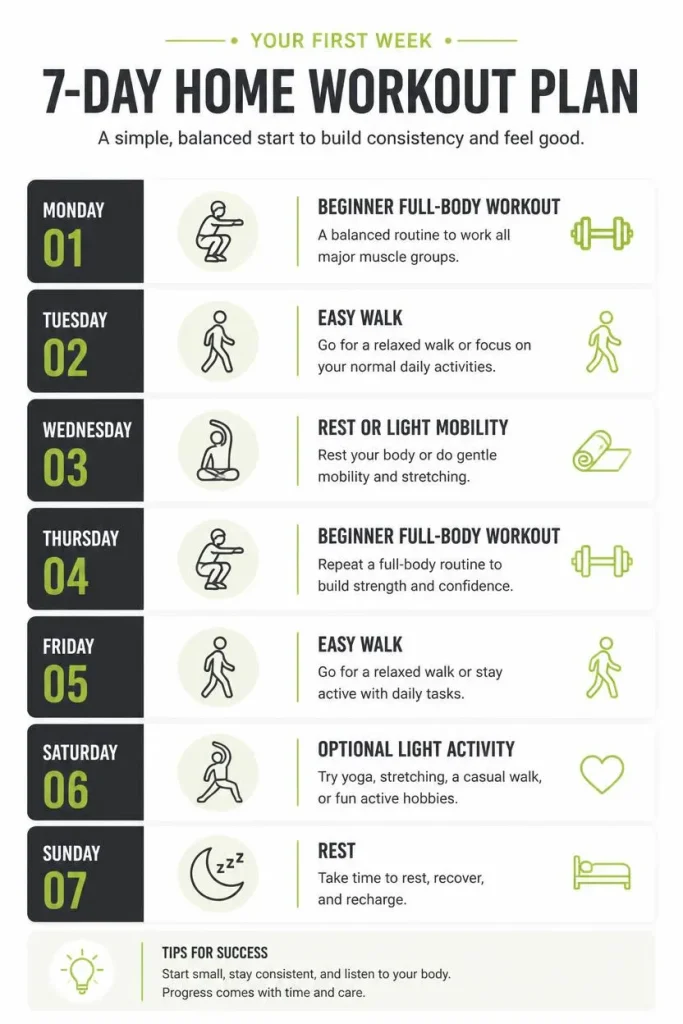
Your First Week Could Be This Simple
You do not have to work out every day to begin building a routine.
| Day | Activity | Goal |
|---|---|---|
| Monday | Beginner full-body workout | Learn movements |
| Tuesday | Easy walk or normal activity | Keep moving |
| Wednesday | Rest or light mobility | Recover |
| Thursday | Beginner full-body workout | Repeat technique |
| Friday | Easy walk | Build activity |
| Saturday | Optional light activity | Stay active |
| Sunday | Rest | Recover and prepare |
This is simply an example. Your schedule can be different.
The long-term target for adults is at least 150 minutes of moderate-intensity aerobic activity per week and muscle-strengthening activity on at least two days, but beginners can build toward those levels gradually rather than attempting everything immediately.
What If You Have Only 10 Minutes?
Do the essentials.
10-minute beginner version
2 minutes: Easy marching and mobility
6 minutes:
- Chair squats
- Wall push-ups
- Glute bridges
Alternate the exercises at a comfortable pace.
2 minutes: Easy walking and breathing
A short session is still useful. Physical activity does not have to happen in one long block, and current guidance emphasizes that some activity is better than none.
What If You Have No Equipment?
That’s fine.
A beginner can train many major movement patterns using bodyweight exercises and household setup.
| Movement | No-equipment option | Easier version |
|---|---|---|
| Squat | Bodyweight squat | Chair squat |
| Push | Floor push-up | Wall push-up |
| Hip movement | Glute bridge | Shorter bridge range |
| Single-leg | Reverse lunge | Supported reverse lunge |
| Core/stability | Bird dog | Smaller range of motion |
| Cardio | Marching | Slow marching |
ACSM’s 2026 resistance-training guidance specifically notes that resistance bands, bodyweight exercises, and home-based routines can be effective ways to train without a traditional gym.
Common First-Day Mistakes
| Mista ke | Why it can be a problem | Better approach |
|---|---|---|
| Trying to get extremely sore | Soreness is not the goal of training | Focus on controlled movement |
| Doing too many exercises | Makes the session unnecessarily complicated | Start with a few fundamental movements |
| Exercising every day immediately | Leaves little time to adapt and recover | Alternate harder sessions with easier activity |
| Copying an advanced workout | The intensity may not match your current ability | Choose beginner modifications |
| Ignoring technique | Poor movement can make exercises less effective and harder to control | Reduce repetitions or difficulty |
| Comparing yourself with online workouts | Other people’s fitness levels may be very different | Measure progress against your own starting point |
| Waiting for the perfect equipment | Equipment is not required to begin | Start with bodyweight movements |
| Treating one workout as a test | Can turn exercise into an all-or-nothing challenge | Treat day one as practice |
How to Progress After Day One
Once the basic movements feel comfortable, change one variable at a time.
You could gradually:
- Add a few repetitions.
- Add another set.
- Increase the exercise range of motion.
- Use a more challenging variation.
- Add resistance bands.
- Add light dumbbells.
- Increase walking time.
- Improve your movement control.
You do not need to make every workout harder.
For example, your progression might look like:
Week 1: One set of basic movements
↓
Week 2: One to two sets
↓
Week 3: Slightly more repetitions or a harder variation
↓
Week 4: Continue building gradually
The exact timeline can vary. Your progression should reflect how you are actually responding to the workouts.
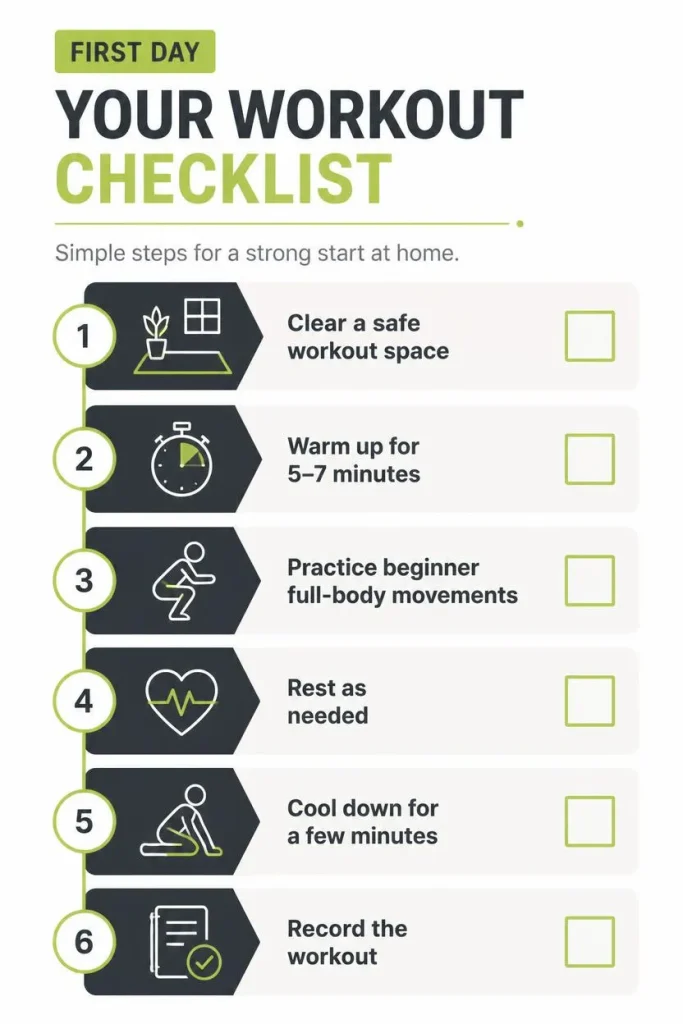
A Simple First-Day Checklist
Before
- Clear a safe workout area
- Put water nearby
- Wear comfortable clothing
- Decide how much time you have
- Choose beginner-level exercises
During
- Warm up
- Move under control
- Breathe normally
- Rest when needed
- Use easier variations when necessary
- Stop if something feels sharply painful or concerning
After
- Cool down gradually
- Drink normally according to thirst
- Eat a balanced meal
- Record the exercises you completed
- Schedule your next workout
Frequently Asked Questions
Is 20 minutes enough for my first home workout?
Yes. Your first session is primarily about learning the movements and establishing a routine. A focused 20-minute workout can be a practical starting point.
Should I work out every day when I start?
Not necessarily. Beginners can combine structured workouts with walking, normal daily movement, lighter activity, and rest days. Starting gradually is more practical than forcing hard workouts every day.
Do I need dumbbells?
No. Bodyweight exercises can provide a useful starting point. As you become stronger, resistance bands, dumbbells, or other equipment can provide additional ways to progress.
Should my first workout make me sore?
No. Muscle soreness is not a requirement for an effective workout. Focus on learning good movement and finishing with enough energy to continue your routine.
What if I cannot do a regular push-up?
Start with a wall push-up. Once that becomes comfortable, progress to a higher stable surface and then gradually toward a floor push-up.
Can I exercise if I have not worked out for years?
Many people can begin with light-to-moderate activity, but your starting point should match your current health and abilities. If you have a chronic health condition, disability, or other concern about starting exercise, discuss appropriate activity with a healthcare professional. CDC guidance specifically recommends professional advice for people with chronic conditions and before vigorous activity in certain previously inactive adults.
What should I do if I feel dizzy or have unusual shortness of breath?
Stop the workout and recover. Significant dizziness, unusual shortness of breath, chest discomfort, fainting, or severe pain warrants appropriate medical attention rather than trying to push through the session.
The Bottom Line
Your first home workout should not be a test of how much discomfort you can tolerate.
Think of it as an introduction.
Clear your space, warm up, practice a few basic movements, keep the intensity manageable, and finish with enough energy to want to come back. Over time, you can gradually increase the amount and difficulty of your activity.
You do not need a perfect home gym or a complicated program to begin. You need a realistic starting point that fits your life.
For your first day, aim to finish the workout thinking: “I can do that again.”
Save This Guide: Your First Home Workout
5–7 min: Warm-up
8–10 reps: Chair squats
8–10 reps: Wall push-ups
8–12 reps: Glute bridges
5–8/side: Supported reverse lunges
5–8/side: Bird dogs
2–5 min: Easy cool-down
Start comfortably. Learn the movements. Build gradually. Then keep showing up.
Sources & Further Reading
- Centers for Disease Control and Prevention (CDC): CDC — Adult Activity: An Overview
- Centers for Disease Control and Prevention (CDC): CDC — Adding Physical Activity as an Adult
- American College of Sports Medicine (ACSM): ACSM — 5 Things to Know About Creating an Effective Resistance Training Plan
- U.S. Department of Health and Human Services: Physical Activity Guidelines for Americans, 2nd edition