
Most advice about how to build a healthy routine assumes you have time to build one properly — a structured workout plan, a full week of meal prep, a consistent sleep schedule. For genuinely busy people, that advice doesn’t fail because it’s wrong. It fails because the first chaotic week breaks it, and there’s no fallback plan for what happens next.
This guide is about something more specific than “how to be healthier when busy”: it’s about defining your minimum viable healthy routine — the smallest version of healthy habits you can sustain on your worst week, so a bad week never turns into a lost month.
Quick Takeaway
A minimum viable healthy routine isn’t a lighter version of your ideal routine — it’s a deliberately small, non-negotiable floor: roughly 10 minutes of movement, one balanced meal, a consistent sleep window, and five minutes of next-day planning. The goal isn’t progress on your busiest days; it’s not losing the thread entirely. Everything beyond that floor is a bonus, not a requirement.
What “Minimum Viable” Actually Means Here
Borrowed from the idea of a minimum viable product, a minimum viable healthy routine is the smallest set of habits that still counts as “on track” — not the routine you’d choose if you had more time, but the one you can actually run on your worst day without fail.
This matters because most people don’t abandon healthy habits because they lack motivation. They abandon them because their version of “healthy” requires 45 minutes of exercise, from-scratch meals, and eight hours of sleep — and the day that’s genuinely impossible, they do nothing instead of doing something smaller. A minimum viable routine exists specifically to close that gap.
This guide intentionally stays at the floor level. It isn’t a full workout program, a complete meal-prep system, or a fat-loss plan — those each deserve their own depth, and FitVibe covers them elsewhere. What follows is the groundwork that makes those other routines possible to sustain in the first place.
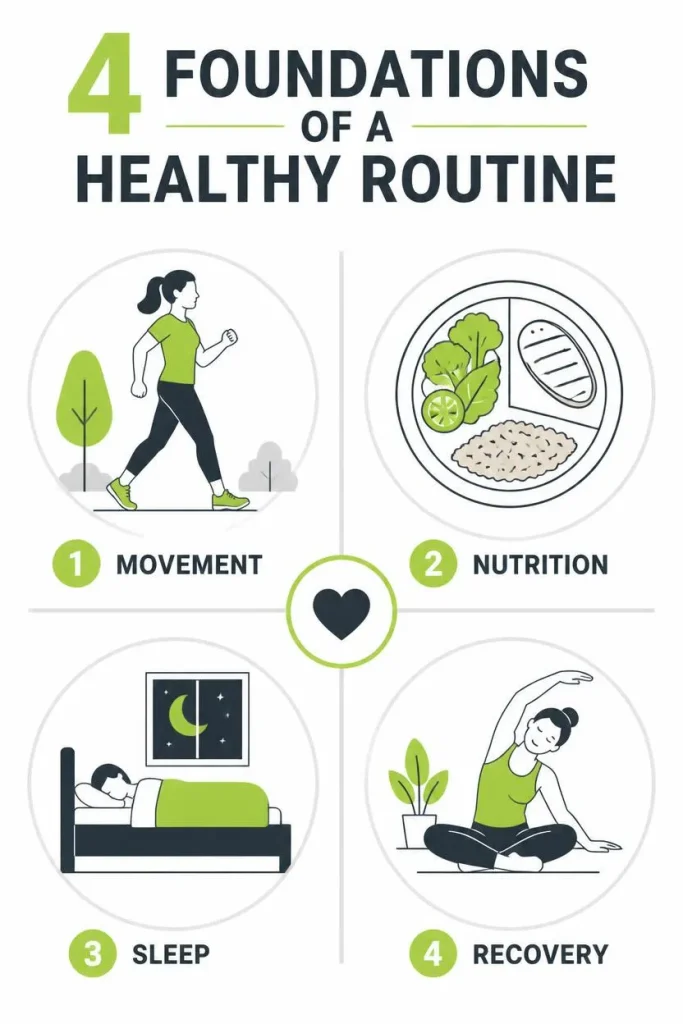
The Four Non-Negotiables
These are the absolute minimums — not goals to aim for, but the floor you don’t go below, even on the worst day.
| Pillar | Minimum Viable Version | Why It’s the Floor, Not the Ceiling |
|---|---|---|
| Movement | 10 minutes of deliberate movement (a brisk walk, a short bodyweight circuit) | Keeps the habit alive; far easier to resume a daily habit than to restart an abandoned one |
| Food | One meal with a protein source, a vegetable, and a carbohydrate | Doesn’t require a recipe or meal prep — just one deliberately balanced plate |
| Sleep | A consistent wake time, even if bedtime shifts | The CDC recommends 7 or more hours of sleep per night for adults; a fixed wake time is the easiest lever to protect that on a busy week |
| Planning | 5 minutes, the night before, deciding tomorrow’s minimum | Removes the decision fatigue that causes people to skip everything when the day gets away from them |
Notice what’s missing: there’s no mention of workout splits, macros, or sleep hygiene routines here on purpose. Those live in dedicated guides — this is about the floor underneath all of them.
The Three-Tier Day System
Not every day can carry the same expectations, so stop trying to apply one standard to all of them. A simple tiering system makes the floor explicit and removes the all-or-nothing thinking that sinks most routines.
| Tier | When to Use It | What It Looks Like |
|---|---|---|
| Green day | A normal day with reasonable time | Full routine: a real workout, planned meals, normal bedtime |
| Yellow day | Busier than normal, but not chaotic | 15–20 minutes of movement, one properly planned meal, everything else simplified |
| Red day | Genuinely overwhelming — travel, deadlines, a sick kid | Just the four non-negotiables above: 10 minutes of movement, one balanced meal, consistent wake time, five-minute plan for tomorrow |
The point of naming a day “red” in advance is psychological as much as practical: it gives you permission to do the minimum without treating it as a failure. A red day where you hit the floor is a maintained routine. A red day where you do nothing because you “didn’t have time for the real thing” is the start of a lapse.
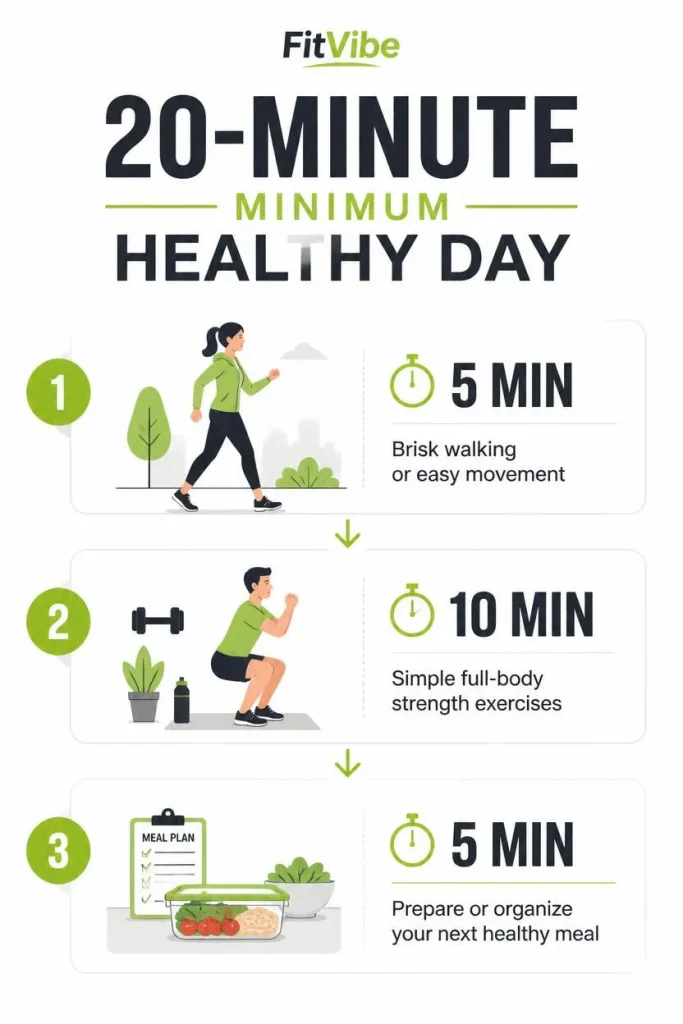
Building Your Own Minimum
The table above is a starting template, not a universal prescription — your actual floor depends on your schedule, your living situation, and what you find easiest to protect under pressure. Work through these three questions once, honestly:
- What’s genuinely always possible, even on your worst day? Not optimistic-possible — actually possible. If 10 minutes of movement is unrealistic some weeks, your real floor might be 5.
- What’s your fastest “good enough” meal? It doesn’t need to be exciting. Eggs and toast, yogurt with oats, or a bean and cheese wrap all count if they include protein and something beyond refined carbs.
- What one planning habit prevents the most chaos for you specifically? For some people that’s packing a lunch the night before; for others it’s picking tomorrow’s workout clothes so the decision is already made.
Write your answers down. The specificity is what makes a minimum routine actually survive a bad week — a vague intention to “do something” doesn’t hold up the same way a pre-decided floor does.
What This Routine Isn’t
Because this guide stays deliberately minimal, it’s worth being clear about what it doesn’t try to cover — and where to go instead once the floor is solid:
- It’s not a workout program. The 10-minute movement minimum is a floor, not a training plan. If you’re ready to build an actual structured routine, see how to start a beginner strength training plan or, if you’re brand new to exercise entirely, what to do on your first day working out at home.
- It’s not a meal-prep system. “One balanced meal” is meant to be achievable with zero advance preparation. For an actual weekly food system, see the complete meal prep guide for beginners.
- It’s not a fat-loss plan. Nothing here is calibrated around calories or a specific body-composition goal. If that’s your focus, a sustainable approach is covered in how to lose weight without extreme dieting.
Treat this guide as the foundation those other systems sit on top of — not a replacement for any of them.
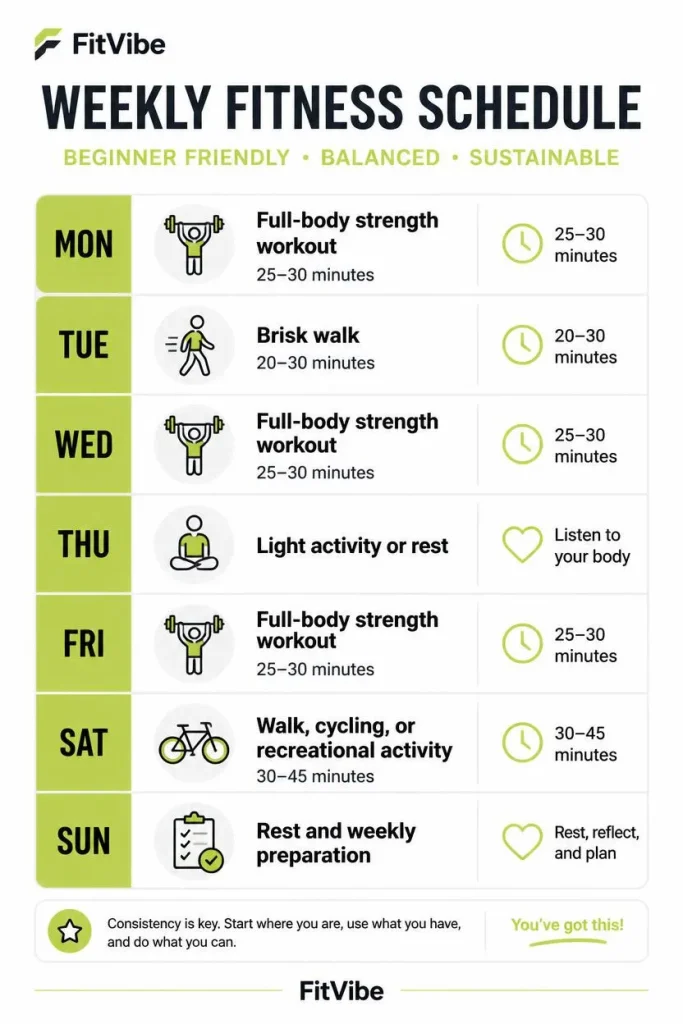
Sample Minimum-Viable Week
This is what a week looks like when it’s built around the tier system rather than a fixed, identical schedule every day.
| Day | Tier | What Actually Happened |
|---|---|---|
| Monday | Green | Full 45-minute workout, both main meals planned ahead |
| Tuesday | Green | Normal routine, slightly shorter workout |
| Wednesday | Yellow | Work ran late; 15-minute home circuit, one planned meal, rest improvised |
| Thursday | Red | Travel day; 10-minute walk between meetings, one balanced meal at the airport, set tomorrow’s alarm |
| Friday | Green | Back to normal routine |
| Saturday | Yellow | Family commitments; short walk, one planned meal, rest flexible |
| Sunday | Green | Full routine, plus the five-minute plan for the week ahead |
Two Yellow days and one Red day in a single week isn’t a failed week — it’s what a realistic week actually looks like for most busy adults. The floor held every single day, which is the entire point.
Habit-Stacking and Environmental Shortcuts
A few small structural choices make the floor easier to hit without relying on willpower each day:
- Attach new habits to existing ones. Do your 10-minute movement minimum right after a task you already do daily, like brewing coffee or finishing a work call — it borrows the existing habit’s momentum instead of needing its own trigger.
- Decide the night before. Laying out gym clothes, prepping tomorrow’s “good enough” meal ingredients, or picking the specific 10-minute movement option removes the one decision most likely to get skipped under time pressure.
- Make the easy choice the visible one. Keep a water bottle, a pair of shoes, or quick-meal ingredients somewhere you’ll actually see them — friction removed in advance is friction you don’t have to overcome in the moment.
Common Mistakes
| Mistake | Why It Happens | Better Approach |
|---|---|---|
| Treating the minimum as the ceiling | Doing only the floor even on an easy day | Use Green days for your full routine; reserve the floor for genuinely busy days |
| Building a floor that’s still too ambitious | Optimism about a “realistic” minimum that isn’t actually realistic | Test your floor on an intentionally bad day before trusting it |
| Skipping the floor entirely on bad days | All-or-nothing thinking — “if I can’t do the real workout, why bother” | Remember that a 10-minute Red day beats a missed day every time, cumulatively |
| Trying to make up for a missed day with a longer session | Guilt-driven overcorrection | One missed day needs nothing extra — just resume the floor tomorrow |
| No pre-decided plan for bad days | Assuming you’ll figure it out in the moment | Decide your Red-day floor now, while you’re not under pressure |
If the Routine Lapses: A Simple Reset
If a few days or weeks slip past the floor entirely, the reset doesn’t need to be dramatic:
- Go for one walk today, regardless of length.
- Eat one balanced meal today — protein, a vegetable, a carbohydrate.
- Set tomorrow’s alarm for a consistent wake time.
- Spend five minutes planning tomorrow’s floor, specifically.
- Resume the tier system from there — no penalty lap, no “getting back to 100%” before it counts.
Frequently Asked Questions
Is 10 minutes of movement actually enough to matter? On its own, occasionally, no single 10-minute session changes much. What it does is keep the habit and the identity of “someone who moves daily” intact through a hard week, which is what makes it possible to return to a fuller routine once things ease up. The floor’s job is continuity, not results.
Should I feel bad about a week full of Yellow and Red days? No — as the sample week above shows, a realistic busy week includes several Yellow or Red days. The measure of success is whether the floor held, not whether every day looked like your ideal routine.
What if my job or life situation makes even the floor hard most days? Make the floor smaller. A genuinely sustainable minimum that you hit consistently is more valuable than an aspirational one you hit half the time. Revisit the three questions in the “Building Your Own Minimum” section and scale down honestly.
How is this different from just lowering my goals? Lowering your goals usually means lowering your standard routine. A minimum viable routine keeps your standard (Green-day) routine exactly as ambitious as you want — it just adds an explicit, pre-planned fallback for the days that routine isn’t realistic.
Do I need to plan every single day in advance? No — the five-minute planning habit is really only essential the night before a day you expect to be Yellow or Red. On ordinary Green days, most people don’t need much advance planning at all.
Final Thoughts
A healthy routine doesn’t fail because people don’t know what to do — it fails because the plan has no answer for a genuinely bad day. Defining your floor in advance, rating each day honestly with the tier system, and treating a Red day that hits the minimum as a win rather than a shortfall is what actually makes a routine survive contact with a busy, unpredictable schedule. Once that floor is solid, the deeper systems — a real workout plan, a full meal-prep routine, a specific fat-loss or performance goal — have something stable to build on.
Sources & Further Reading
- Centers for Disease Control and Prevention — adult sleep duration guidance
- World Health Organization / CDC physical activity guidance on weekly moderate-intensity activity targets