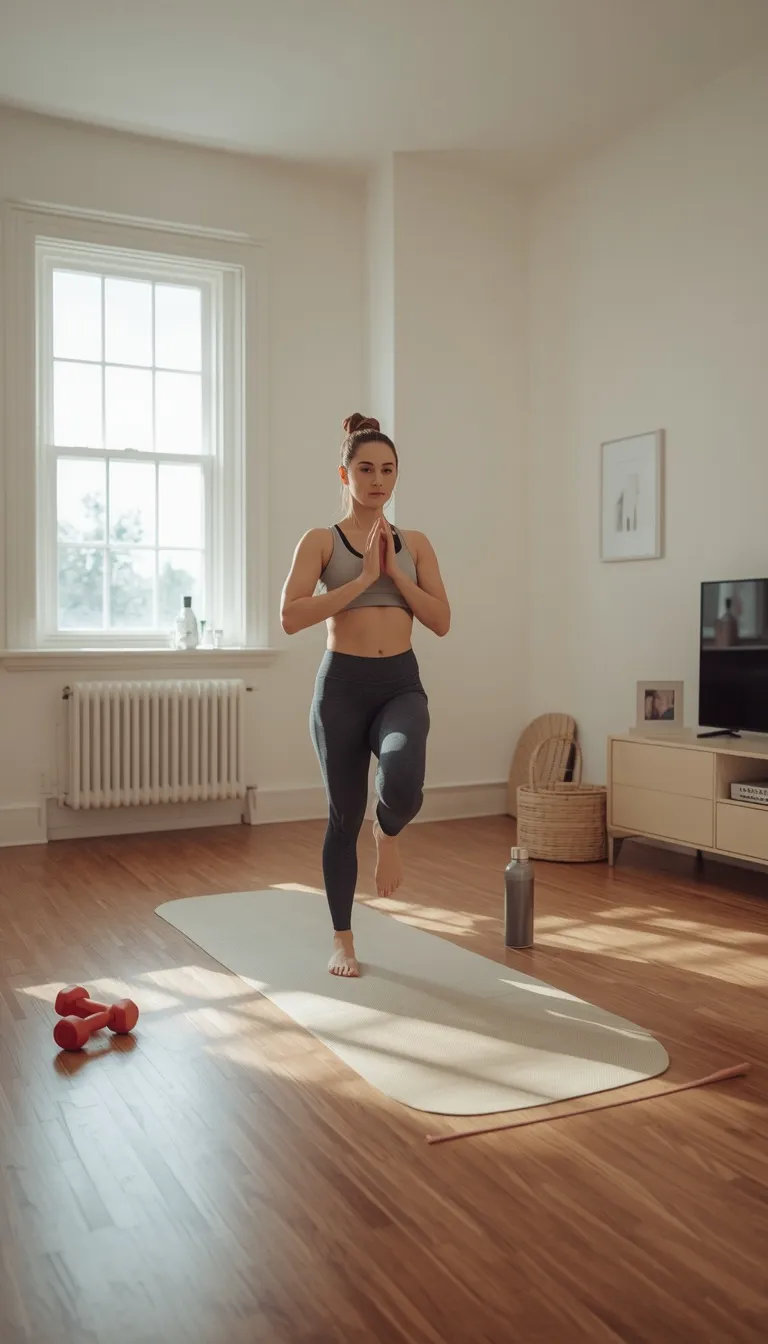
Finding a consistent workout routine gets harder when you’re juggling work, family, and everything else. A 30-minute full body workout at home solves a lot of that friction — no commute, no equipment hunt, no waiting for machines. You just need a small patch of floor space and half an hour.
A 30-minute full-body workout can be a practical way to fit exercise into a busy schedule. If you’re new to home training, our guide on how often beginners should work out at home explains how to build a sustainable weekly routine.
This guide gives you a complete workout you can start today, plus modifications for different fitness levels, a weekly schedule, and the specific mistakes that tend to derail people in the first month.
Quick Answer
A well-structured 30-minute full body workout typically breaks down as: 5 minutes warming up, 20–22 minutes of working sets covering the major movement patterns (squat, hinge, push, pull, core), and 3–5 minutes cooling down. Done 2–3 times per week with progressive difficulty, this is enough to build real strength for most beginners and intermediates.
Why Full Body Beats Split Routines at Home
Gym-style “split” routines — chest day, leg day, back day — assume you’re training 5–6 days a week. Most people working out at home aren’t.
Full body training hits every major muscle group each session. If you only manage two workouts in a busy week, you’ve still trained everything twice rather than hitting chest twice and skipping your legs entirely. It’s a more forgiving structure for inconsistent schedules.
It also fits the equipment reality of home training. Without machines, you’re relying on compound bodyweight and dumbbell movements anyway, and those naturally recruit multiple muscle groups at once.
If this is your first time exercising at home, start with manageable movements and focus on learning good technique rather than trying to do everything at maximum intensity. Our first day working out at home guide covers what beginners can expect and how to approach that first session.
What You’ll Need
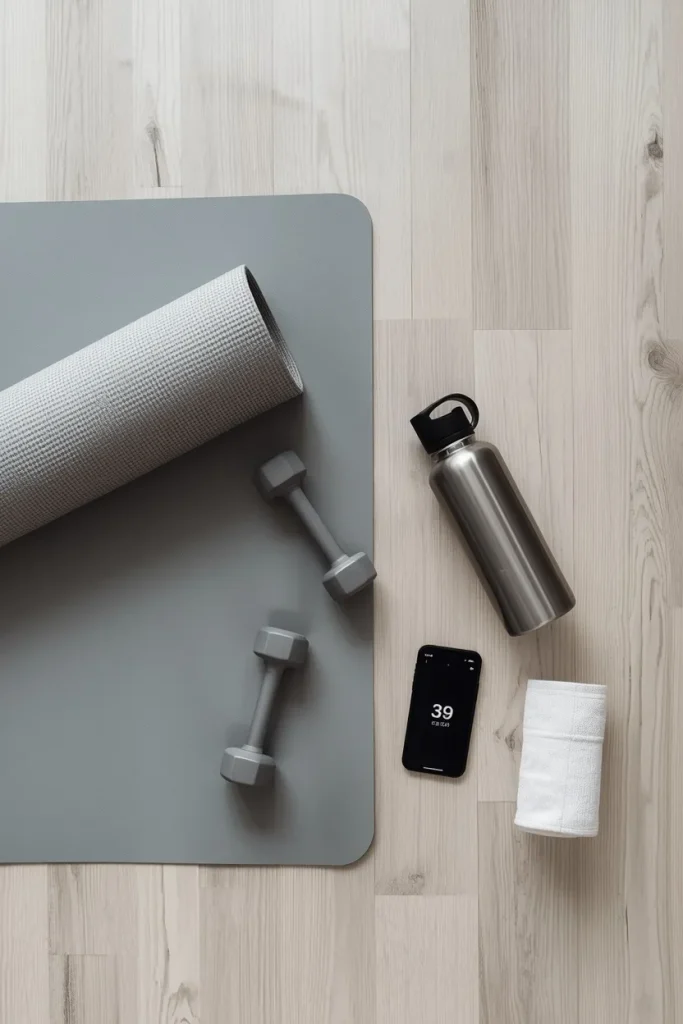
| Equipment | Required? | Notes |
|---|---|---|
| Floor space (~6×6 ft) | Yes | Enough to lie down and extend arms |
| Exercise mat | Helpful | Cushions joints during floor work; a towel works |
| Dumbbells | Optional | 5–20 lbs covers most beginners; water jugs or backpacks work as substitutes |
| Sturdy chair or bench | Optional | Used for incline push-ups and step-ups |
| Timer | Helpful | Phone timer is fine |
You can complete the entire workout below with zero equipment. Dumbbells are listed where they add difficulty.
The 30-Minute Full Body Workout
Warm-Up (5 minutes)
Don’t skip this. A warm-up raises your body temperature, increases blood flow to working muscles, and prepares your joints for load — all of which reduce injury risk and generally improve how the workout feels.
| Movement | Duration |
|---|---|
| March in place or light jog | 60 sec |
| Arm circles (30 sec each direction) | 60 sec |
| Leg swings (front-to-back, each leg) | 60 sec |
| Bodyweight squats (slow, controlled) | 60 sec |
| Inchworms or cat-cow stretches | 60 sec |
Main Workout (20–22 minutes)
Perform 3 rounds of the circuit below. Work for 40 seconds, rest 20 seconds, then move to the next exercise. After completing all 6 exercises, rest 60–90 seconds before starting the next round.
| # | Exercise | Target | Beginner Version | Harder Version |
|---|---|---|---|---|
| 1 | Goblet or bodyweight squat | Quads, glutes | Box squat to chair | Add dumbbell, slow 3-sec descent |
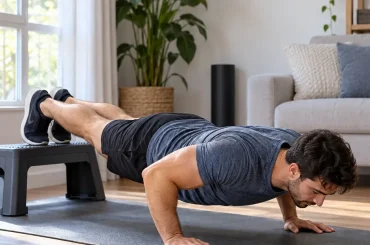
| 2 | Push-up | Chest, shoulders, triceps | Incline on chair or wall | Feet elevated, slower tempo |
| 3 | Romanian deadlift (dumbbell or bodyweight) | Hamstrings, glutes, lower back | Bodyweight, hands sliding down thighs | Single-leg RDL |
| 4 | Bent-over row (dumbbell or backpack) | Back, biceps | Lighter weight, higher reps | Single-arm row, pause at top |
| 5 | Reverse lunge (alternating) | Legs, glutes, balance | Hold a wall for balance | Add dumbbells, add a knee drive |
| 6 | Plank | Core, shoulders | Knees down, or elevated on chair | Plank with shoulder taps |
Three rounds at 60 seconds per exercise (40 work + 20 rest) is 18 minutes, plus roughly 3 minutes of between-round rest. That lands right around 21 minutes.
Cool-Down (3–5 minutes)
- Standing quad stretch — 30 sec each leg
- Standing hamstring stretch — 30 sec each leg
- Chest doorway stretch — 30 sec
- Child’s pose — 45 sec
- Slow nasal breathing — 30 sec
How to Scale This Workout
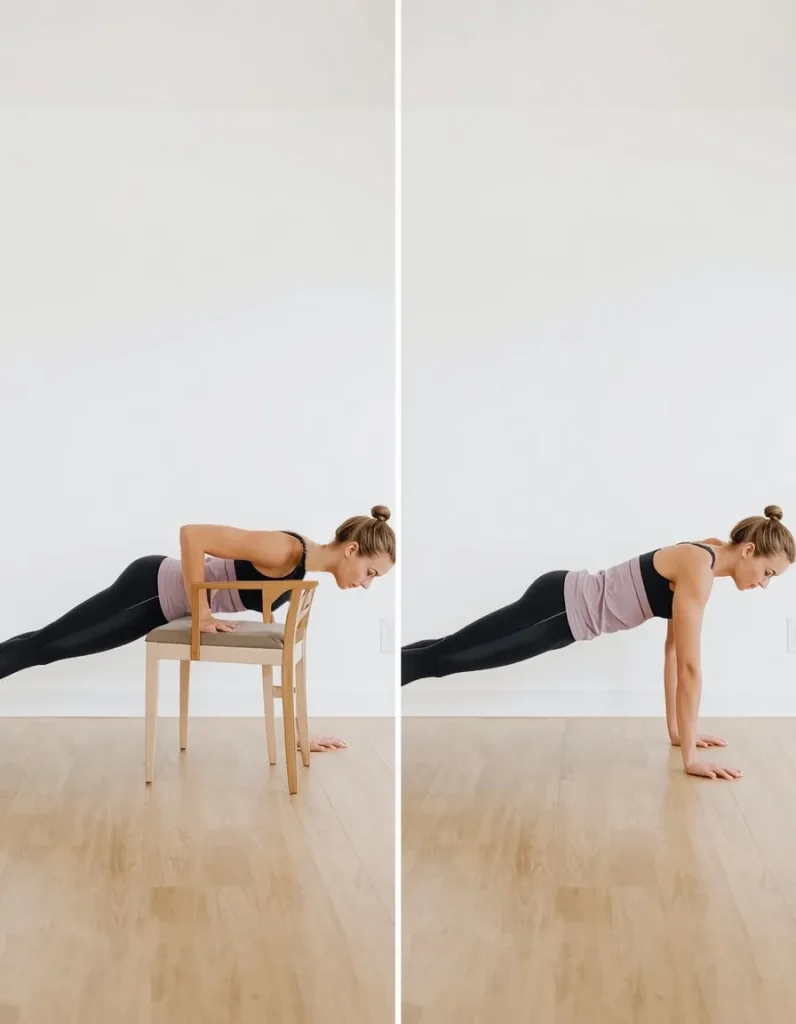
The same circuit works across fitness levels. What changes is intensity, not the exercises.
If you’re brand new to exercise: Start with 2 rounds instead of 3. Use the beginner variations. Rest 30 seconds between exercises instead of 20. The workout will take about 20 minutes — that’s fine. Add the third round once two rounds stop feeling difficult.
If you’re returning after a break: Your movement patterns come back faster than your conditioning. Start at 2 rounds even if the exercises feel easy, and give your connective tissue a couple of weeks to readapt before pushing hard.
If you’re already reasonably fit: Add dumbbells to squats, RDLs, rows, and lunges. Extend work periods to 45 seconds. Progress to 4 rounds, or add a second exercise per station as a superset.
Progressive Overload Without a Gym
The most common reason home workouts stop working is that they never get harder. Your body adapts to a stimulus and then stops changing. Here’s how to keep progressing without buying a rack of weights:
- Add reps. Count your reps in each 40-second window and try to beat that number next session.
- Slow the tempo. A 3-second lowering phase on a squat or push-up increases time under tension significantly.
- Reduce rest. Cut rest from 20 seconds to 15, then 10.
- Add rounds. Move from 3 to 4 rounds.
- Change leverage. Elevate your feet during push-ups. Move to single-leg RDLs. These make bodyweight moves substantially harder without any equipment.
- Add external load. A loaded backpack is a legitimate training tool. So are dumbbells if you have them.
Pick one variable at a time. Changing everything at once makes it impossible to know what’s working, and usually leads to doing too much too fast.
The most effective routine is one you can realistically maintain. If your schedule is often the biggest obstacle, see our guide to building a healthy routine for busy people for practical ways to make healthy habits fit into everyday life.
A Realistic Weekly Schedule
| Day | Activity |
|---|---|
| Monday | Full body workout |
| Tuesday | Walk, light activity, or rest |
| Wednesday | Full body workout |
| Thursday | Rest |
| Friday | Full body workout |
| Saturday | Optional: walk, hike, recreational activity |
| Sunday | Rest |
Three non-consecutive sessions per week gives your muscles roughly 48 hours to recover between workouts, which is generally adequate for this kind of training volume.
If three feels like too much, two sessions consistently beats three sessions that you abandon after two weeks. Consistency over months matters more than any single week’s volume.
For general health, the U.S. Department of Health and Human Services Physical Activity Guidelines for Americans recommends adults get at least 150 minutes of moderate-intensity aerobic activity weekly plus muscle-strengthening activities on two or more days. This workout covers the strength side; the walks on your off days help with the aerobic portion.
Common Mistakes
| Mistake | Why It’s a Problem | Better Approach |
|---|---|---|
| Rushing reps to fit more into the 40 seconds | Speed usually comes at the cost of range of motion and control, which reduces the training effect and increases injury risk | Move deliberately. Fewer good reps beat more sloppy ones |
| Skipping the warm-up to “save time” | Cold muscles and joints handle load less well, and the workout itself tends to feel worse | Keep the 5-minute warm-up. If time is short, cut a round from the main circuit instead |
| Doing the same workout at the same difficulty for months | Without progressive overload, adaptation stalls | Track your reps or rounds and increase something every 1–2 weeks |
| Training hard every single day with no rest | Muscles adapt during recovery, not during the session itself; constant training can lead to fatigue and burnout | Build in rest days. Three quality sessions beat seven exhausted ones |
| Only doing exercises you’re already good at | Creates imbalances and lets weak points stay weak | Keep all six movement patterns in the circuit, even the ones you find hardest |
Before-You-Start Checklist
- Clear enough floor space to lie down and extend your arms
- Set a timer or open an interval-timer app
- Have water within reach
- Wear supportive footwear (or go barefoot if that’s more comfortable for you)
- Decide in advance whether you’re doing 2, 3, or 4 rounds
- Choose beginner or harder variations for each exercise before you start
- Note your rep counts somewhere so you can track progress

Frequently Asked Questions
Do I need equipment to see results?
No. Bodyweight training can build meaningful strength, especially for beginners. Adding load becomes more useful over time as bodyweight versions get easier, but it isn’t a requirement to start.
How long before I notice changes?
This varies widely between individuals and depends on training consistency, nutrition, sleep, and starting point. Many people notice improvements in how movements feel within a few weeks; visible changes generally take longer.
Can I do this workout every day?
It’s generally better not to. Muscles adapt during recovery, so training the same muscle groups daily doesn’t leave adequate time for that. Two to three sessions per week with rest days between them is a more sustainable structure.
What if 30 minutes is too long?
Cut to two rounds instead of three. A 20-minute session you actually do is more valuable than a 30-minute one you skip.
Should I do cardio too?
Walking, cycling, or any activity you enjoy on your off days complements this routine well and helps meet general aerobic activity recommendations.
What if an exercise hurts?
Muscle fatigue and burning during a set is normal. Sharp, joint-specific, or persistent pain is not. Stop the exercise, try the beginner variation, and consider speaking with a qualified healthcare professional if the pain continues.
Safety Considerations
If you have an existing injury, a chronic health condition, or you’ve been inactive for a long stretch, it’s worth checking with a healthcare provider before starting a new exercise program. That’s not a formality — it’s genuinely useful for tailoring intensity to your situation.
During the workout, stop immediately if you experience chest pain, significant dizziness, unusual shortness of breath, or any sharp pain. These warrant medical attention rather than pushing through.
Where to Go From Here
The workout above is complete as written. Your next step is simply to schedule your first three sessions this week and write down your rep counts for each exercise. That record is what lets you apply progressive overload rather than guessing.
After four to six weeks of consistent training, reassess. If three rounds now feel manageable, add load, extend work intervals, or move to four rounds. Small, tracked increases over months produce far better results than any single intense week.
Save This Guide
The workout: 5 min warm-up → 3 rounds of 6 exercises (40 sec work / 20 sec rest, 60–90 sec between rounds) → 3–5 min cool-down.
The six exercises: Squat, push-up, Romanian deadlift, bent-over row, reverse lunge, plank.
The frequency: 2–3 non-consecutive days per week.
The progression: Change one variable every 1–2 weeks — reps, tempo, rest, rounds, leverage, or load.
Sources & Further Reading
- U.S. Department of Health and Human Services: Physical Activity Guidelines for Americans, 2nd edition
- American College of Sports Medicine (ACSM): ACSM — 5 Things to Know About Creating an Effective Resistance Training Plan