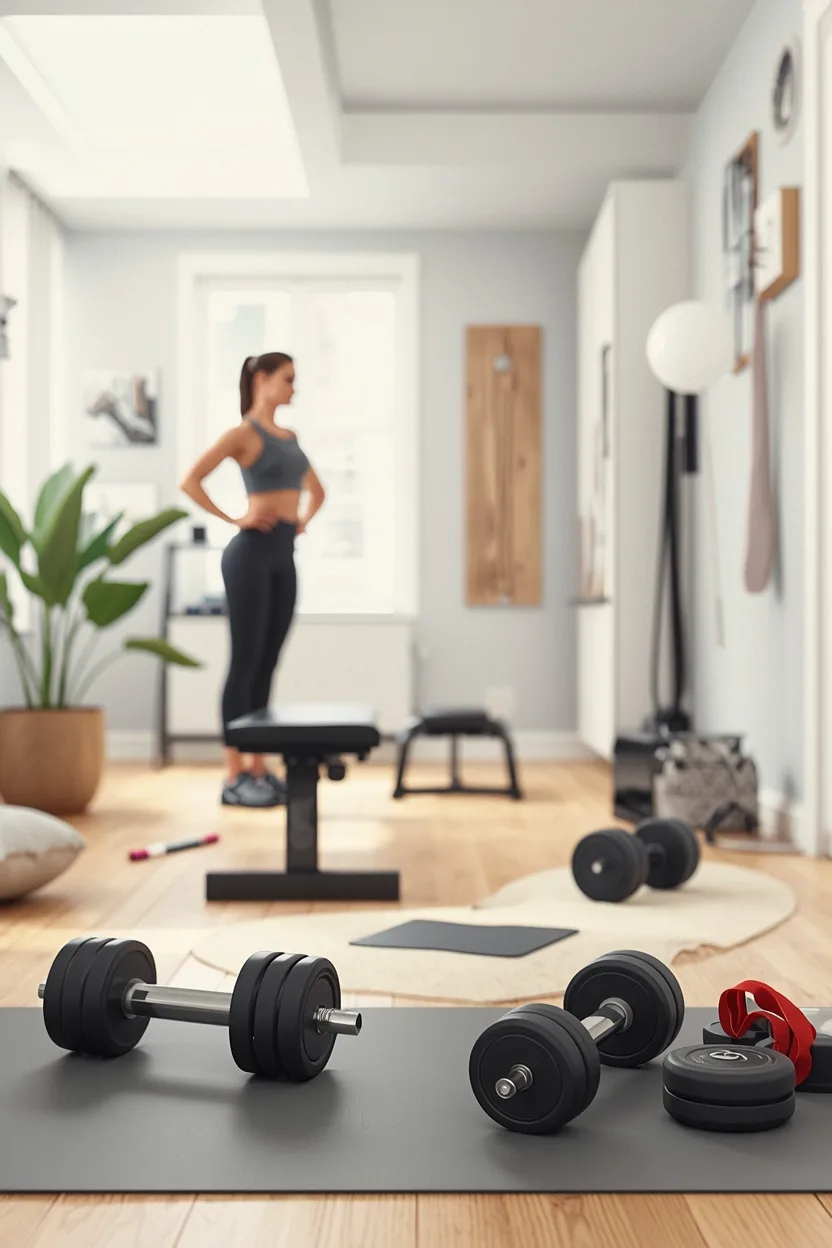
Starting a home workout routine does not require turning a spare room into a fully equipped gym. For most beginners, a small collection of versatile equipment is enough to train the major movement patterns, build strength, improve fitness, and create a routine that can actually fit into everyday life.
The challenge is knowing what is genuinely useful and what can wait.
A pair of dumbbells may be more valuable than a shelf full of specialized equipment. Resistance bands can add pulling and pressing options without taking up much space. A workout mat can make floor exercises more comfortable, while a stable bench or step can expand your exercise choices later.
This guide breaks down the best home workout equipment for beginners, what each item is useful for, what you can skip initially, and how to build a practical home setup without overspending.
Quick Answer: What Equipment Does a Beginner Actually Need?
If you are starting from scratch, you can begin with:
- Exercise mat — for floor exercises, mobility, core work, and general comfort.
- Resistance bands — inexpensive, portable, and useful for rows, presses, pulls, and lower-body exercises.
- A pair of dumbbells — one of the most versatile options for progressive strength training.
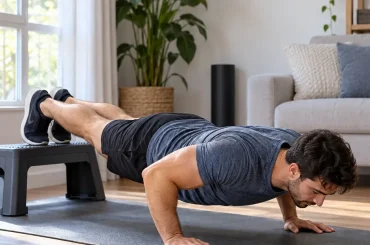
- A sturdy step or bench — useful for step-ups, split squats, supported exercises, and additional dumbbell movements.
- A jump rope or other cardio option — optional, depending on your goals and preferences.
You do not need all five on day one.
If your budget is limited, start with a mat and one form of resistance, such as bands or dumbbells. Add equipment only when you can identify an exercise or training limitation that the new item solves.
What Makes Home Workout Equipment Beginner-Friendly?
Good beginner equipment should do more than look impressive.
Ideally, it should be:
- Versatile: useful for several exercises rather than just one.
- Easy to learn: suitable for practicing basic movement patterns.
- Appropriately challenging: allows you to progress as you become stronger.
- Easy to store: particularly important in apartments and smaller homes.
- Safe and stable: equipment should not introduce unnecessary balance or setup problems.
- Realistically priced: a beginner should not need a large investment to start exercising.
- Compatible with your routine: equipment that remains packed away in a closet is unlikely to help your consistency.
This is also why simple equipment often makes more sense than buying a complete home gym immediately.
The American College of Sports Medicine’s 2026 resistance-training guidance emphasizes that effective resistance training does not depend on complicated programs or a particular type of equipment. Its updated position stand reviewed evidence across resistance-training approaches for healthy adults and highlighted consistency and individualized training as important considerations.
1. Exercise Mat
An exercise mat is one of the simplest additions to a home workout area.
It does not make an exercise more effective by itself, but it can make floor-based training more comfortable and give you a defined workout space.
Useful for
- Glute bridges
- Dead bugs
- Planks
- Bird dogs
- Floor-based mobility
- Stretching
- Kneeling exercises
- Yoga-style movement
What to look for
You do not necessarily need the thickest mat available. Look for a surface that provides enough cushioning for your knees, elbows, and back while remaining stable during standing exercises.
If your workouts are primarily strength-focused, a durable exercise mat with a non-slip surface is generally more useful than an extremely soft mat.
Beginner tip
Keep the mat somewhere visible if possible.
The goal is to reduce the number of steps between thinking, “I should exercise,” and actually starting.
2. Resistance Bands
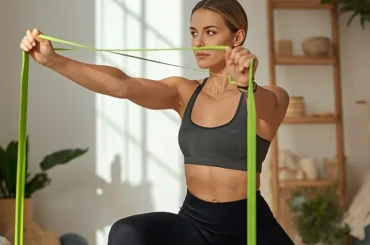
Resistance bands are among the most practical pieces of beginner home workout equipment because they take up very little space and can provide resistance for both upper- and lower-body exercises.
They are particularly useful when you do not yet have room or budget for a larger collection of weights.
The CDC specifically recognizes resistance bands, weights, and bodyweight exercises as examples of muscle-strengthening activities.
Exercises you can do with resistance bands
| Movement | Example Exercise | Main Focus |
|---|---|---|
| Pull | Band row | Upper back |
| Press | Band chest press | Chest and triceps |
| Hinge | Band good morning | Hips and hamstrings |
| Squat | Banded squat | Legs and glutes |
| Abduction | Lateral band walk | Hip muscles |
| Curl | Band biceps curl | Biceps |
| Extension | Band triceps extension | Triceps |
Resistance bands are also convenient for travel because they can fit into a small bag.
Loop bands vs. tube bands
Loop bands are particularly useful for lower-body exercises and lateral movements.
Tube bands with handles can be convenient for rowing, pressing, curls, and other upper-body movements.
You do not necessarily need both types immediately. Choose the style that matches the exercises you are most likely to perform.
Safety point
Inspect bands regularly for cracks, tears, or significant wear. When anchoring a band, make sure the anchor point is appropriate and secure before applying substantial tension.
3. Dumbbells
If you eventually want to build a more complete home strength-training setup, dumbbells are one of the most useful investments.
They allow you to add external resistance to many fundamental movements without requiring a large machine.
Beginner-friendly dumbbell exercises
- Goblet squats
- Romanian deadlifts
- Dumbbell rows
- Floor presses
- Shoulder presses
- Biceps curls
- Triceps extensions
- Split squats
- Calf raises
- Farmer carries
Dumbbells can also be used individually, which creates additional options for unilateral exercises.
Fixed vs. adjustable dumbbells
Fixed dumbbells
Pros:
- Simple
- Quick to use
- No adjustment mechanism
- Easy to grab during a circuit
Cons:
- Multiple weights require more storage
- The cost increases as your collection grows
Adjustable dumbbells
Pros:
- Several resistance levels in one system
- More space-efficient
- Useful as your strength develops
Cons:
- Usually more expensive initially
- Adjustment mechanisms can make transitions slower
- Some designs are less convenient for certain exercises
For someone with limited space, adjustable dumbbells can make sense. For someone who prefers simplicity and has enough storage, fixed dumbbells can be perfectly practical.
How heavy should beginner dumbbells be?
There is no single weight that is appropriate for every beginner.
Your starting resistance depends on the exercise, your current strength, technique, and training history.
The better approach is to choose a load that allows you to perform the exercise with controlled technique while still making the final repetitions meaningfully challenging.
Do not choose a weight simply because it is marketed as a “beginner weight.”
4. A Stable Bench or Step
A bench is useful, but it is not an essential first purchase.
If you have a sturdy, stable platform that is appropriate for the exercise, you may already have alternatives for some movements. However, a purpose-built adjustable bench can make a home strength setup considerably more versatile.
What a bench can add
- Dumbbell bench press
- Supported dumbbell rows
- Step-ups, if the surface is specifically designed for them
- Split-squat variations
- Seated shoulder presses
- Additional exercise positions
What to check before buying
Look for:
- A stable base
- Appropriate weight capacity
- A surface that does not wobble
- A height suitable for your intended exercises
- Enough room to move safely around it
Do not use an unstable household chair or makeshift platform for exercises that place significant load or movement demands on it.
For simple chair-based strength movements, the NHS recommends using a solid, stable chair without wheels that will not slip. It also recommends building up gradually rather than trying to progress too quickly.
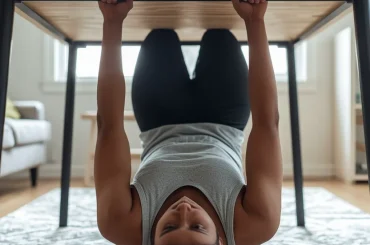
5. Pull-Up Bar
A pull-up bar can become a valuable addition once you are ready to train vertical pulling movements.
However, it is not necessarily a beginner priority.
Pull-ups are demanding for many people who are new to strength training. You can develop pulling strength with resistance bands, dumbbell rows, and other movements before working toward unassisted pull-ups.
If you buy one
Pay particular attention to installation and load requirements.
A pull-up bar should be securely installed according to the manufacturer’s instructions. Avoid improvising with unsuitable doorframes, loose hardware, or unstable mounting points.
Beginner alternatives
Before attempting full pull-ups, consider:
- Resistance-band rows
- One-arm dumbbell rows
- Band pulldowns where a secure setup is available
- Assisted pull-up variations
- Scapular-control exercises
6. Kettlebell
A kettlebell can be useful for people who enjoy simple, dynamic workouts.
It is particularly suitable for movements such as:
- Goblet squats
- Deadlifts
- Carries
- Rows
- Controlled kettlebell swings after learning the required technique
The important distinction is that a kettlebell does not automatically make a workout better.
For a beginner who has no equipment, dumbbells and resistance bands may cover more basic training needs. A kettlebell becomes more worthwhile when you specifically want to use kettlebell-based training.
Be careful with swings
Kettlebell swings are not simply a matter of lifting the weight with your arms. They involve a hip-hinge movement and require appropriate technique.
Learn the hinge pattern first and start with a manageable resistance rather than trying to make the exercise explosive immediately.
7. Jump Rope
A jump rope is an inexpensive cardio option, but it is not essential for everyone.
It can provide a convenient way to add vigorous movement to a home routine. However, jumping is not the right choice for every person or every living environment.
Consider:
- Your current fitness level
- Joint comfort
- Available ceiling height
- Flooring
- Noise
- Whether you actually enjoy jumping
If jumping is uncomfortable or impractical, brisk walking, cycling, marching, or other aerobic activities can serve the same broader purpose of increasing physical activity.
8. Workout Timer
A timer is optional, but it can be surprisingly useful.
You can use a phone or basic timer to structure:
- Work intervals
- Rest periods
- Circuit workouts
- Mobility sessions
- Short workouts during busy days
You do not need a dedicated fitness smartwatch or expensive timer.
For beginners, the simplest system is often enough: set the workout, put the phone somewhere safe, and focus on the exercise rather than constantly checking the clock.
The Best Beginner Home Gym Setup by Budget
You do not need to purchase everything at once.
| Setup | Equipment | Best For |
|---|---|---|
| No-cost | Bodyweight + walking | Absolute beginners |
| Minimal | Mat + resistance bands | Small spaces and limited budgets |
| Basic strength | Mat + dumbbells | Building a simple strength routine |
| Versatile | Mat + bands + dumbbells | Most general home workouts |
| Expanded | Bands + dumbbells + bench + cardio option | More exercise variety |
| Advanced home setup | Multiple weights + bench + specialized equipment | Experienced users with dedicated space |
The versatile setup is a particularly practical middle ground: a mat, resistance bands, and dumbbells can cover a wide range of exercises without requiring a dedicated gym room.
What Equipment Can Beginners Skip?
Some equipment looks useful but does not need to be part of your initial setup.
Weight machines
Large machines can be excellent for specific training goals, but they are expensive and consume considerable space.
They are not necessary for someone who is simply trying to establish a basic home strength routine.
Ab machines
You do not need a specialized machine to train your core.
Exercises such as planks, dead bugs, bird dogs, carries, and appropriately selected resistance exercises can contribute to core training.
Balance trainers
Balance equipment can have legitimate uses, but it is not a priority for most beginners whose main goal is to establish basic strength and movement capacity.
Large cardio machines
A treadmill, elliptical, rowing machine, or stationary bike can be useful if you genuinely enjoy using one and have the space.
But do not buy a large machine simply because you assume a “real” home gym needs one.
Walking is already a practical form of aerobic activity.
How to Choose Equipment Based on Your Goal
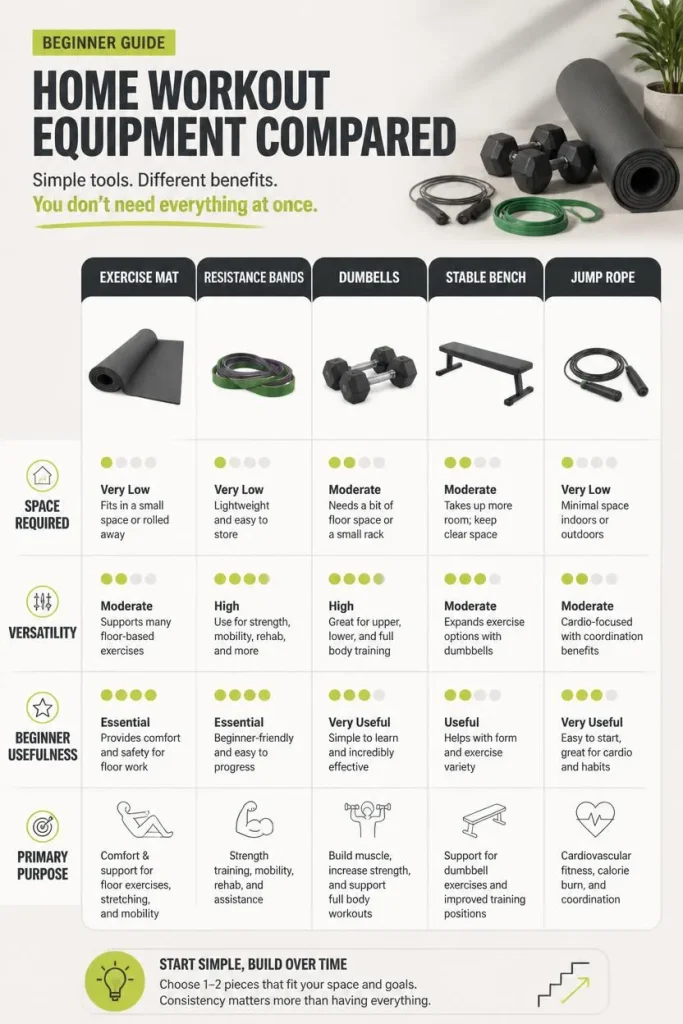
Your equipment should follow your training goal rather than the other way around.
| Goal | Useful Starting Equipment |
|---|---|
| General fitness | Mat + bands |
| Beginner strength | Dumbbells + mat |
| Muscle building | Adjustable dumbbells + bench + bands |
| Small-space workouts | Bands + compact dumbbells |
| Home cardio | Jump rope or preferred cardio option |
| Full-body training | Dumbbells + bands + mat |
| Travel workouts | Resistance bands |
| Learning basic movement | Mat + bodyweight |
There is considerable overlap. You do not need a separate piece of equipment for every goal.
A Simple Beginner Workout Using Basic Equipment
Once you have a mat, resistance bands, or dumbbells, you can build a straightforward full-body workout.
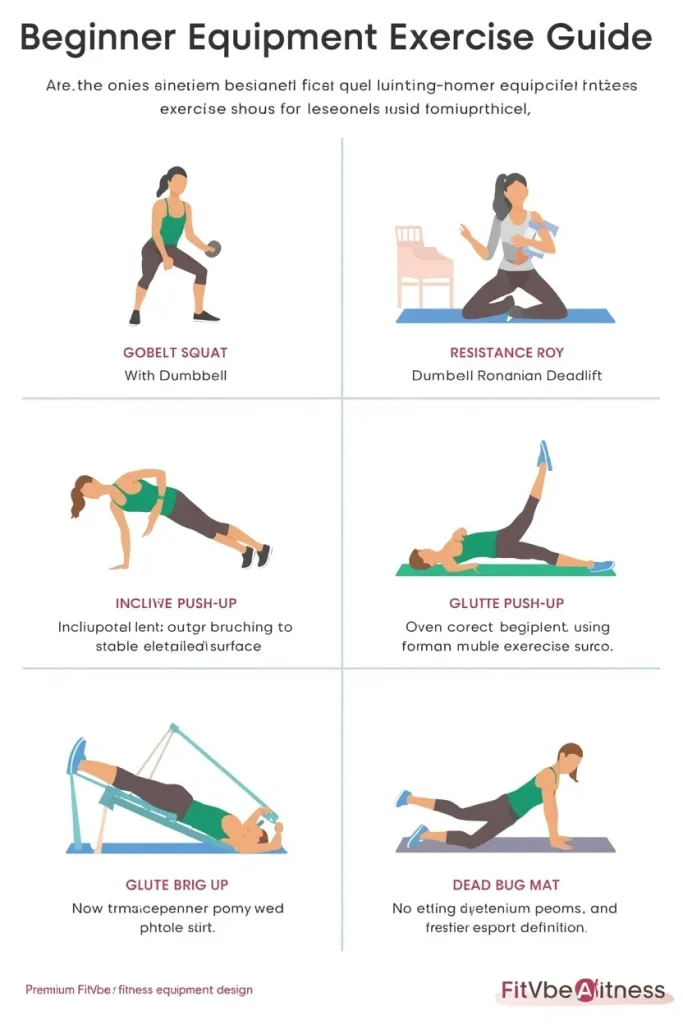
Beginner full-body session
1. Squat variation
8–12 controlled repetitions
Choose bodyweight squats, chair squats, or goblet squats depending on your ability.
2. Push variation
8–12 repetitions
Try wall push-ups, incline push-ups, or dumbbell floor presses.
3. Pull variation
8–12 repetitions
Use a resistance-band row or dumbbell row.
4. Hip-hinge movement
8–12 repetitions
A bodyweight hip hinge or light dumbbell Romanian deadlift can help you practice the movement.
5. Core exercise
Controlled repetitions or a short hold
Try dead bugs, bird dogs, or an appropriately modified plank.
Start conservatively rather than trying to exhaust yourself.
For adults, current physical-activity guidance recommends at least 150 minutes of moderate-intensity aerobic activity per week, or 75 minutes of vigorous activity, plus muscle-strengthening activity on at least two days per week. The CDC also recognizes weights, resistance bands, and bodyweight exercises as muscle-strengthening activities.
If you are still establishing your routine, FitVibe’s How Often Should Beginners Work Out at Home? can be linked here for a deeper discussion of workout frequency and recovery.
How to Progress Without Constantly Buying More Equipment
One of the biggest beginner mistakes is assuming progress requires purchasing heavier or more sophisticated equipment every few weeks.
It does not.
You can make an exercise more challenging by gradually changing variables such as:
- Resistance
- Repetitions
- Sets
- Range of motion
- Exercise variation
- Tempo
- Rest periods
- Exercise control
For example, you might progress from:
Wall push-up → incline push-up → modified floor push-up → standard push-up
Similarly:
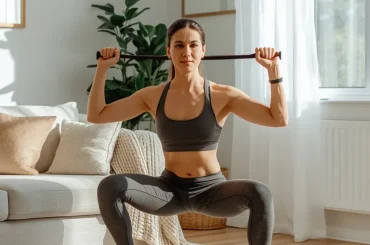
Bodyweight squat → goblet squat → heavier goblet squat → more challenging squat variation
Progress should be gradual and appropriate to your ability.
The 2026 ACSM resistance-training guidance found that complicated programming and particular equipment types are not prerequisites for effective resistance training in healthy adults.
Common Home Workout Equipment Mistakes
| Mistake | Why It Can Be a Problem | Better Approach |
|---|---|---|
| Buying everything immediately | High cost and clutter | Start with versatile basics |
| Choosing weights that are too heavy | Technique can deteriorate | Start manageable and progress |
| Buying equipment without a plan | Equipment may remain unused | Identify exercises first |
| Ignoring storage | Clutter makes workouts harder to start | Choose compact equipment |
| Using unstable furniture | Increased safety risk | Use stable, appropriate equipment |
| Chasing specialized gadgets | Adds complexity without solving a need | Prioritize fundamental movements |
| Changing equipment constantly | Makes progression harder to track | Keep a simple setup for several weeks |
The best equipment is not necessarily the equipment with the most features.
It is the equipment that helps you perform useful exercises consistently.
A Beginner Home Gym Checklist
Before buying anything, use this checklist:
Start with the basics
- I have enough clear floor space to exercise safely.
- I have comfortable workout clothing and suitable footwear when needed.
- I have a stable surface for floor exercises.
- I can perform basic bodyweight movements.
- I know which exercises I want the equipment to support.
- I have somewhere safe to store the equipment.
If buying resistance equipment
- The resistance is appropriate for my current ability.
- I can progress gradually.
- The equipment is stable and undamaged.
- I understand how to use it correctly.
- I am not buying it simply because it is popular online.
Before each workout
- Clear the workout area.
- Check equipment for damage.
- Warm up appropriately.
- Use controlled technique.
- Stop if something causes significant or unusual pain.
A Practical Weekly Routine for Beginners
Equipment becomes useful when it supports a consistent schedule.
A simple starting week could look like this:
| Day | Activity |
|---|---|
| Monday | Full-body strength |
| Tuesday | Walking or light activity |
| Wednesday | Full-body strength |
| Thursday | Easy movement or recovery |
| Friday | Optional strength session |
| Saturday | Walking, cycling, or recreational activity |
| Sunday | Rest or gentle movement |
You do not need to follow this exact schedule.
The CDC recommends that adults work toward at least 150 minutes of moderate-intensity aerobic activity each week, alongside muscle-strengthening activity on at least two days. Activity can be spread across the week rather than completed in one long session.
If you are starting from a very low activity level, build gradually rather than trying to reach the full recommendation immediately.
For beginners who need help structuring their first sessions, FitVibe’s What to Do on Your First Day Working Out at Home is a natural related resource to link here.
What If You Have Very Little Space?
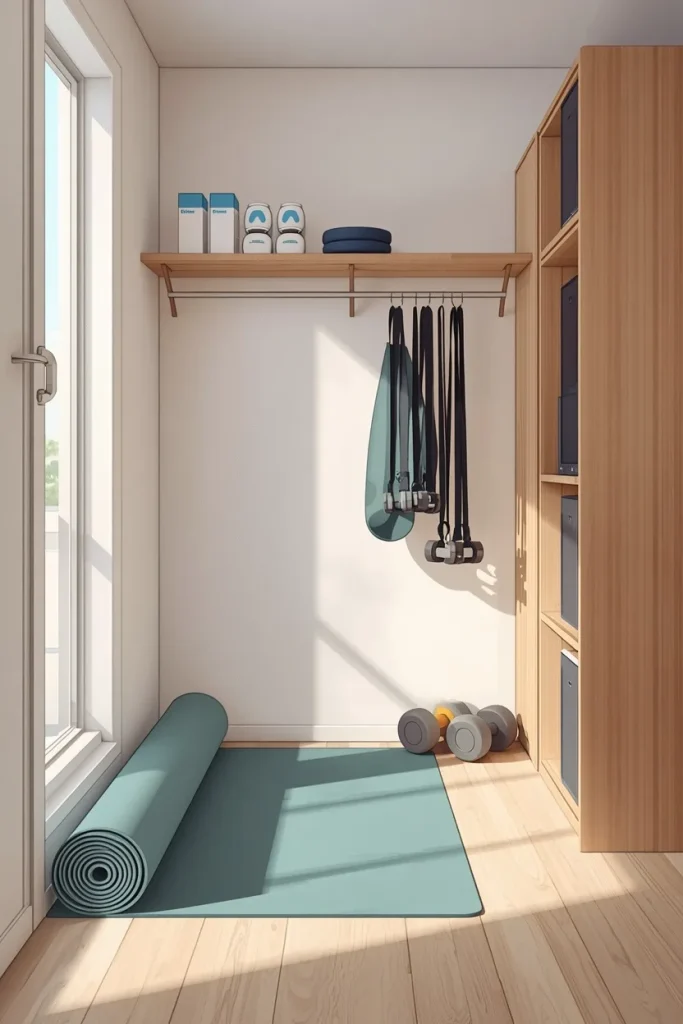
You can still create an effective workout area.
A small-space setup might consist of:
Mat + resistance bands + one pair of dumbbells
Store the bands in a drawer or small container and keep the dumbbells somewhere accessible.
You do not need a rack, large bench, weight plates, or multiple machines unless your training eventually requires them.
If you live in an apartment, also consider noise. Jumping, dropping weights, or using heavy equipment on hard flooring may disturb other people.
A quieter routine using bands, controlled dumbbell exercises, bodyweight movements, and walking can be much easier to maintain.
For readers interested in creating a more dedicated home workout space, link naturally to FitVibe’s How to Design a Practical Garage Gym here.
What If You Are Completely New to Exercise?
Start with movement quality rather than equipment.
Before adding significant resistance, learn basic patterns such as:
- Squatting
- Hip hinging
- Pushing
- Pulling
- Lunging
- Carrying
- Bracing your core
Once you can perform these movements with reasonable control, equipment becomes a tool for gradually increasing the challenge.
If you are returning to exercise after a long period of inactivity, starting with shorter, easier sessions is reasonable. The NHS recommends building up slowly and gradually increasing repetitions over time in its beginner strength exercises.
For readers who want additional guidance before beginning, link to How Often Should Beginners Work Out at Home? after this section.
Frequently Asked Questions
What is the best home workout equipment for a beginner?
A mat, resistance bands, and a pair of appropriately chosen dumbbells are a practical starting point for many beginners. You can add a bench, pull-up bar, kettlebell, or cardio equipment later based on your goals.
Can I build strength at home without equipment?
Yes. Bodyweight exercises can provide resistance, and resistance bands are another simple option. As your strength improves, adding external resistance can provide additional progression opportunities. The CDC includes bodyweight exercises, resistance bands, and weights among examples of muscle-strengthening activities.
Are dumbbells or resistance bands better for beginners?
Neither is universally better. Bands are compact and versatile, while dumbbells provide straightforward external loading for many exercises. Your available space, budget, goals, and preferred exercises should guide the choice.
Do I need a bench for a home gym?
No. A bench is useful but not essential. Many beginner exercises can be performed standing, on the floor, or with appropriate bodyweight modifications.
How much home workout equipment should I buy?
Start with the smallest setup that allows you to perform the workouts you actually plan to do. Add equipment when you encounter a genuine training limitation rather than buying an entire gym immediately.
Can home workouts help with fat loss?
Home workouts can contribute to an active lifestyle and help you perform resistance and aerobic exercise. Fat loss, however, depends on overall energy balance and is influenced by nutrition, activity, sleep, and other individual factors. Equipment itself does not cause fat loss.
Should I buy expensive equipment if I am a beginner?
Not necessarily. Expensive equipment can be useful for specific goals, but beginners can establish a strong foundation with relatively simple equipment.
Safety: Use Equipment That Matches Your Ability
Exercise should challenge you without requiring reckless progression.
Start with manageable resistance and spend time learning the movement before increasing the load.
Pay particular attention to:
- Stable footing
- Secure equipment
- Adequate workout space
- Controlled movements
- Proper setup
- Gradual progression
Stop exercising if you experience significant pain, dizziness, fainting, chest discomfort, or unusual shortness of breath.
If you have a chronic health condition, disability, significant physical limitation, or uncertainty about whether vigorous exercise is appropriate for you, discuss an appropriate activity plan with a healthcare professional or qualified exercise professional. CDC guidance specifically recommends discussing appropriate activity with a healthcare professional for people with chronic conditions and certain other circumstances.
The Bottom Line
The best home workout equipment for beginners is not the biggest collection or the most expensive setup.
Start with equipment that makes fundamental exercises easier to perform and progress:
Mat → resistance bands → dumbbells → optional bench → specialized equipment
If you are starting with almost nothing, that is completely fine. Bodyweight training and walking can give you a foundation while you decide what equipment genuinely fits your routine.
The most useful purchase is ultimately the one that supports a workout you will actually do.
Save This Guide
Minimal setup: Mat + resistance bands
Strength-focused setup: Mat + dumbbells
Versatile setup: Mat + bands + dumbbells
Expanded setup: Add a stable bench
Cardio option: Walking, cycling, jump rope, or another activity you enjoy
Progression: Increase challenge gradually
Priority: Consistency, technique, and sustainability
You do not need a perfect home gym to begin. You need enough space, a manageable plan, and equipment that solves a real training need.