
Returning to Exercise After 3+ Months Away is a different situation than starting from zero, and it’s a different situation than missing a week or two. Your body has lost a meaningful amount of conditioning, but it hasn’t forgotten how to move — and treating a comeback like either a fresh start or a quick return to where you left off tends to cause the same problem: unnecessary soreness, frustration, or injury in the first two weeks back.
This guide is specifically about that gap — the physiology of what’s changed during your time away, and a structured, week-by-week progression for closing it safely. It isn’t a general beginner program, a single first-workout walkthrough, or a time-boxed routine; it’s built around one problem: how to re-enter training after a real break without re-injuring yourself or quitting again by week two.
Quick Takeaway
After 3+ months away, expect noticeably reduced strength and cardiovascular capacity compared to where you left off — but a faster return than a true beginner experiences, since your body retains some structural and neurological adaptations from before. The right approach is a phased return: roughly two weeks at reduced intensity to reacquaint your body with the movements, two weeks rebuilding toward your previous working loads, and then a gradual push back to your prior level — rather than jumping back in at the intensity you remember.
What Actually Happens During 3+ Months Off
It helps to know what you’re working against, because it explains why “just starting back at my old weights” backfires so often.
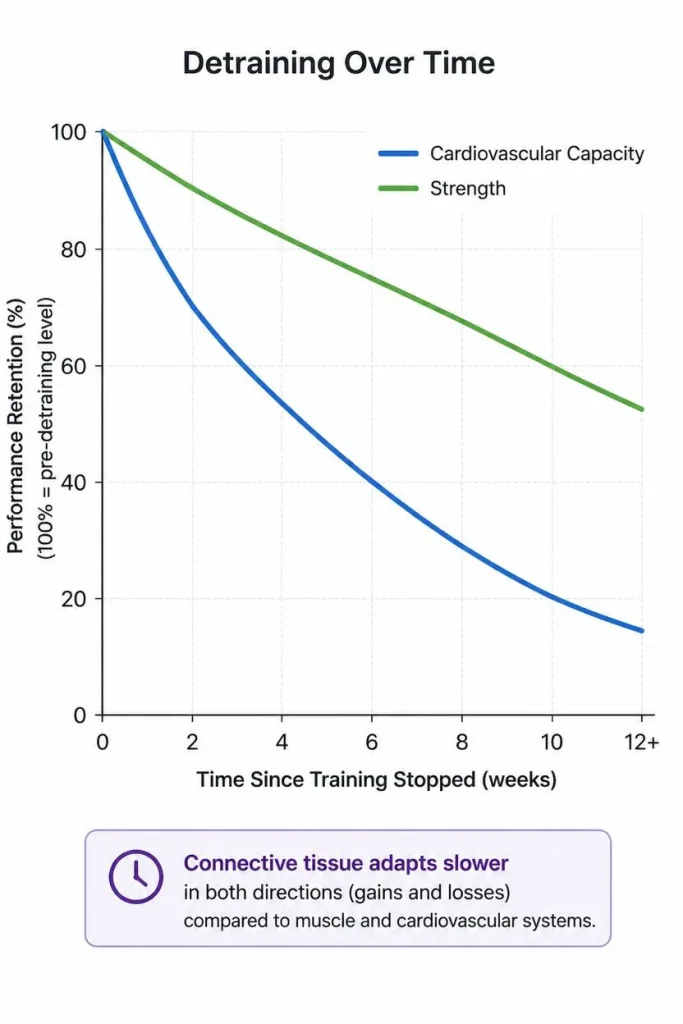
- Cardiovascular fitness declines relatively quickly. Research on detraining shows measurable reductions in cardiopulmonary function within just two weeks of stopping training, and the decline continues the longer the break lasts. After three-plus months, it’s reasonable to expect a noticeably lower capacity than you had at your peak.
- Strength declines more slowly than cardio fitness, but it does decline. Maximal strength tends to hold up somewhat better than endurance capacity over a period of weeks, but by the three-month mark, most people see a real, measurable drop in how much they can lift compared to their previous working weights.
- “Muscle memory” is real, but it’s not instant. Resistance-trained muscle retains some of its cellular adaptations (including myonuclei, which support muscle fiber function) even after a layoff, which is a big part of why returning lifters tend to rebuild strength faster than someone training those muscles for the first time. This is a genuine advantage — but it’s a reason you’ll likely progress faster through the early weeks, not a reason to skip them.
- Your joints and connective tissue adapt more slowly than your muscles do. This is the part that catches people out: your muscles might feel ready to lift close to your old numbers within a couple of weeks, while tendons and connective tissue are still behind. This mismatch is a common source of overuse injuries in people returning from a break.
The Core Mistake: Training Like No Time Passed
The single most common error after a long break is using pre-break numbers as the starting point — the same weights, the same running pace, the same class intensity. Because strength and movement patterns feel partially familiar almost immediately, it’s easy to assume the rest of your capacity has come back just as fast. It hasn’t, and the mismatch between what feels familiar and what your cardiovascular system and connective tissue can currently handle is exactly what produces excessive soreness, minor strains, and the kind of discouraging setback that ends a comeback in the first two weeks.
Not All Breaks Are the Same: What Caused Yours?
Before picking a starting point, it’s worth being specific about why you were away, because it changes how cautious the first phase should be.
| Reason for the Break | What’s Different | Adjustment to the Plan Below |
|---|---|---|
| Life got busy / lost the habit (no health event) | Detraining is the only factor at play | Follow the three-phase progression below as written |
| Illness or infection (including anything requiring bed rest) | Cardiovascular and immune recovery may lag behind how you feel day-to-day | Add 3–5 extra days to Phase 1 and watch resting heart rate and fatigue closely |
| Injury or surgery | The injured area may have additional, localized deconditioning beyond general detraining | Get specific clearance from a doctor or physical therapist before starting, and expect that area to need its own slower sub-progression |
| Pregnancy and postpartum | Involves tissue and joint changes beyond standard detraining, plus recovery from delivery | Follow postpartum-specific medical guidance and clearance before using this general progression |
| High stress period, poor sleep, but still somewhat active informally | Detraining is likely less severe than a fully sedentary break | You may be able to compress Phase 1 to one week if early sessions feel genuinely easy |
If your break involved any medical event, treat the phase percentages in this guide as a general framework to discuss with your provider, not a substitute for their specific clearance and guidance.
A Phased Return-to-Training Progression
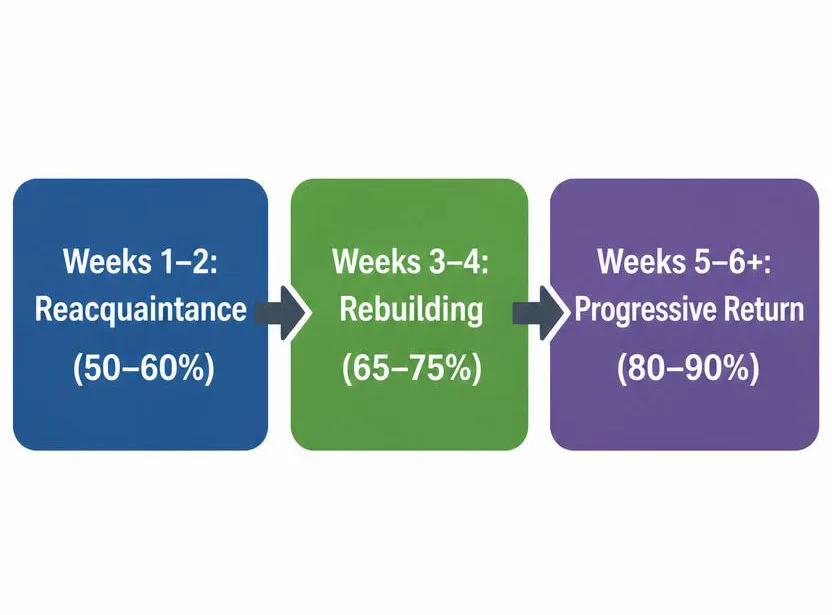
This progression is built around three phases rather than a single flat program, because the goal in each phase is different.
Which Phase Should You Actually Start In?
Most people returning after 3+ months should start at Phase 1 regardless of how fit they feel right now, but a short honest checklist helps confirm that:
- [ ] It’s been 3 or more months since your last consistent training period
- [ ] You haven’t tested a near-maximal lift or hard effort since before the break
- [ ] You’re not currently nursing an injury that needs separate clearance
- [ ] You’d describe your current activity level as “mostly sedentary” over the break
If all four are true, start at Phase 1 as written. If you’ve actually stayed moderately active (regular walking, occasional bodyweight sessions, recreational sports) throughout the break, you may be able to start at the upper end of Phase 1’s intensity range or move through it slightly faster — but still pass through it rather than skipping straight to Phase 2.
Phase 1: Reacquaintance (Weeks 1–2)
Goal: Re-establish movement patterns and routine without generating excessive soreness or fatigue.
- Train at roughly 50–60% of your remembered previous effort — lighter weights, shorter distances, or lower-intensity versions of what you used to do.
- Keep sessions to 2–3 per week, full-body, with at least one rest day between sessions.
- Stop sets with several clean repetitions left in reserve — this is not the phase to test your limits.
- Expect some muscle soreness in the first week; this is a normal response to resuming activity after a layoff; what you’re managing for is excessive soreness that limits normal movement for several days.

Sample Phase 1 full-body session:
| Exercise | Sets x Reps | Notes |
|---|---|---|
| Bodyweight squat | 2 x 10–12 | Focus on full range of motion, not speed |
| Incline or knee push-up | 2 x 8–10 | Choose the version that allows clean form |
| Supported row (band or light dumbbell) | 2 x 10–12 | Light load — this is about re-grooving the movement |
| Glute bridge | 2 x 12–15 | Low-impact, good reintroduction for the posterior chain |
| Walking | 15–20 minutes | Separate from strength session or on off days |
Phase 2: Rebuilding (Weeks 3–4)
Goal: Progress load and volume while your cardiovascular system and connective tissue catch up to your muscles.
- Increase to roughly 65–75% of your previous working loads.
- Add a third set to your main movements if recovery from Phase 1 was smooth.
- Introduce one additional training day if your schedule allows (3–4 sessions per week).
- Begin layering in light cardio intervals rather than only steady walking, if cardiovascular conditioning is part of your previous training background.
Sample Phase 2 full-body session:
| Exercise | Sets x Reps | Notes |
|---|---|---|
| Goblet squat or loaded squat | 3 x 10–12 | Add external load if Phase 1 bodyweight sets felt easy |
| Standard push-up or dumbbell floor press | 3 x 8–10 | Progress from the incline/knee version used in Phase 1 |
| Dumbbell or cable row | 3 x 10–12 | Moderate load — working weight, not maximal |
| Romanian deadlift or hip hinge | 2–3 x 10–12 | Introduces posterior-chain loading beyond the bridge |
| Plank | 2 x 20–30 seconds | Reintroduce core bracing under light fatigue |
Phase 3: Progressive Return (Weeks 5–6 and Beyond)
Goal: Close the remaining gap to your previous performance level, without rushing the final stretch.
- Progress toward 80–90% of previous working loads, adding weight or intensity only when the previous session felt genuinely manageable with good form.
- This is typically the phase where people are tempted to “catch up all at once.” Resist that — the data on detraining suggests cardiovascular and connective tissue adaptations take longer to rebuild than the early strength gains suggest, so a steady weekly progression outperforms a sudden jump back to old numbers.
- By the end of this phase, most people returning from a 3+ month break are back to, or very close to, their previous baseline — but exactly how long this takes depends heavily on how long the break was and how trained you were before it.
Sample Phase 3 full-body session:
| Exercise | Sets x Reps | Notes |
|---|---|---|
| Barbell or loaded squat | 3–4 x 6–10 | Progress toward previous working weight across these weeks, not in one jump |
| Bench press or weighted push-up | 3–4 x 6–10 | Same gradual progression principle applies |
| Weighted row or pull-up | 3–4 x 6–10 | Reintroduce your previous pulling volume last, since pulling strength often lags slightly behind pushing in a comeback |
| Deadlift or loaded hinge | 3 x 6–8 | One of the better indicators of how close you are to baseline |
| Core work (your previous preference) | 2–3 sets | Return to your prior core routine once the main lifts feel stable |
Warming Up for a Comeback Session
A longer, more deliberate warm-up matters more during a comeback than it does once you’re fully back up to speed, precisely because connective tissue is the part still catching up. A reasonable structure:
- 2–3 minutes of easy general movement — walking, light cycling, or marching in place, enough to raise your heart rate slightly.
- 3–5 minutes of dynamic mobility for the joints you’ll load that day — leg swings and hip circles before a lower-body session, arm circles and band pull-aparts before an upper-body session.
- 1–2 light warm-up sets of your first main exercise, well below your working weight for that session, before loading up to the day’s actual working sets.
Skipping or rushing this is a common way people reintroduce the exact mismatch (muscles ready, connective tissue not) that the phased progression is designed to avoid.
Returning Cardio and Endurance Training
Strength numbers get most of the attention in comeback planning, but the same phased logic applies directly to running, cycling, swimming, or any cardio-based activity you’re returning to — arguably more so, since cardiovascular detraining happens faster than strength loss.
| Week | Walking/Running Example | General Guidance |
|---|---|---|
| 1–2 | Brisk walking, or run-walk intervals (1–2 min easy jog / 2–3 min walk) | Keep effort conversational; this mirrors Phase 1’s 50–60% effort guidance |
| 3–4 | Continuous easy jogging or cycling, 15–25 minutes | Mirrors Phase 2; add duration before adding pace |
| 5–6+ | Gradual return toward previous pace and distance | Mirrors Phase 3; increase weekly distance by no more than roughly 10% at a time |
The same connective-tissue lag that applies to lifting applies here too — shins, knees, and ankles are common trouble spots when runners return to their old mileage too quickly after a long break. Building duration before intensity, and distance before speed, is the more reliable order for this population specifically.
Supporting the Comeback: Sleep, Protein, and Hydration
None of the phased progression above works as intended if the basics around it are neglected — this is doubly true during a comeback, when your body is simultaneously adapting to renewed training stress and rebuilding lost conditioning.
- Sleep is when a lot of the adaptive work from each session actually happens. Treating sleep as a lower priority during the exact weeks you’re asking your body to re-adapt is a common way comebacks stall out through fatigue rather than injury.
- Protein intake supports the muscle-rebuilding side of the comeback the same way it supports muscle retention during a fat-loss phase — adequate intake spread across your day’s meals gives your body the raw material it needs to respond to the renewed training stimulus. If you’re rebuilding meals around this, a high-protein breakfast is a practical way to start the day ahead on that front.
- Hydration affects workout performance and recovery more than people tend to assume, particularly if your break also coincided with a period of lower general activity and correspondingly lower fluid intake.
None of this needs to be complicated or tracked to the gram — the point is that a comeback asks slightly more of these basics than a steady-state training period does, so they’re worth deliberately not letting slide during these first several weeks.
Managing Soreness and Fatigue
Some muscle soreness in the first one to two weeks is a normal, expected response to resuming exercise after time off — a phenomenon commonly called delayed-onset muscle soreness (DOMS), which typically peaks 24–72 hours after a session and resolves on its own within a few days. It is not, by itself, a sign that something has gone wrong.
What’s worth paying closer attention to:
- Soreness that significantly limits normal daily movement for more than 3–4 days
- Sharp or localized pain, as opposed to the general dull soreness of DOMS
- Soreness that gets worse, rather than better, across consecutive sessions — a sign the volume or intensity is outpacing your recovery
- Joint pain, rather than muscle soreness, which deserves more caution given how much more slowly connective tissue adapts
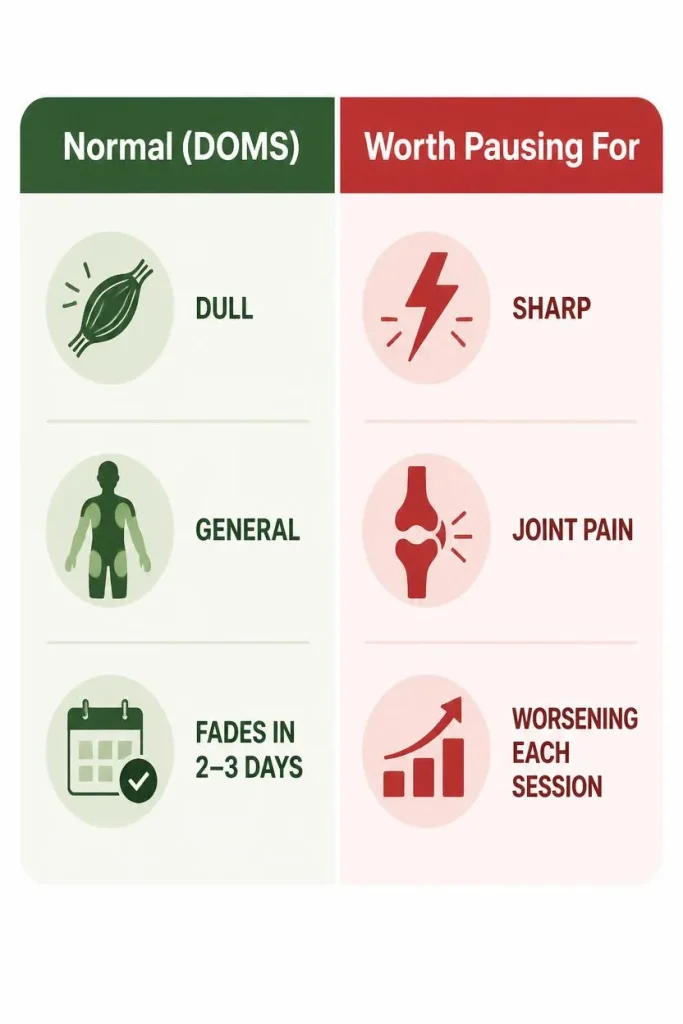
If you experience any of these, it’s a reasonable signal to extend your current phase rather than progress to the next one, or to check in with a doctor or physical therapist if pain persists or is sharp rather than generally achy.
A Sample Weekly Structure (Phase 1)
| Day | Activity |
|---|---|
| Monday | Phase 1 full-body session |
| Tuesday | Rest or short walk |
| Wednesday | Phase 1 full-body session |
| Thursday | Rest or short walk |
| Friday | Phase 1 full-body session |
| Saturday | Optional light activity |
| Sunday | Rest |
Shift this toward 3–4 strength sessions with lighter cardio days layered in as you move into Phase 2 and 3.
How to Know You’re Ready for the Next Phase
Rather than moving phases strictly by the calendar, check for all three of these before progressing:
- The previous phase’s sessions felt genuinely manageable, not just survivable, for at least the final week.
- Soreness resolved within 2–3 days after each session, rather than compounding session to session.
- Sleep and general energy levels were stable or improving, not declining, through the phase.
If one or two of these aren’t true yet, it’s generally better to repeat a week of your current phase than to push forward on schedule. The week-ranges given for each phase are a reasonable default pace, not a deadline.
Common Mistakes When Returning After a Long Break
| Mistake | Why It Happens | Better Approach |
|---|---|---|
| Starting at previous working weights or pace | Movement patterns feel familiar quickly, which masks how much cardio and connective-tissue capacity has actually dropped | Start at 50–60% of previous effort in Phase 1, regardless of how “ready” you feel |
| Training daily to “catch up faster” | Motivation is high right after deciding to restart | Keep rest days built in — they matter more, not less, after a long layoff |
| Treating any soreness as a red flag and stopping entirely | Uncertainty about what’s normal after time off | Expect mild, general soreness in week one; watch for sharp or joint pain instead |
| Ignoring the connective-tissue lag | Muscles recover capacity faster than tendons and joints do | Progress load gradually through all three phases, even if lifts feel easy sooner |
| Comparing week one to your old peak performance | Natural but discouraging comparison | Compare this week to last week, not to months ago |
| Increasing running mileage and lifting load at the same time | Both stress connective tissue, and combined load is easy to underestimate | Prioritize one domain’s progression at a time if you’re returning to both strength and cardio |
| Skipping the warm-up because “it’s a light session anyway” | Phase 1 sessions can feel too easy to warrant a full warm-up | Keep the full warm-up through all three phases — it protects the still-adapting connective tissue, regardless of session intensity |
Frequently Asked Questions
How long will it take to get back to where I was? It depends heavily on how long you trained before your break and how long the break itself lasted. Many people returning after 3+ months find they’re back near their previous baseline within 6–10 weeks of consistent, phased training, but this varies enough that it’s more useful to track your own week-to-week progress than to aim for a fixed date.
Will I lose all my progress after 3 months off? No — some of the adaptations behind your previous strength and movement skill are retained even after a layoff, which is why returning tends to go faster than starting from scratch. Cardiovascular fitness typically drops more than strength does, so expect that gap to feel larger in the first couple of weeks.
Is it safe to jump straight back into my old routine? It’s not recommended. The mismatch between how quickly muscles feel ready and how slowly cardiovascular capacity and connective tissue actually recover is the most common cause of injury or excessive soreness in people returning from a long break.
How sore should I expect to be? Mild to moderate general soreness in the first week, peaking around 24–72 hours after a session, is normal. Soreness that prevents normal daily movement for several days, or sharp/localized pain rather than general achiness, is worth treating as a signal to slow down.
Should I check with a doctor before starting back? If your break was due to an injury, surgery, pregnancy, or a health condition, or if you have any new symptoms, checking with a doctor before resuming structured exercise is a reasonable precaution. For a break with no underlying medical cause, this phased approach is generally considered a safe way to self-progress, but anyone with health concerns should still check in first.
What if I was very advanced before my break? The same phase structure still applies — the percentages are relative to your own previous numbers, whatever they were. A higher previous training level doesn’t exempt you from the detraining and connective-tissue-lag issues described above; if anything, the gap between what your muscles remember and what your joints can currently handle is often larger for previously advanced trainees.
Can I do strength training and cardio at the same time during the comeback? You can, but it’s worth being conservative about progressing both at once, since both place demands on the same recovering connective tissue and overall recovery capacity. A common approach is to progress one (often strength, since it was likely your primary focus before the break) slightly ahead of the other through Phases 1 and 2, then bring both up together in Phase 3.
What if I plateau partway through a phase and don’t feel ready to move on? That’s a normal and expected outcome for some people, not a sign the plan has failed. Repeat the current phase’s intensity for an additional week or two rather than advancing on the original schedule — the phase lengths given here are a typical pace, not a fixed requirement.
Do I need to retest my previous maxes before starting, so I know what percentages to use? No, and it’s generally not a good idea to test a near-maximal effort this early in a comeback. Use your memory of your previous working weights (the loads you trained with regularly, not a one-time best effort) as the reference point for the phase percentages instead.
Final Thoughts
A comeback after three-plus months away succeeds or fails less on willpower than on pacing. Your body isn’t starting from zero, but it also hasn’t kept pace with where your memory of your old routine says it should be — and the space between those two things is where most comeback injuries and burnout happen. Move through the three phases deliberately, let soreness and recovery guide how fast you progress rather than the calendar or your memory of your old numbers, and the gap closes faster than most people expect.
Sources & Further Reading
- Harvard T.H. Chan School of Public Health — Delayed Onset Muscle Soreness (DOMS)
- Research on detraining effects on cardiopulmonary function and muscular fitness in trained individuals
- Centers for Disease Control and Prevention — physical activity guidance on frequency and intensity of aerobic and muscle-strengthening activity