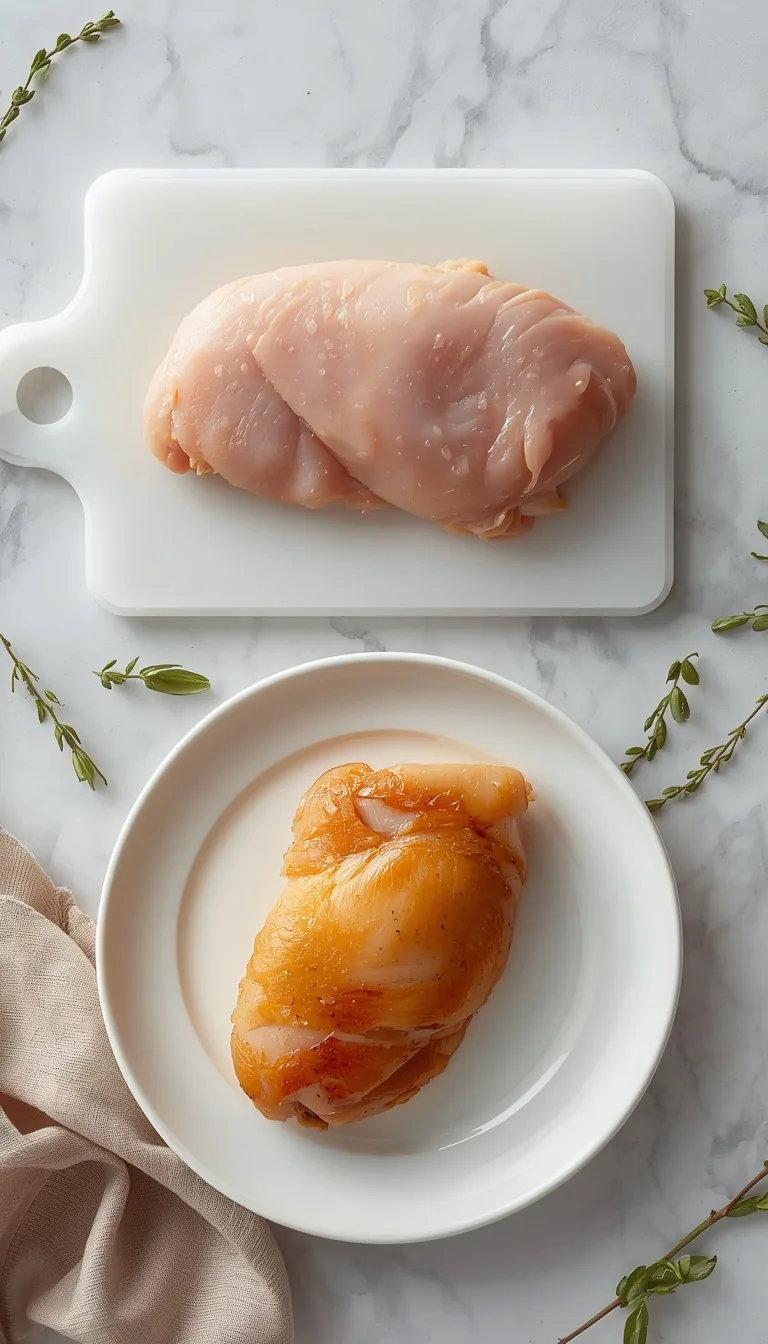
If you’ve ever looked up “chicken breast protein” and gotten two different answers depending on the source, you’re not imagining things. A raw chicken breast and the same chicken breast after cooking can show noticeably different protein numbers per 100 grams, and neither number is wrong. They’re just measuring different things.
This mismatch trips up a lot of people trying to hit a daily protein target, especially anyone tracking macros or building meals around a specific gram goal. Get the comparison wrong and you can end up under- or over-estimating your actual intake by a meaningful margin, day after day.
This guide (How to Compare Protein Content in Raw and Cooked Foods) explains exactly why raw and cooked protein numbers differ, how to compare them correctly, and how to stop the confusion from throwing off your tracking.
Quick Answer
Protein itself doesn’t change in quantity during cooking under normal conditions — what changes is the food’s weight, mostly due to water loss (or occasionally water gain). Since nutrition labels and food databases report protein per 100 grams of food, and cooking changes how much a given weight of food actually weighs, the per-100g protein number shifts even though the total protein in the piece of food stays roughly the same. The fix is simple: always check whether a protein number is reported on a raw or cooked basis, and compare like with like — or convert between them using a known yield percentage.
Why Raw and Cooked Protein Numbers Don’t Match
Protein is a stable macronutrient. Normal home cooking temperatures don’t destroy meaningful amounts of it or make it disappear. What cooking does change is the food’s total weight, and that’s the actual source of the confusion.
Water Loss Is the Main Driver
Most proteins — meat, poultry, fish, eggs — contain a significant amount of water. When you cook them, heat causes some of that water (along with some fat, in fattier cuts) to evaporate or render out. The food shrinks and gets lighter, but the protein inside it stays largely intact.
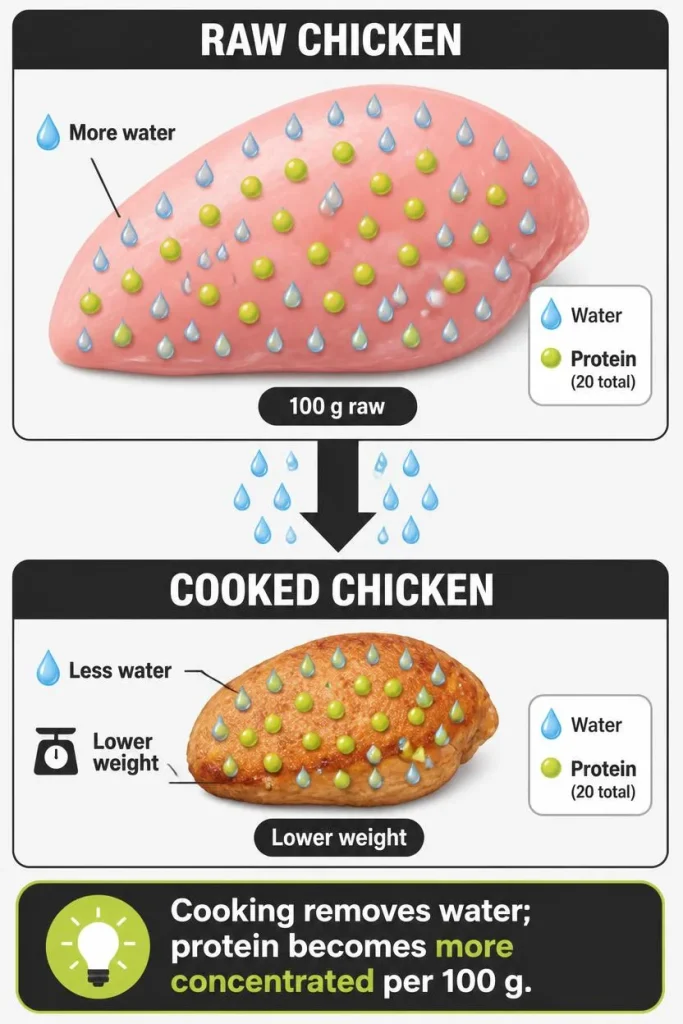
Here’s the key effect: if the same amount of protein is now packed into a smaller, lighter piece of food, the protein per 100 grams goes up, even though the total protein hasn’t increased at all.
A useful way to picture it: imagine a sponge soaked with water. Squeeze out some of the water, and the sponge gets smaller and denser, but you haven’t added more sponge material. The “sponge per cubic inch” number goes up because there’s less water diluting it, not because new sponge appeared.
Some Foods Gain Water Instead
Foods like rice, pasta, beans, lentils, and oats work in the opposite direction. These foods absorb water as they cook, which increases their total weight substantially. Since the same amount of protein is now spread across a larger, heavier portion, the protein per 100 grams actually goes down after cooking, even though — again — the total protein content hasn’t meaningfully changed.
This is why a package of dry lentils looks like it has far more protein per 100g than the same lentils once they’re cooked and have absorbed several times their dry weight in water.
How Food Databases Handle This
The USDA’s nutrient database system addresses this directly through what it calls retention and yield factors. When a cooked version of a food isn’t measured directly, its values are calculated from the raw version using a retention factor (the share of a nutrient that survives cooking) and a yield factor (how much the food’s weight changes during cooking). The raw per-100g value is adjusted by both factors to estimate the cooked per-100g value (USDA Agricultural Research Service, nutrient retention and yield methodology). This is exactly why raw and cooked entries for the same food can show meaningfully different numbers per 100 grams in food tracking apps and labels — they’re accounting for exactly the weight change described above.
Raw vs. Cooked Protein: What the Numbers Typically Look Like
The table below shows the general pattern for common high-protein foods. These are commonly cited approximate ranges rather than precise lab values — actual numbers vary by specific cut, cooking method, cooking time, and the exact product, so treat them as a general guide rather than an exact reference for any single piece of food you’re preparing.
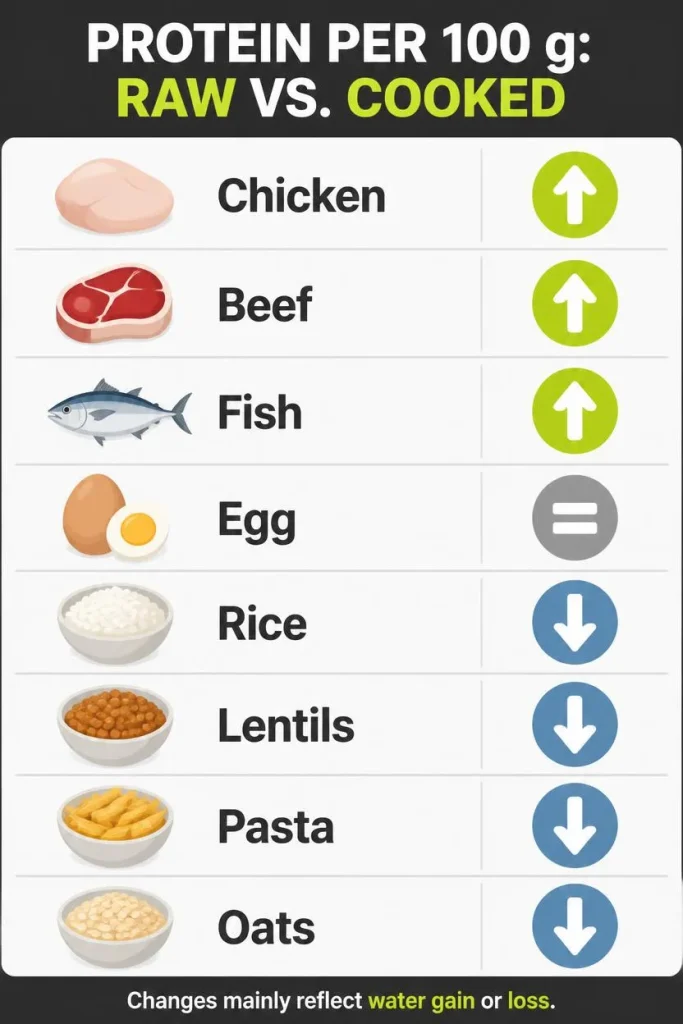
| Food | Typical Direction After Cooking | Why |
|---|---|---|
| Chicken breast | Protein per 100g increases | Loses water weight during cooking; protein becomes more concentrated |
| Beef (lean cuts) | Protein per 100g increases | Similar water-loss effect, plus some rendered fat in fattier cuts |
| Salmon and other fish | Protein per 100g increases slightly | Moderate water loss during cooking |
| Eggs | Protein per 100g stays roughly similar | Minimal weight change during cooking compared to meat |
| White rice | Protein per 100g decreases substantially | Absorbs several times its dry weight in water |
| Lentils and beans | Protein per 100g decreases substantially | Absorbs significant water during cooking |
| Pasta | Protein per 100g decreases substantially | Absorbs water, roughly doubling in weight |
| Oats | Protein per 100g decreases | Absorbs water when cooked (less dramatic than rice or pasta) |
The practical takeaway: for meat, poultry, and fish, cooked weight typically shows a higher protein number per 100g than raw weight of the same food. For grains and legumes, it’s the reverse — dry/raw weight shows a much higher number than the cooked, water-absorbed version.
Why Serving Basis Matters So Much
“Serving basis” simply means whether a nutrition number refers to the food raw, cooked, dry, or as part of a prepared dish. This single detail can change the apparent protein content of the same food by 20-40% or more, which is a large enough swing to meaningfully throw off daily tracking.
This matters in a few common real-world situations:
Meal planning from a recipe. Recipes often list ingredient weights in raw form (like “6 oz raw chicken breast”), but you eat the cooked portion. If you log the cooked weight but pull the protein number for raw chicken, you’ll underestimate how much protein is actually on your plate.
Comparing food labels to a database. Packaged food labels show nutrition per the product as sold, which may be raw (a raw chicken breast package) or ready-to-eat (a cooked rotisserie chicken). If you’re cross-referencing with a different database entry, mismatched serving basis is an easy way to get inconsistent numbers.
Portioning for meal prep. If you’re batch-cooking and portioning meals in advance, understanding this distinction helps you decide whether to weigh and log portions before or after cooking — and to stay consistent, since mixing the two approaches across different meals compounds the error. This is especially relevant if you’re building out a structured weekly meal-prep routine, where consistency in how you weigh and log food matters more than any single meal.
How to Actually Compare Protein Content Correctly
Follow these steps to avoid the most common mistakes:
Step 1: Identify the Serving Basis Before You Compare
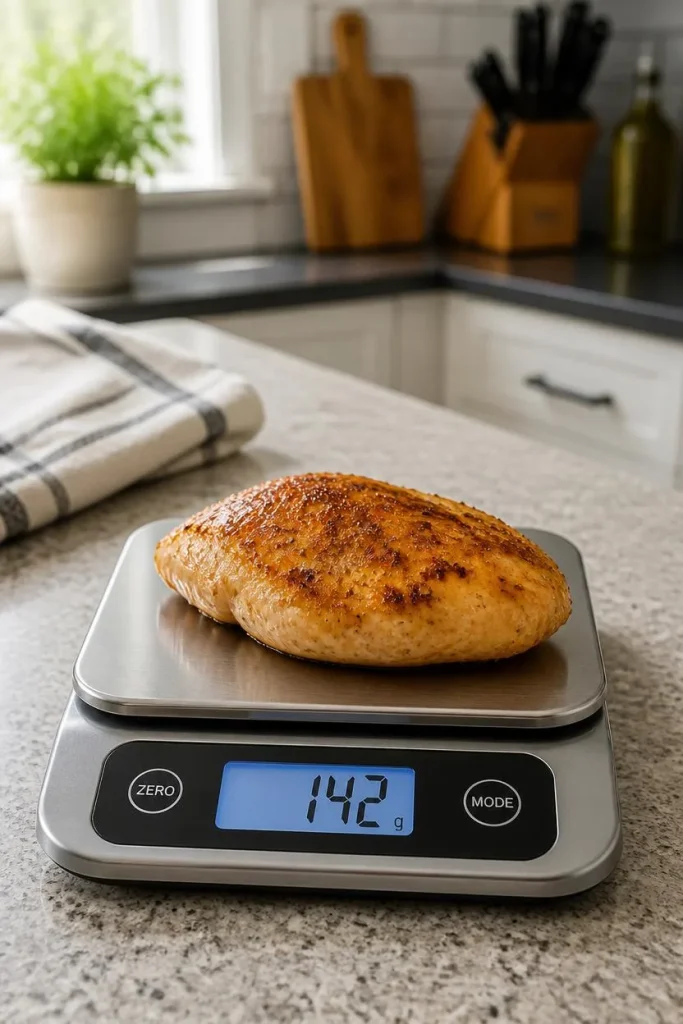
Before comparing two protein numbers, check whether each one is listed as raw, cooked, dry, or some other preparation state. Most reputable food databases label this directly (for example, “chicken breast, cooked, roasted” vs. “chicken breast, raw”).
Step 2: Match Your Weighing Method to Your Tracking Method
Pick one approach and stay consistent:
- Weigh raw, log raw values — weigh your protein source before cooking and use the raw nutrition data.
- Weigh cooked, log cooked values — weigh the finished, cooked portion and use the cooked nutrition data.
Either approach works. The error comes from mixing them — weighing cooked food but logging raw values, or vice versa.
Step 3: Use a Yield Percentage If You Need to Convert
If you only have one set of values (say, raw) but you’ve already cooked and weighed the food, you can estimate using a general yield percentage. Meat, poultry, and fish typically lose somewhere in the range of 20-30% of their raw weight during cooking, though this varies by cooking method and cut — grilling and roasting tend to cause more moisture loss than gentler methods like poaching.
As a rough example: if a raw chicken breast weighs 180 grams and you expect roughly 25% weight loss from roasting, the cooked portion would weigh approximately 135 grams. The total protein in that piece of chicken stays about the same whether you measure it raw or cooked — what changes is how that same protein amount is expressed per 100 grams of food, since the food now weighs less.
Step 4: Double-Check High-Stakes Numbers
If you’re closely tracking toward a specific daily protein target — particularly relevant if you’re working through a fat-loss plan built around preserving muscle — it’s worth confirming whether your tracking app defaults to raw or cooked values for meat and poultry entries, since this is one of the most common sources of silent tracking errors.
Does the Cooking Method Change the Effect?
Yes, and this is worth knowing if you’re trying to be reasonably precise. Different cooking methods cause different amounts of moisture loss, which means the same raw chicken breast can show a somewhat different cooked protein-per-100g number depending on how it’s prepared.
- Grilling and roasting tend to cause more moisture loss than gentler methods, since dry, direct heat draws out more water. Expect protein concentration to increase more noticeably with these methods.
- Poaching and boiling generally cause less moisture loss than dry-heat methods, since the food is surrounded by liquid rather than losing water to open air. The protein-concentration effect is usually smaller.
- Pan-frying and sautéing fall somewhere in between, and can also add a small amount of weight from absorbed cooking oil in some cases, which slightly affects the fat and calorie numbers even though it doesn’t meaningfully change protein content.
- Slow, low-temperature cooking (slow cookers, sous vide) tends to retain more moisture than high-heat methods, so weight loss — and the resulting protein concentration — is typically smaller.
None of this changes the core principle: protein content itself is stable. Cooking method mainly affects how much water is lost, which is what shifts the per-100g number. If you’re regularly tracking the same protein source prepared the same way, the numbers will be far more consistent than if you switch between grilling one week and poaching the next while using the same database entry for both.
A Worked Example: Tracking a Real Meal
To make this concrete, here’s how the raw-versus-cooked distinction plays out in a single meal.
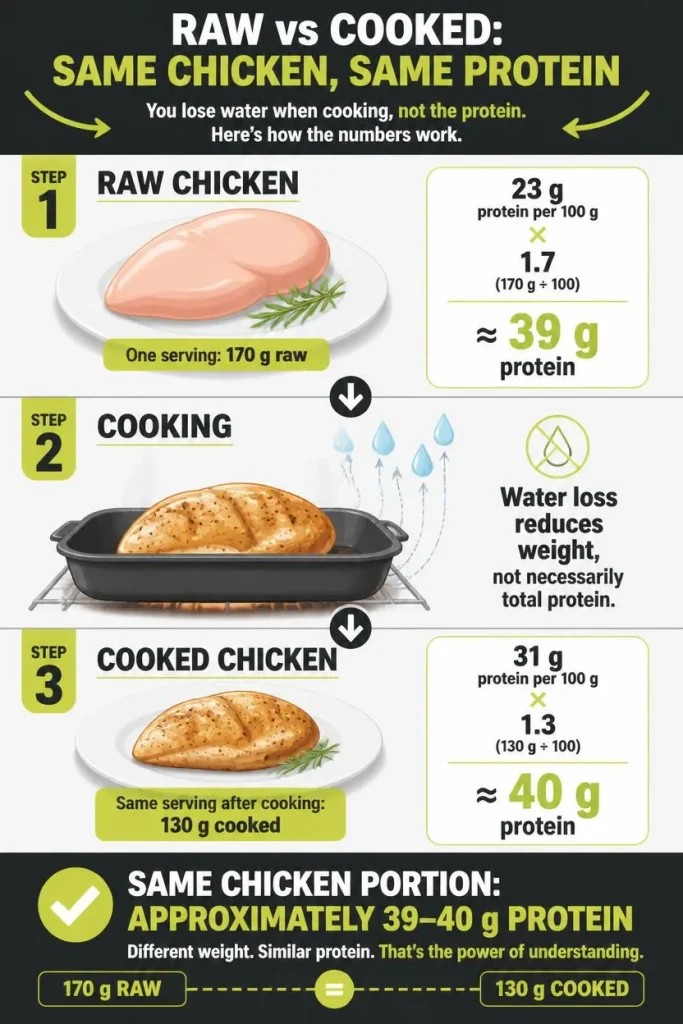
Suppose a recipe calls for 170 grams of raw, boneless chicken breast, and a database lists raw chicken breast at approximately 23 grams of protein per 100 grams. That raw portion contains roughly 39 grams of protein in total (170 g × 0.23).
After roasting, that same piece of chicken might weigh closer to 130 grams, having lost water weight during cooking. The total protein in the chicken hasn’t changed — it’s still roughly 39 grams — but if you weigh the cooked chicken and look up cooked chicken breast in a database (commonly listed around 31 grams of protein per 100 grams), the math checks out: 130 g × 0.31 ≈ 40 grams, consistent with the original raw-based estimate within normal rounding and natural variation.
The mistake to avoid: weighing the cooked 130-gram portion but looking up the raw protein value (23g per 100g). That would incorrectly suggest only about 30 grams of protein, underestimating the actual amount by roughly 9 grams — a meaningful gap if you’re tracking toward a specific daily target across multiple meals.
Common Mistakes in Comparing Raw and Cooked Protein
| Mistake | Why It’s a Problem | Better Approach |
|---|---|---|
| Logging cooked chicken weight using raw-value protein numbers | Significantly underestimates actual protein intake | Match your weighing point (raw or cooked) to the matching database entry |
| Assuming rice and pasta have the same protein density cooked and dry | Overestimates protein from grains and legumes if using dry-weight numbers for a cooked portion | Use cooked-weight values when tracking a cooked grain or legume serving |
| Treating “protein per 100g” as a fixed property of a food | Ignores that this number changes with preparation state | Always check whether a number is raw, cooked, or dry before comparing |
| Mixing weighing methods across different meals | Compounds small errors across a full day’s tracking | Pick one method (raw or cooked) and use it consistently |
| Assuming all meats lose the same percentage of weight when cooked | Cooking method and cut both affect moisture loss significantly | Treat yield percentages as general estimates, not precise values for every cut |
A Simple Before-You-Track Checklist
- [ ] Confirm whether the protein number you’re using is for raw, cooked, or dry food
- [ ] Decide whether you’ll weigh your food raw or cooked, and stick with that choice
- [ ] Match your weighing point to the correct database entry (raw-to-raw, cooked-to-cooked)
- [ ] For grains and legumes, default to cooked-weight values unless you’re measuring the dry ingredient directly
- [ ] Treat yield percentages as general estimates rather than precise conversions
- [ ] Recheck your tracking app’s default assumption for common proteins like chicken, beef, and fish
Where This Fits Into Everyday Protein Tracking
Understanding raw-versus-cooked protein numbers isn’t just a technical detail — it directly affects whether your daily protein target is realistic or quietly off. This is especially relevant for anyone building meals around a protein goal, such as planning a high-protein breakfast or structuring a full day of meals to hit a target consistently. Getting the serving basis right once, as a habit, removes one of the more common and avoidable sources of tracking error.
Frequently Asked Questions
Does cooking destroy protein? No, not in any meaningful way under normal home cooking conditions like baking, grilling, roasting, boiling, or sautéing. Protein is a relatively heat-stable macronutrient. What changes during cooking is the food’s weight, primarily due to water loss or water absorption, which shifts the protein-per-100g number without actually changing the total protein in the food.
Should I weigh my protein before or after cooking? Either works, as long as you’re consistent and matching your weighing point to the correct nutrition data. Many people find weighing raw more practical for meal prep planning, while others prefer weighing cooked portions since that’s what actually ends up on the plate. The key is not mixing the two.
Why does raw chicken show less protein per 100g than cooked chicken? Raw chicken contains more water by weight. As it cooks, some of that water evaporates, so the same amount of protein is packed into a smaller, lighter portion. That makes the protein-per-100g number go up, even though the total protein in the piece of chicken hasn’t increased.
Why does cooked rice show less protein per 100g than dry rice? The opposite effect happens here: rice absorbs a large amount of water as it cooks, roughly tripling in weight. The same amount of protein is now spread across a much heavier portion, so the protein-per-100g number drops substantially compared to the dry, unabsorbed rice.
Is there a reliable percentage I can use to convert raw meat weight to cooked weight? General ranges exist (commonly cited as roughly 20-30% weight loss for meat and poultry), but the exact percentage depends on the cut, fat content, and cooking method. Treat any conversion percentage as a reasonable estimate rather than a precise figure for your specific meal.
Do food tracking apps usually default to raw or cooked values? This varies by app and even by specific food entry within the same app. It’s worth checking the entry you’re using for a food you track often, particularly meat and poultry, since this is one of the easiest places for a tracking error to creep in unnoticed.
Does the same raw-versus-cooked effect apply to plant-based proteins like tofu and tempeh? Somewhat, though the effect is usually smaller than with meat. Tofu and tempeh already contain significant water from processing, and most home cooking methods (pan-frying, baking) cause modest additional water loss rather than the larger shrinkage seen with meat and poultry. The same principle still applies: check whether the protein value you’re using matches the preparation state of what you actually weighed.
A Note on Accuracy
Nutrition values for both raw and cooked foods — whether from a food label, a government database, or a tracking app — are estimates, not laboratory-certified measurements for the specific piece of food on your plate. Natural variation in the animal, cut, cooking method, cooking time, and equipment all affect the actual numbers. Treat protein tracking as a useful guide for building consistent habits rather than a precise daily accounting, and don’t let small discrepancies between sources cause unnecessary stress about hitting an exact number.
Conclusion
Raw and cooked protein numbers differ mainly because of weight change during cooking, not because protein is created or destroyed. Meat, poultry, and fish typically show a higher protein number per 100g once cooked, because they lose water weight. Grains and legumes show the opposite pattern, since they absorb water and gain weight as they cook.
The fix for accurate tracking isn’t complicated: identify whether a number is raw or cooked before comparing it to anything else, and stay consistent about when you weigh your food. That one habit removes one of the most common, avoidable sources of protein-tracking error.
Save This Guide: Quick Reference
- Meat, poultry, fish: Protein per 100g typically increases after cooking (water loss concentrates it)
- Rice, pasta, legumes, oats: Protein per 100g typically decreases after cooking (water absorption dilutes it)
- Eggs: Protein per 100g stays roughly similar before and after cooking
- Golden rule: Always match your weighing point (raw or cooked) to the matching nutrition database entry
- Typical meat/poultry cooking weight loss: Roughly 20-30%, varying by cut and cooking method
- Biggest tracking error to avoid: Mixing raw-weight logging with cooked-value database entries, or the reverse