If you are new to strength training, you have probably heard about creatine.
It is one of the most widely studied sports supplements, but beginner advice can quickly become confusing.
How much should you take? Do you need a loading phase? When should you take it? Will it make you gain fat? Is it safe?
The good news is that creatine for beginners or anyone does not need to be complicated.
For most healthy adults interested in strength training, creatine monohydrate is the simplest form to consider. A practical maintenance approach is 3–5 grams per day, taken consistently. A loading phase can increase muscle creatine stores more quickly, but it is optional. The NIH Office of Dietary Supplements’ guide to exercise and athletic-performance supplements identifies creatine as one of the most thoroughly studied sports-performance supplements and describes its strongest applications around repeated, short-duration, high-intensity activity.
This guide explains what a beginner actually needs to know—without turning creatine into a complicated supplement routine.
Quick Answer: How Should a Beginner Take Creatine?
For a healthy adult who wants to try creatine:
- Choose creatine monohydrate.
- Take 3–5 grams per day.
- Take it consistently rather than worrying about an exact pre-workout or post-workout window.
- You do not need a loading phase.
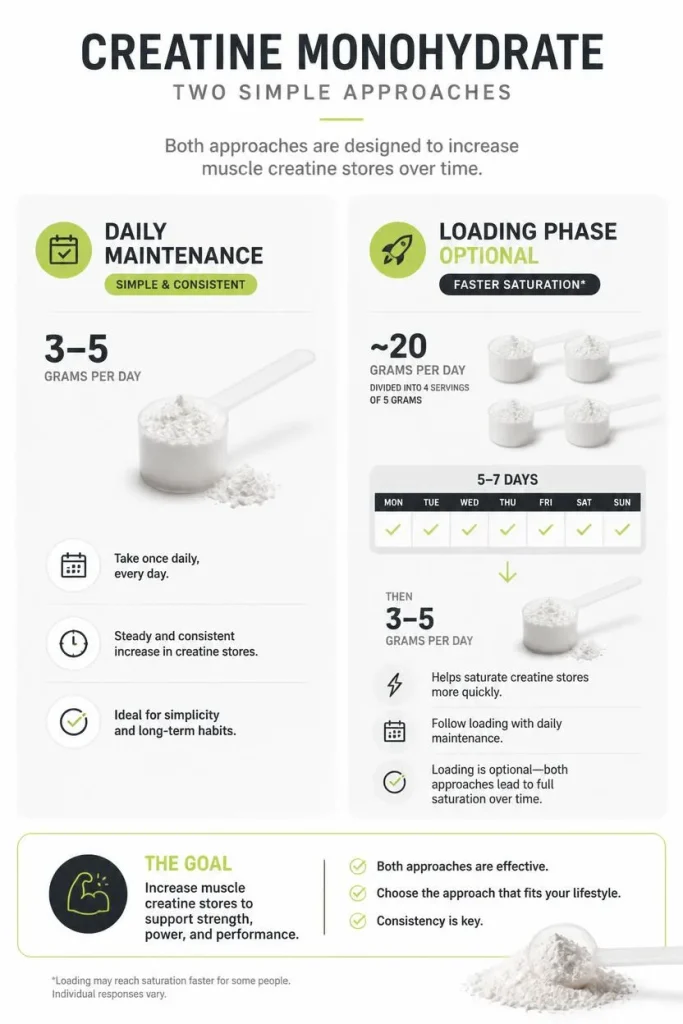
- If you choose to load, a commonly studied approach is about 20 g/day for 5–7 days, divided into four 5-g servings, followed by 3–5 g/day.
- Expect that your body weight may increase somewhat because creatine increases water stored in muscle.
- Keep resistance training, adequate nutrition, sleep and recovery as the foundation.
- If you have kidney disease or another relevant medical condition, speak with a healthcare professional before using creatine.
The simplest option
Creatine monohydrate: 3–5 g every day.
No loading. No complicated timing strategy. No supplement stack required.
What Is Creatine?
Creatine is a compound your body naturally produces and also obtains from food, particularly animal-based foods.
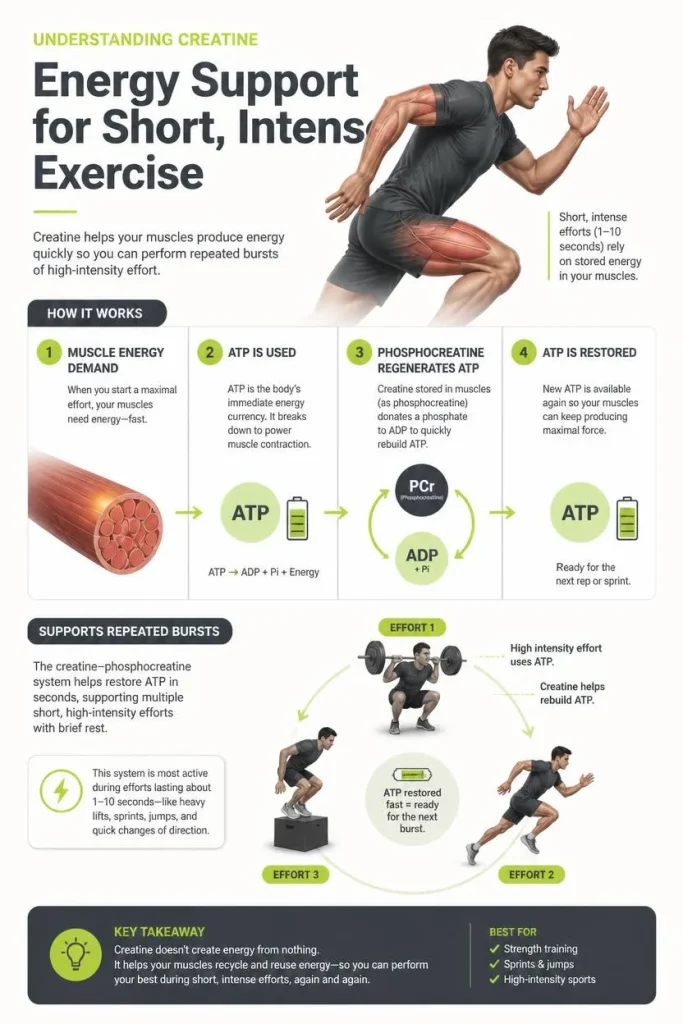
Most creatine is stored in skeletal muscle. During short, intense efforts, muscles use the phosphocreatine system to rapidly regenerate ATP—the energy currency required for muscle contractions.
In simple terms:
Creatine → more available phosphocreatine → support for repeated high-intensity efforts.
This is why creatine is particularly relevant to activities such as:
- Resistance training
- Weightlifting
- Sprinting
- Repeated short bursts of intense activity
- Some team and court sports
It is not a stimulant like caffeine.
You generally will not feel a sudden energy “kick” immediately after taking it. Its value comes from consistently increasing muscle creatine stores over time.
What Does Creatine Actually Do?
The strongest evidence for creatine relates to strength, power and repeated high-intensity exercise.
The NIH reports that creatine supplementation can increase strength, power and the ability to perform repeated maximal-effort muscle contractions. It can also support adaptations to structured training over time.
Recent systematic reviews support this overall picture.
A 2024 systematic review and meta-analysis of 23 studies found that creatine combined with resistance training significantly improved upper- and lower-body strength compared with placebo.
Another 2024 systematic review and meta-analysis found that creatine combined with resistance training increased lean body mass compared with resistance training alone. The pooled difference was approximately 1.14 kg of lean body mass, although individual responses varied and the included studies had limitations.
That does not mean creatine builds muscle by itself.
A better model is:
Progressive resistance training + adequate nutrition + recovery + consistency + creatine, when appropriate
rather than:
Creatine alone = muscle gain
Your training remains the foundation.
If you are still building that foundation, FitVibe’s 1-Month Beginner Fitness Plan provides a structured starting point for building consistency with strength training, aerobic activity and recovery.
Who Can Benefit From Creatine?
Creatine is most relevant when your exercise involves repeated, high-intensity efforts.
Strength-training beginners
You do not need to be an advanced lifter to use creatine.
If your workouts include movements such as squats, presses, rows, deadlifts and other resistance exercises, creatine may complement your training.

People training for muscle and strength
Creatine can support a resistance-training program aimed at increasing strength and lean mass.
However, it should remain a supporting tool—not the center of your fitness plan.
People doing short, intense sports
Creatine can be useful for activities involving repeated bursts of intense effort, such as sprinting and many team or court sports.
Endurance-focused exercisers
Creatine is less compelling when your primary activity is long-duration endurance exercise.
The NIH notes that creatine provides relatively little value for endurance sports such as distance running, cycling and swimming compared with activities that depend heavily on repeated short, intense efforts.
Creatine Monohydrate vs. Other Types
Supplement companies sell many forms of creatine, which can make a simple decision seem unnecessarily complicated.
For most beginners, the practical choice is:
Creatine monohydrate
It is the most widely studied form of creatine and remains the standard against which other forms are compared. The NIH notes that other forms have not been proven superior to creatine monohydrate for increasing muscle creatine levels or improving performance.
You may see products containing:
- Creatine hydrochloride
- Buffered creatine
- Creatine ethyl ester
- Creatine blends
These products may be marketed as more advanced, more soluble or easier to digest, but there is no strong reason for a beginner to choose them over plain creatine monohydrate.
Beginner rule
If you want the simplest evidence-based option, choose plain creatine monohydrate.
How Much Creatine Should a Beginner Take?
For most healthy adults, a simple maintenance approach is:
3–5 grams per day
You do not need to increase the dose on training days.
You do not need to take extra creatine after a particularly hard workout.
And you do not need to calculate the dose based on how many exercises you performed.
Creatine works by increasing muscle creatine stores over time, so consistent daily use is more important than finding a perfect dose for every individual workout.
Do You Need a Creatine Loading Phase?
No.
Loading is optional.
A commonly studied loading protocol is approximately:
20 grams per day for 5–7 days
usually divided into four servings of about 5 grams, followed by:
3–5 grams per day
The purpose of loading is simply to increase muscle creatine stores more quickly. A lower daily dose can also increase muscle creatine stores, but more gradually.
Choose no loading if you want:
- A simpler routine
- Fewer daily servings
- Less chance of digestive discomfort
- A routine that is easier to maintain
Consider loading if:
You specifically want to increase muscle creatine stores more quickly and are comfortable dividing the daily dose.
For most beginners, there is no need to rush.
When Should You Take Creatine?
This is one of the most common beginner questions.
The practical answer is:
Take it at a time you can consistently remember.
You could take it:
- With breakfast
- With lunch
- With your post-workout meal
- With dinner
- With another daily supplement
You do not need to build your workout around a narrow “creatine timing window.”
For example:
Breakfast → creatine
or
Post-workout meal → creatine
or
Dinner → creatine
The best time is often simply the time you are least likely to forget.
Should You Take Creatine on Rest Days?
Yes.
If you are following a daily maintenance approach, continue taking your normal serving on rest days.
A simple routine is:
Training day → 3–5 g
Rest day → 3–5 g
You do not need to double the dose because you had a difficult workout.
Creatine is not a pre-workout stimulant that needs to be taken only before exercise.
What Happens When You Start Taking Creatine?
One of the first things some people notice is an increase in body weight.
This is important because beginners sometimes see the scale increase and immediately assume they have gained body fat.
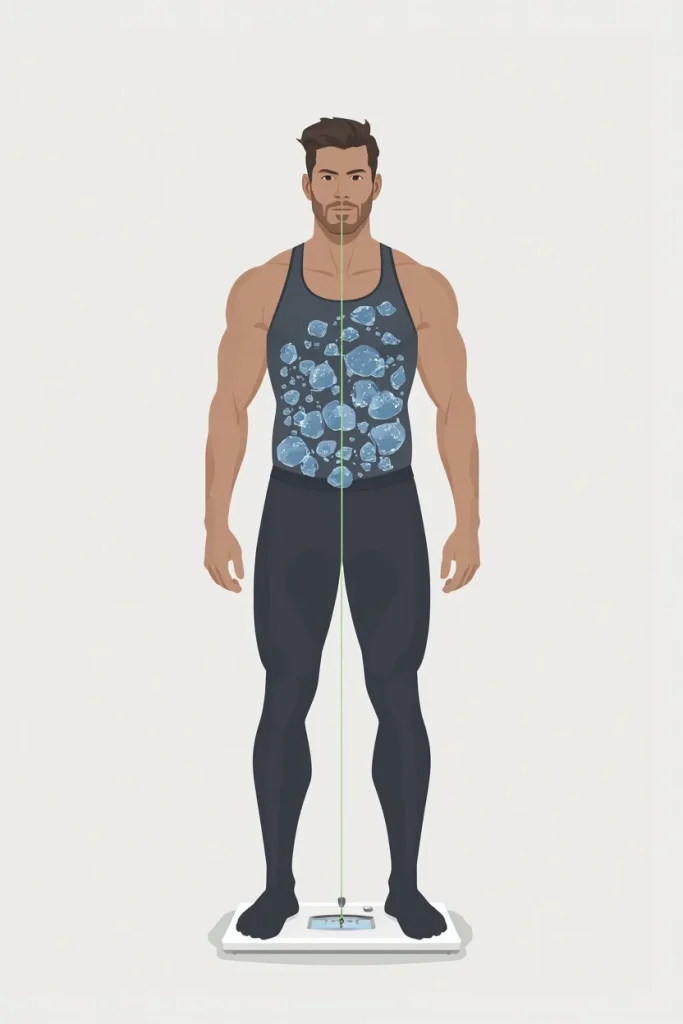
Creatine increases water stored in muscle. The NIH identifies increased body weight from water retention as the most consistent effect associated with creatine supplementation.
That is different from automatically gaining body fat.
Some studies have reported approximately 1–2 kg of additional body weight over a month with creatine supplementation during strength training, although individual responses vary.
If fat loss is your goal
Do not judge your progress from one weigh-in.
Consider tracking:
- Body-weight trends
- Waist measurement
- Strength progression
- Workout performance
- Training consistency
- How your clothes fit
This gives you a more useful picture than reacting to a single change on the scale.
Can Creatine Help With Muscle Gain?
Yes, creatine can complement resistance training when your goal is to build muscle and strength.
Research supports improvements in strength and lean body mass when creatine is combined with resistance training, although the size of the response varies between individuals.
The priorities should remain:
- Follow a progressive resistance-training program.
- Eat enough protein and overall nutrition to support your goal.
- Get adequate sleep and recovery.
- Train consistently.
- Use creatine as a supporting tool if appropriate.
If your training is inconsistent, creatine will not fix that problem.
Creatine vs. Protein: What’s the Difference?
Creatine and protein are not interchangeable.
They have different roles.
Use this responsive table format
| Supplement | Main role |
|---|---|
| Protein | Provides amino acids needed to build and maintain body tissues |
| Creatine | Supports the phosphocreatine energy system during short, intense efforts |
You can use both if they fit your goals.
But you do not need a complicated supplement stack.
Start by making sure your normal diet provides enough protein from foods such as:
- Eggs
- Fish
- Chicken
- Dairy
- Soy
- Beans
- Lentils
- Nuts and seeds
For a more detailed explanation of daily protein needs, see FitVibe’s How Much Protein Do You Need a Day?. The guide explains how protein needs can differ according to body size, activity level and goals.
For practical options between meals, see Quick High-Protein Snacks You Can Make in 5 Minutes.
For breakfast, FitVibe’s High-Protein Breakfast for Muscle Gain: Greek Yogurt Protein Oats is another practical option.
Can You Take Creatine While Trying to Lose Fat?
Yes.
Creatine can fit into a fat-loss plan.
But creatine is not a fat-loss supplement.
It does not create a calorie deficit and does not directly cause body fat to disappear.
Someone trying to lose fat while maintaining or building strength may still choose creatine because it can support training performance and lean-mass adaptations.
Think of it this way:
Creatine can support your training.
Your overall nutrition and activity habits drive your fat-loss strategy.
If fat loss is your goal, prioritize:
- A sustainable calorie deficit
- Adequate protein
- Resistance training
- Regular physical activity
- Nutritious foods
- Adequate sleep
- Long-term consistency
Interestingly, a 2024 systematic review found that creatine combined with resistance training increased lean body mass and produced small reductions in body-fat measures compared with resistance training alone. This does not establish creatine as a fat-loss supplement; the primary context was resistance training and body-composition adaptation.
For more practical guidance on combining nutrition and exercise habits, start with FitVibe’s 1-Month Beginner Fitness Plan.
Does Creatine Cause Fat Gain?
Creatine itself is not generally considered a fat-gain supplement.
The early increase in body weight commonly associated with creatine is primarily related to increased water stored in muscle.
That means:
Scale weight can increase without a corresponding increase in body fat.
If you are trying to lose fat, look at your weight trend alongside your waist measurement, training performance and overall progress.
Is Creatine Safe?
For healthy adults, creatine monohydrate has a substantial research history and is generally considered safe when used appropriately.
The NIH Office of Dietary Supplements states that creatine is safe for healthy adults over several weeks or months and that available evidence also supports safety over several years.
Possible effects include:
- Increased body weight from water retention
- Stomach discomfort
- Nausea
- Diarrhea, particularly with larger doses
- Muscle cramps or stiffness in some people
Digestive problems may be more noticeable with large loading doses.
For a beginner, the simpler 3–5 g/day approach may therefore be easier to tolerate.
Who Should Speak With a Healthcare Professional First?
Do not treat a general creatine recommendation as individualized medical advice.
Speak with an appropriate healthcare professional before using creatine if you:
- Have kidney disease
- Have abnormal kidney-function tests
- Have another significant medical condition
- Take medications that may affect kidney function
- Are pregnant or breastfeeding and are considering supplementation
- Have been advised to restrict or carefully manage supplements
Creatine is metabolized to creatinine, which is commonly measured when evaluating kidney function. Supplementation can therefore affect blood creatinine measurements without automatically meaning that kidney damage has occurred.
If you have kidney concerns, let your healthcare professional interpret your laboratory results rather than trying to interpret them yourself.
The NIH also recommends discussing performance supplements with a healthcare provider when you have medical conditions or take medications that could interact with them.
Does Creatine Dehydrate You?
The idea that creatine automatically causes dehydration is not supported by the available evidence.
Creatine increases water stored in muscle. That is different from simply “pulling water out of your body.”
You should still maintain normal hydration, especially when exercising in hot or humid conditions.
There is no need to force excessive amounts of water simply because you take creatine.
Can You Take Creatine With Caffeine?
Yes, many people use creatine and caffeine together.
There has been debate about whether caffeine might interfere with some effects of creatine, but the evidence does not justify telling every person to avoid the combination.
A more useful consideration is your overall caffeine intake and whether caffeine affects:
- Sleep
- Digestion
- Anxiety
- Heart rate
- Exercise tolerance
Remember:
Creatine is not a stimulant.
You do not need caffeine to make creatine work.
Common Creatine Mistakes
Use the same responsive table format here:
| Mistake | Better approach |
|---|---|
| Taking creatine only on workout days | Use a consistent daily routine |
| Taking much more than necessary | Use a straightforward 3–5 g/day maintenance dose |
| Obsessing over timing | Take it at a convenient time |
| Expecting an immediate energy boost | Remember that creatine is not a stimulant |
| Panicking about scale weight | Remember that water retention can increase body weight |
| Buying complicated blends | Plain creatine monohydrate is the simplest option |
The key idea is simple: don’t let supplement details distract you from the training and nutrition habits that matter most.
A Simple Beginner Creatine Routine
If you want the least complicated approach, use this:
Every day
Creatine monohydrate: 3–5 grams
Take it at a convenient time.
Training days
Follow your normal workout and take your usual creatine dose.
Rest days
Take the same daily serving.
First few weeks
Pay attention to:
- Training consistency
- Strength progression
- Exercise performance
- Body-weight trends
- Waist measurement if fat loss is a goal
- Digestion and overall tolerance
Do not judge creatine based on one workout or one weigh-in.
Optional loading
If you specifically want faster muscle creatine saturation:
Approximately 20 g/day for 5–7 days, divided into four 5-g servings, followed by 3–5 g/day.
Loading is optional.
Make Creatine Boring
For busy adults, the best supplement routine is often the one that requires the least thought.
Instead of asking:
“What is the perfect time to take creatine?”
Ask:
“What daily habit can I attach it to?”
For example:
Breakfast → creatine
Lunch → creatine
Post-workout meal → creatine
The goal is to remove unnecessary decisions.
The same principle applies to nutrition. Preparing a few useful foods in advance can make it easier to maintain adequate protein and balanced meals throughout the week.
You can also use FitVibe’s Meal Prep for Beginners: The Complete Guide for a broader meal-preparation system.
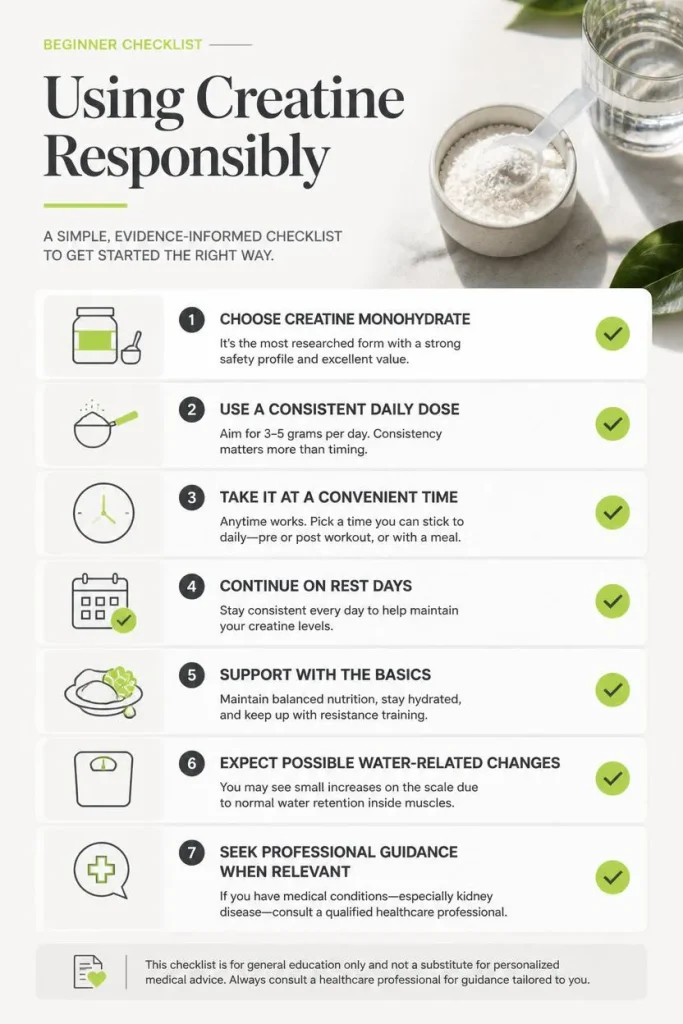
Creatine Beginner Checklist
Before starting:
- Choose creatine monohydrate.
- Use 3–5 g/day as the simplest maintenance approach.
- Decide whether you actually need loading—it is optional.
- Choose a daily habit to associate with your supplement.
- Maintain a sensible resistance-training routine.
- Eat balanced meals with adequate protein.
- Stay appropriately hydrated.
- Expect that water retention may affect the scale.
- If you have kidney disease or another relevant medical condition, speak with a healthcare professional first.
Frequently Asked Questions
Is creatine good for beginners?
Yes.
Healthy adults do not need to be advanced athletes to use creatine. It is particularly relevant to resistance training and other activities involving repeated high-intensity efforts.
How much creatine should a beginner take?
A straightforward maintenance dose is 3–5 grams of creatine monohydrate per day.
Loading is optional.
Do I need to take creatine before my workout?
No.
Choose a time that makes consistent daily use easy.
Should I take creatine on rest days?
Yes.
If you are using a daily supplementation approach, continue your normal dose on rest days.
Does creatine make you gain weight?
It can increase body weight because it increases water stored in muscle.
This should not automatically be interpreted as body-fat gain.
Is creatine only for men?
No.
Creatine is not exclusively a men’s supplement. Research includes both men and women, although individual responses can vary.
Is a loading phase necessary?
No.
Loading can increase muscle creatine stores more quickly, but 3–5 g/day without loading is a practical alternative.
Can I take creatine if I have kidney problems?
If you have kidney disease, abnormal kidney-function tests or another relevant medical condition, speak with your healthcare professional before using creatine.
The Bottom Line
For a healthy adult beginner, creatine does not need to be complicated.
Creatine monohydrate + consistent daily use + resistance training + adequate nutrition + recovery is the basic framework.
A practical starting point is:
3–5 grams of creatine monohydrate every day
Loading is optional.
You do not need to worry excessively about the exact timing.
You may notice some additional scale weight because creatine increases water stored in muscle. That does not automatically mean you have gained body fat.
Most importantly, keep your priorities in the right order.
Training, nutrition, sleep and consistency should do most of the work.
Creatine is a tool that can complement those habits—not replace them.
Save This Guide: Creatine for Beginners
Best-studied form: Creatine monohydrate
Simple daily dose: 3–5 g/day
Loading: Optional; approximately 20 g/day divided into four 5-g servings for 5–7 days
Timing: Any convenient, consistent time
Rest days: Continue the daily dose
Main use: Support for repeated high-intensity exercise, strength and training adaptations
Common early change: Increased body weight from water retention
Not a replacement for: Training, adequate nutrition, protein, sleep or recovery
Before using: Seek professional guidance if you have kidney disease, another relevant medical condition, or concerns about medication interactions.
Sources & Further Reading
NIH Office of Dietary Supplements
Dietary Supplements for Exercise and Athletic Performance
A detailed evidence-based resource covering creatine’s mechanism, performance effects, dosing approaches, forms and safety.
Wang et al., 2024
A systematic review and meta-analysis examining the effects of creatine combined with resistance training on upper- and lower-body strength.
Desai et al., 2024
The Effect of Creatine Supplementation on Resistance Training-Based Changes to Body Composition
A systematic review and meta-analysis examining lean body mass and body-composition outcomes when creatine is combined with resistance training.
Editorial review
This article provides general educational information and is not individualized medical advice.