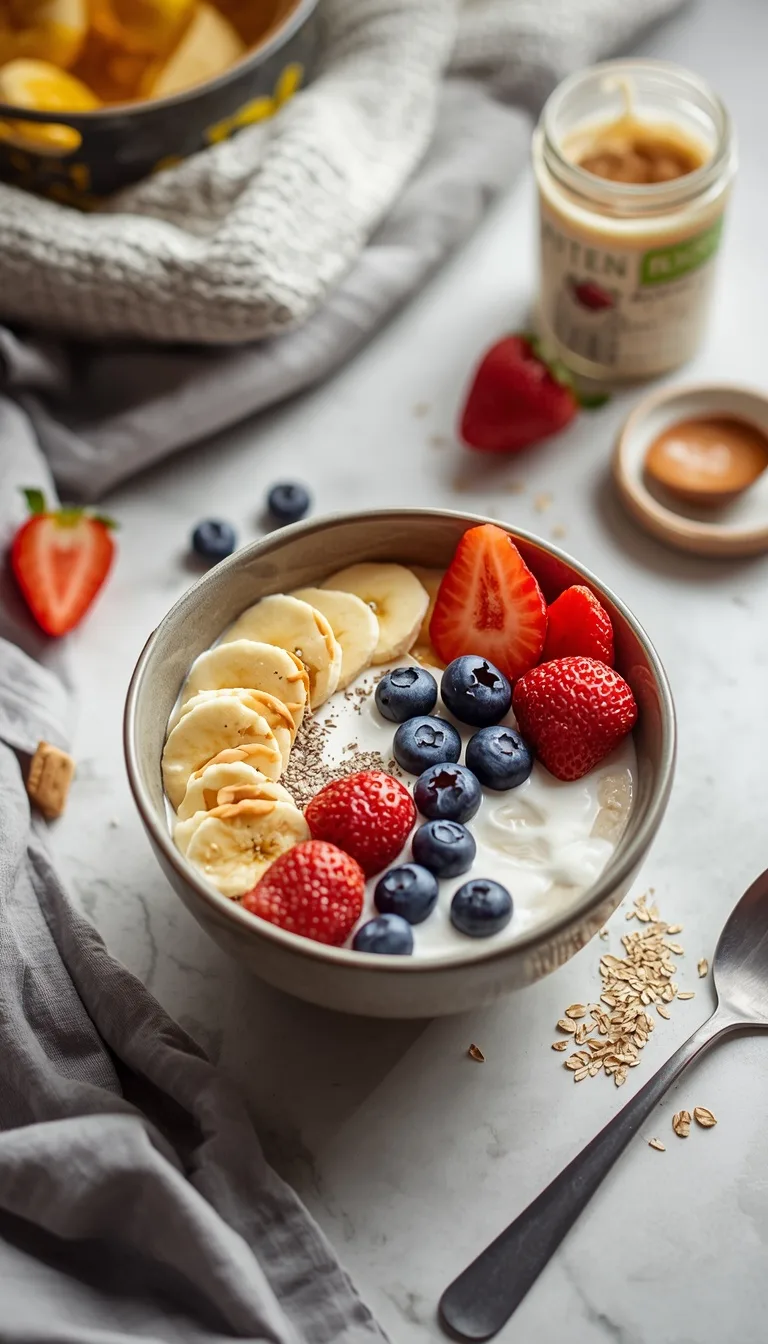
A high-protein breakfast for muscle gain matters most on the days you’re trying to build muscle, because it’s usually the meal people shortchange — a coffee and a granola bar, eaten standing at the counter. This recipe is built to fix that: a make-ahead, no-cook bowl of Greek yogurt protein oats that delivers roughly 35–40 grams of protein in a single serving, using ingredients and ratios you can buy at any grocery store.
This version has been developed and nutritionally calculated using standard USDA ingredient data (methodology below) rather than tested in a professional kitchen — so treat the quantities as a precise, defensible starting recipe, and adjust next time based on how it turns out for your taste and your specific brands.
Recipe at a Glance
| Category | Details |
|---|---|
| Prep Time | 8–10 minutes active |
| Chill Time | Minimum 2 hours; 6–8 hours (overnight) recommended |
| Total Time | ~10 minutes active, 2–8 hours inactive |
| Servings | 1 (easily doubled or batched to 4–6) |
| Difficulty | Beginner — no cooking required |
| Equipment | Mixing bowl or jar with lid, measuring cups/spoons, kitchen scale (optional but recommended) |
Ingredients (Exact Quantities, Single Serving)
Measurements are given by weight first, with a volume approximation in parentheses — Greek yogurt and oats in particular vary enough by brand that weight is the more reliable measurement if you have a kitchen scale.
| Ingredient | Amount | Notes |
|---|---|---|
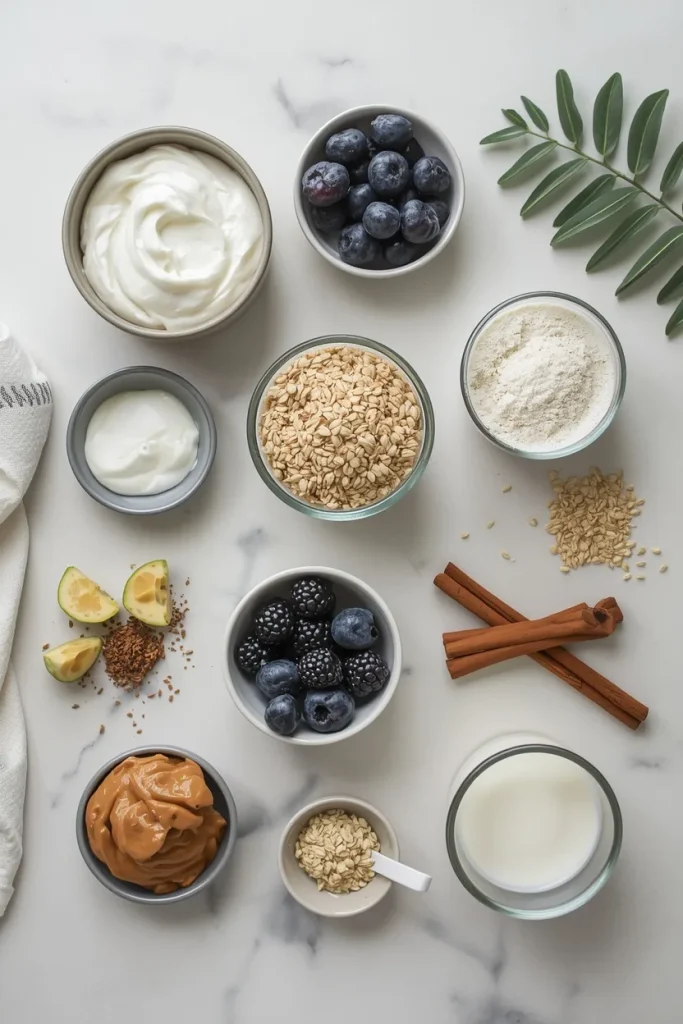
| Plain nonfat Greek yogurt | 200 g (≈ ¾ cup + 1 Tbsp) | Strained, thick-style; not “Greek-style” blends |
| Rolled oats (old-fashioned, not instant) | 45 g (≈ ½ cup) | Old-fashioned rolled, not quick oats or steel-cut |
| Milk (2% or whole) | 120 g (≈ ½ cup) | Dairy or unsweetened fortified plant milk |
| Chia seeds | 12 g (≈ 1 Tbsp) | Whole, not pre-ground |
| Natural peanut butter | 16 g (≈ 1 Tbsp) | Stir well first — natural PB separates |
| Blueberries (or mixed berries) | 80 g (≈ ½ cup) | Fresh or frozen, thawed |
| Honey or maple syrup | 7 g (≈ 1 tsp) | Optional; omit for a lower-sugar version |
| Vanilla extract | 2.5 ml (≈ ½ tsp) | Optional |
| Ground cinnamon | 1 pinch (≈ ⅛ tsp) | Optional |
How to Make It
- Combine the base. In a bowl or jar with a lid, add the Greek yogurt, milk, and rolled oats. Stir until no dry oat clusters remain — the mixture should look like thick, slightly lumpy pancake batter at this stage.
- Add the binders and flavor. Stir in the chia seeds, peanut butter, vanilla extract, cinnamon, and honey (if using). Mix until the peanut butter is fully incorporated with no visible streaks — this usually takes 30–45 seconds of stirring, longer if your peanut butter is cold.
- Seal and refrigerate. Cover the jar or bowl and refrigerate for at least 2 hours. For the best texture, leave it overnight (6–8 hours).
- Check the texture before serving. A properly set batch should hold its shape on a spoon without pooling liquid at the bottom — closer to a thick rice pudding than a drinkable smoothie. If it still looks loose or watery after the minimum chill time, the oats and chia haven’t fully hydrated yet; give it another 1–2 hours.
- Top and serve. Add the blueberries just before eating, along with any optional toppings (see Variations). Adding fruit earlier is fine for flavor, but berries added at the start will release moisture and can make the texture slightly looser.
What the texture should look like at each stage
- Right after mixing: thick and slightly grainy, with visible whole oats — this is expected and will soften considerably.
- After 2 hours (minimum chill): oats are softened but still have some bite; chia seeds have started to gel slightly.
- After 6–8 hours (overnight): oats are fully softened and creamy, chia seeds have visibly plumped and gelled, and the mixture holds together on a spoon. This is the texture the recipe is designed around — if you’re eating it at the 2-hour mark, expect a firmer, slightly less creamy bite.
Why This Works for Muscle Gain
Muscle protein synthesis responds to having adequate protein distributed across meals rather than concentrated into one meal late in the day, which is why a protein-forward breakfast is worth planning rather than defaulting to carb-heavy options like cereal or toast. This recipe combines two protein sources with different absorption profiles — Greek yogurt (primarily casein and whey) and milk alongside a smaller contribution from oats, chia, and peanut butter — rather than relying on a single ingredient to carry the whole protein count.
It’s worth being direct about something the fitness content world often overstates: no single breakfast “builds muscle” on its own. What a recipe like this does is make it easier to consistently hit a reasonable protein target at a meal that’s otherwise easy to under-eat. If you’re planning a full day of protein-forward eating around training, it’s worth looking at the rest of your meals too — a few quick high-protein snacks can fill the gaps between meals without much extra effort.
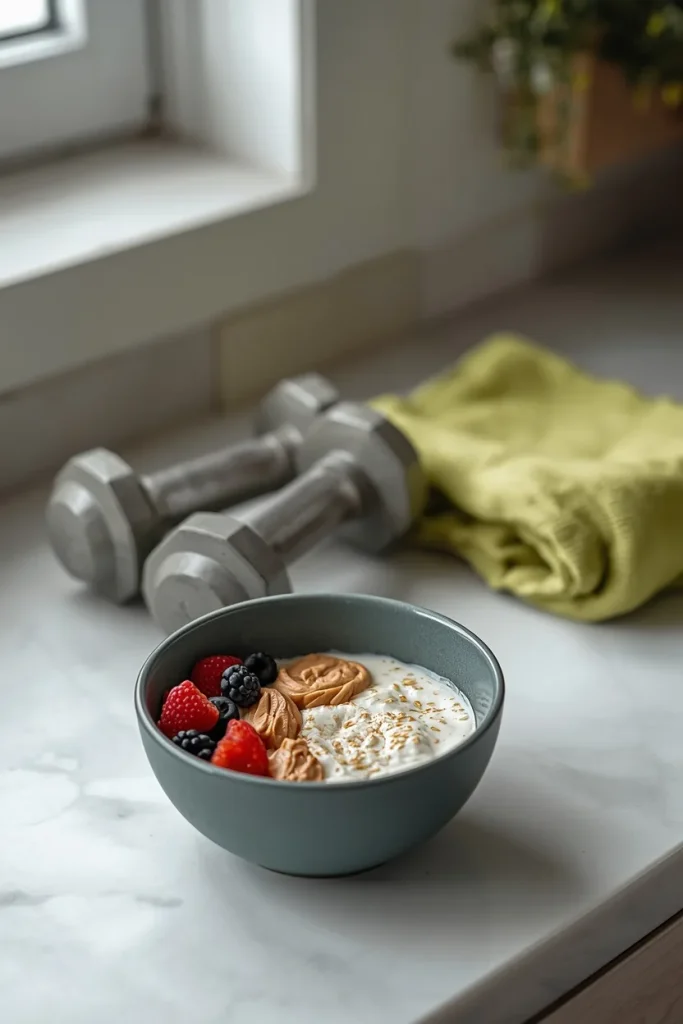
Nutrition Information (Calculated Estimate)
| Nutrient | Per Serving (Estimated) |
|---|---|
| Calories | ~580 kcal |
| Protein | ~37 g |
| Carbohydrates | ~71 g |
| Fat | ~18 g |
| Fiber | ~11.5 g |
Methodology: These figures are calculated, not laboratory-tested. Each ingredient’s contribution was calculated from standard USDA FoodData Central reference values per 100 g (plain nonfat Greek yogurt, dry rolled oats, dried chia seeds, smooth peanut butter without added sugar, 2% milk, and raw blueberries), scaled to the exact gram quantities used in this recipe, then summed. Optional add-ins (honey, vanilla, cinnamon) are included in the total at the amounts listed above.
Actual values for your bowl will vary based on:
- The specific brand of Greek yogurt (strained Greek yogurts range from roughly 9–18 g protein per 100 g depending on brand and straining method)
- Whether you use nonfat, low-fat, or whole milk
- Natural vs. no-stir commercial peanut butter (added sugar and oil change the fat and carb numbers)
- Fresh vs. frozen berries (frozen berries are nutritionally similar but can add a small amount of extra moisture)
If exact numbers matter for your tracking, weigh your specific products and recalculate using the brand’s own label — this table is a reliable planning estimate, not a substitute for that.
Ingredient Substitutions
| Original | Substitute | What Changes |
|---|---|---|
| Plain nonfat Greek yogurt | Low-fat or whole-milk Greek yogurt | Adds roughly 2–8 g fat per serving depending on fat %; protein stays similar |
| Plain nonfat Greek yogurt | Dairy-free Greek-style yogurt (soy or coconut-based) | Protein typically drops unless the product is specifically protein-fortified — check the label, as plant-based Greek-style yogurts vary widely |
| Dairy milk | Unsweetened soy milk | Closest protein match among plant milks (roughly 3–4 g protein per 100 g); other plant milks (almond, oat) are notably lower in protein |
| Rolled oats | Quick oats | Softer, less distinct texture; nutrition is nearly identical |
| Peanut butter | Almond butter or sunflower seed butter | Slightly different fat profile; sunflower seed butter is a reliable nut-free swap |
| Honey | Maple syrup or omit entirely | Maple syrup is nutritionally similar gram-for-gram; omitting removes roughly 21 kcal and 6 g carbs |
| Blueberries | Any berry, or diced apple/banana | Changes sugar and fiber content slightly; berries generally keep this lower in sugar than banana |
For a dairy-free version, note that swapping both the yogurt and milk at once will meaningfully change the protein total — recalculate using your specific products’ labels rather than assuming the total holds.
Variations
- Chocolate peanut butter: Add 1 tsp unsweetened cocoa powder with the other mix-ins.
- Berry almond: Swap peanut butter for almond butter and top with a few sliced almonds.
- Banana cinnamon: Replace the blueberries with half a sliced banana and double the cinnamon.
- Apple cinnamon: Swap blueberries for diced apple folded in with extra cinnamon and a smaller drizzle of honey.
Storage
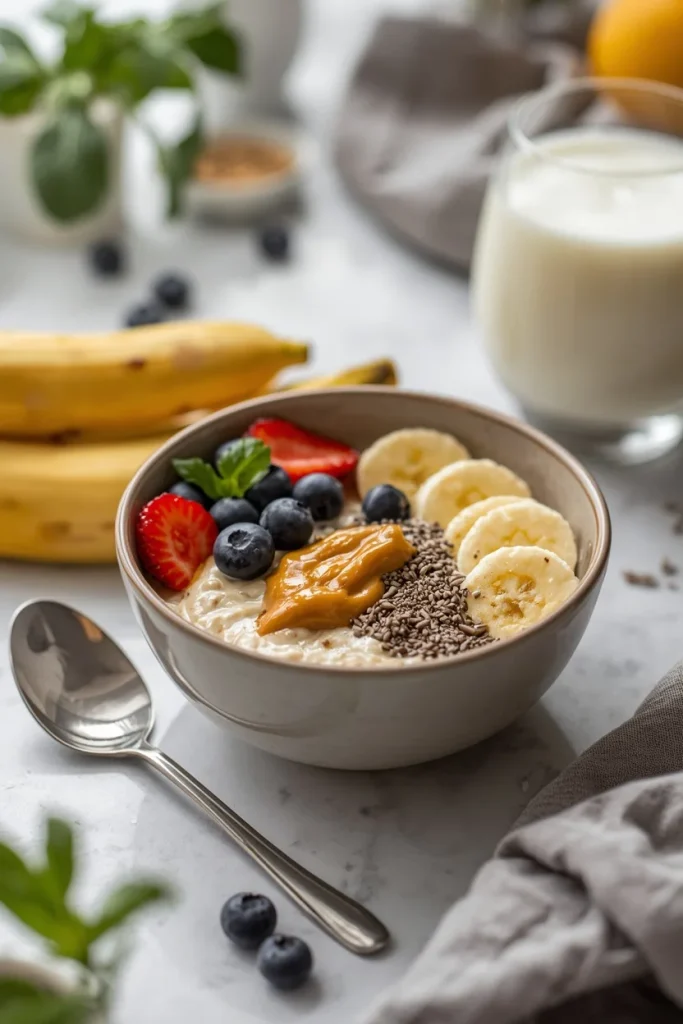
- Refrigerator: Store covered for up to 3 days. The texture holds up well; if it thickens further after day 1, stir in a splash of milk to loosen it before eating.
- Freezer: Not recommended — the yogurt and dairy base separates and turns watery and grainy after thawing.
- Make-ahead/batch prep: This recipe multiplies cleanly. For a 4-day batch, multiply all ingredient quantities by 4 and portion into individual containers right after mixing, before the chill period — this way each portion sets fully and is ready to grab.
- Best quality: For the best texture and flavor, eat within 2 days; by day 3 the oats continue softening and the bowl becomes noticeably creamier (not spoiled, just softer).
Meal Timing
This bowl works as a standard breakfast, but its protein-and-carbohydrate combination also makes it reasonable as a pre- or post-workout meal if your training happens in the morning. For a post-workout version, eating it within an hour or two of training is a common practical window many athletes and dietitians use, though the exact timing matters less than hitting your total daily protein target consistently.
Common Mistakes
| Common Mistake | Why It Happens | Better Approach |
|---|---|---|
| Using quick oats or instant oats | Assuming all oats behave the same | Use old-fashioned rolled oats for the intended texture; quick oats turn mushier |
| Skipping the stir-before-serving step | Natural peanut butter separates in the jar | Give it a quick stir before eating if the oil has settled |
| Not chilling long enough | Eating straight after mixing | Chill at least 2 hours; oats and chia need time to absorb liquid |
| Measuring Greek yogurt by cup instead of weight | Brands vary significantly in thickness | Use a kitchen scale for the yogurt and oats if you want consistent results batch to batch |
| Treating the nutrition table as exact | Assuming all “Greek yogurt” and “peanut butter” are nutritionally identical | Check your own labels if you’re tracking macros closely |
Ways to Increase the Protein Further
- Stir in an additional 50–100 g of Greek yogurt (adds roughly 5–10 g protein)
- Add half a scoop (about 12–15 g) of a neutral or vanilla protein powder with the milk
- Add 50 g of low-fat cottage cheese blended in with the yogurt for a smoother result
Frequently Asked Questions
Can I make this ahead for the whole week? Yes, but the manufacturer’s shelf-stability and the texture guidance above both point to about 3 days as the practical limit. Rather than prepping all 7 days at once, batch 3 servings at a time and prep again midweek.
Is this safe to eat cold straight from the fridge? Yes — this is a no-cook, cold-prep recipe by design, and it’s meant to be eaten chilled.
Can I make this dairy-free? Yes, using a protein-fortified dairy-free Greek-style yogurt and unsweetened soy milk gets you closest to the original protein total. Standard almond or oat milk alone will noticeably lower the total protein, so check labels rather than assuming a 1:1 swap.
How do I prevent it from being too thick or too dry? If it’s too thick after chilling, stir in an extra splash of milk (a tablespoon or two) until it loosens to your preference. This is more common with thicker Greek yogurt brands.
Why is my batch watery instead of thick? Most often this means it hasn’t chilled long enough for the oats and chia to absorb the liquid — give it another hour or two. It can also happen if berries were mixed in from the start rather than added as a topping just before eating.
Can I eat this every day? There’s nothing in the ingredients that makes daily consumption a concern for most people, but as with any single recipe, rotating it with other high-protein breakfasts helps with both nutrient variety and keeping things interesting. If you’re building out a broader weekly plan, a structured option like a 1-Month Beginner Fitness Plan can help you pair meals like this with a consistent training schedule.
Final Thoughts
This Greek yogurt protein oats recipe is built around exact, calculable ratios rather than vague “add some yogurt and oats” instructions — which matters if you’re actually trying to hit a protein number each morning rather than guessing. Weigh your ingredients once to get a feel for the quantities, and adjust the thickness, sweetness, and toppings to your own preference from there. If your broader goal involves fat loss alongside muscle maintenance, it’s worth reading about sustainable approaches to weight loss rather than pairing a high-protein breakfast with an otherwise restrictive diet.
Recipe Card
Greek Yogurt Protein Oats
Prep Time: 8–10 minutes active Chill Time: 2–8 hours (overnight recommended) Total Time: ~10 minutes active + 2–8 hours inactive Servings: 1
Ingredients:
- 200 g (≈ ¾ cup + 1 Tbsp) plain nonfat Greek yogurt
- 45 g (≈ ½ cup) rolled oats
- 120 g (≈ ½ cup) milk (2% or whole)
- 12 g (≈ 1 Tbsp) chia seeds
- 16 g (≈ 1 Tbsp) natural peanut butter
- 80 g (≈ ½ cup) blueberries
- 7 g (≈ 1 tsp) honey (optional)
- 2.5 ml (≈ ½ tsp) vanilla extract (optional)
- 1 pinch ground cinnamon (optional)
Instructions:
- Combine Greek yogurt, milk, and oats in a jar or bowl; stir until no dry clusters remain.
- Stir in chia seeds, peanut butter, vanilla, cinnamon, and honey until fully incorporated.
- Cover and refrigerate at least 2 hours, ideally 6–8 hours.
- Confirm the mixture holds its shape on a spoon before serving; extend chilling if still loose.
- Top with blueberries just before eating.
Storage: Refrigerate up to 3 days; do not freeze.
Nutrition (estimated, calculated from USDA reference values): ~580 kcal | ~37 g protein | ~71 g carbohydrates | ~18 g fat | ~11.5 g fiber per serving.
Sources & Further Reading
- USDA FoodData Central — https://fdc.nal.usda.gov/