Resistance bands are one of the simplest ways to add resistance to a home workout, but choosing your first set can be surprisingly confusing. Loop bands, mini bands, tube bands, different resistance levels, handles, anchors, and fabric options can make a basic purchase feel more complicated than it needs to be.
The good news: you do not need a large collection of bands to start strength training.
For most beginners, the right choice comes down to the exercises you want to perform, the resistance you can control with good technique, and how easily the band fits into your routine.
This guide (Resistance Bands for Beginners) explains the main types of resistance bands, how resistance levels work, what to look for before buying, and how to start using them safely at home.
Quick Answer: What Resistance Band Should a Beginner Choose?
If you are completely new to resistance bands, start with a light-to-moderate resistance band that allows you to perform your intended exercises through a controlled range of motion.
For the most versatility:
- Long loop bands: useful for rows, presses, squats, hinges, assisted movements, and full-body exercises.
- Mini loop bands: useful for glute, hip, and lower-body exercises.
- Tube bands with handles: convenient for movements that feel more familiar with a hand grip, such as rows and presses.
- Fabric mini bands: comfortable for many lower-body movements, particularly if you dislike thin elastic bands rolling or twisting.
You do not necessarily need every type. Choose based on the exercises you actually plan to do.
Resistance bands are also a legitimate form of resistance training. Research comparing elastic resistance with conventional resistance training has found similar improvements in muscular strength in several settings, although results vary by program and population.
Why Use Resistance Bands for Home Strength Training?
Resistance bands offer something that can be difficult to replicate with larger home-gym equipment: useful resistance without much storage space.
A band can fit in a drawer or small bag, making it convenient for apartments, travel, or workouts where you do not want to set up heavy equipment.
They can also be used for many movement patterns, including:
- Squatting
- Hip hinging
- Pulling
- Pressing
- Rowing
- Shoulder exercises
- Hip and glute exercises
- Core and stability work
The American College of Sports Medicine’s 2026 resistance-training guidance specifically recognizes elastic bands and other simple options as effective ways to perform resistance training at home. It also emphasizes consistency, individualization, and gradual progression rather than unnecessary complexity.
That makes bands particularly appropriate for FitVibe’s practical, beginner-focused approach: the best equipment is equipment you can use consistently and appropriately.
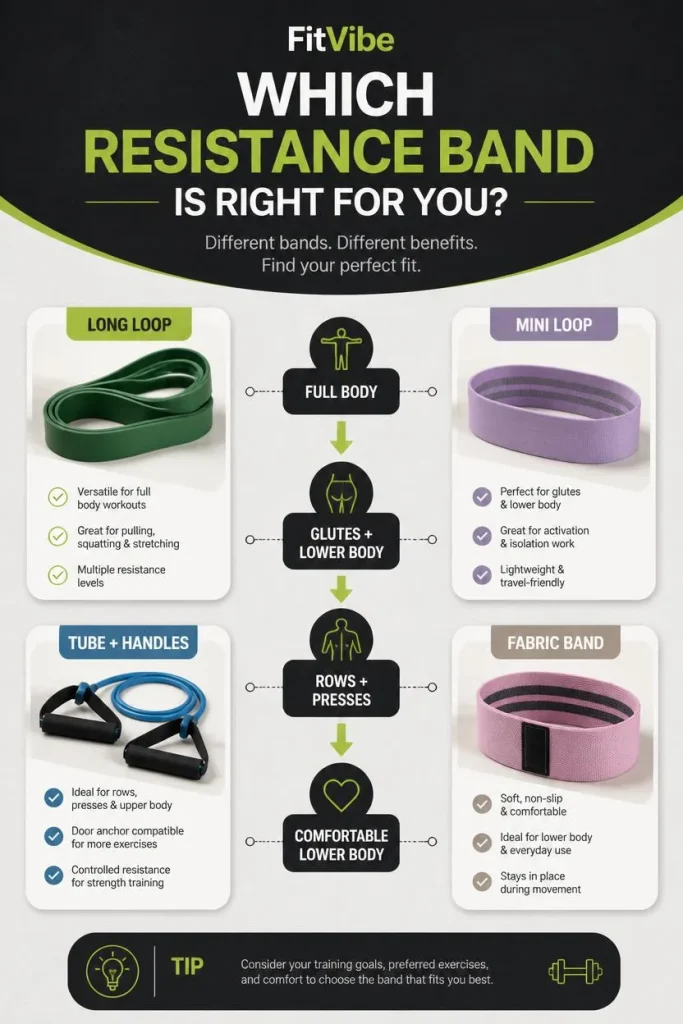
The 4 Main Types of Resistance Bands
The first decision is not resistance level. It is band style.
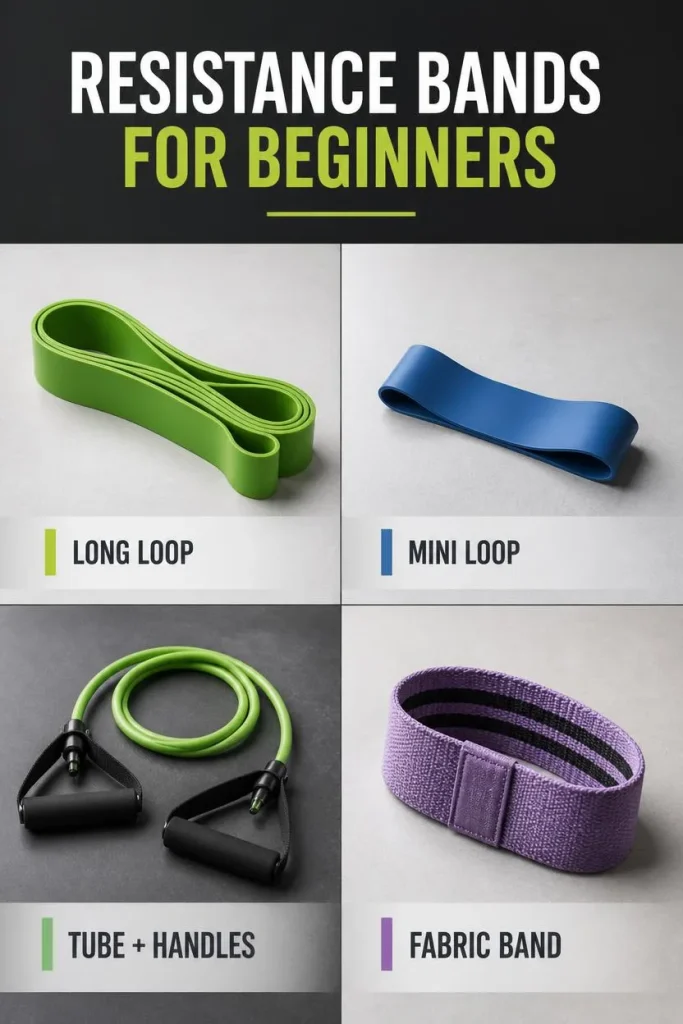
Different designs work better for different exercises.
| Band Type | Best For | Beginner-Friendly? | Main Advantage |
|---|---|---|---|
| Long loop band | Full-body strength exercises | Yes | Very versatile |
| Mini loop band | Glutes, hips, legs | Yes | Compact and simple |
| Tube band with handles | Rows, presses, curls | Yes | Familiar hand grip |
| Fabric mini band | Lower-body exercises | Yes | Comfortable and stable |
1. Long Loop Resistance Bands
Long loop bands are continuous elastic loops that can be several feet long.
They are among the most versatile choices because you can hold them, stand on them, loop them around a stable object when appropriate, or use them for different lower- and upper-body exercises.
They can work well for:
- Resistance-band rows
- Squats
- Romanian deadlift variations
- Chest presses
- Overhead presses
- Lat-focused pulling movements
- Assisted exercises
- Full-body circuits
Best for: someone who wants one band style that can cover many exercises.
If you are building a minimalist home workout setup, a long loop band is often the most versatile place to start.
2. Mini Loop Bands
Mini bands are short continuous loops.
They are particularly useful around the thighs, ankles, or lower legs for exercises that challenge the hips and lower body.
Common examples include:
- Lateral band walks
- Glute bridges
- Squats
- Hip abduction movements
- Clamshells
- Standing leg exercises
Best for: beginners who want to focus on lower-body and hip exercises.
Mini bands are less versatile than long bands for full-body resistance training, but they are extremely convenient for targeted lower-body work.
3. Tube Bands With Handles
Tube bands resemble flexible cords and commonly attach to handles.
The handles can make certain exercises feel more familiar, especially if you are transitioning from dumbbells or gym machines.
They can be useful for:
- Rows
- Chest presses
- Biceps curls
- Triceps exercises
- Shoulder presses
- Pull-apart variations
Best for: beginners who prefer a defined hand grip.
A tube system can also include different attachment options, although you do not need a complicated kit to get started.
4. Fabric Resistance Bands
Fabric bands are often made from woven material rather than exposed latex.
They are commonly used for lower-body exercises and can feel more substantial around the legs.
They may be appealing if you find thin elastic bands uncomfortable or prone to rolling during certain movements.
Best for: lower-body workouts and people who prefer a wider, fabric feel.
The important point is that material preference is personal. A comfortable band that you actually use is more useful than a theoretically ideal band that stays in a drawer.
How Resistance Levels Actually Work
This is where many beginners get confused.
Resistance bands are often sold as light, medium, heavy, extra-heavy, or with colors assigned to different resistance levels.
The problem is that color does not mean the same resistance across every manufacturer.
A green band from one brand may not provide the same resistance as a green band from another.
So instead of buying based on color alone, check the manufacturer’s stated resistance information when it is available.
Think in terms of exercise difficulty
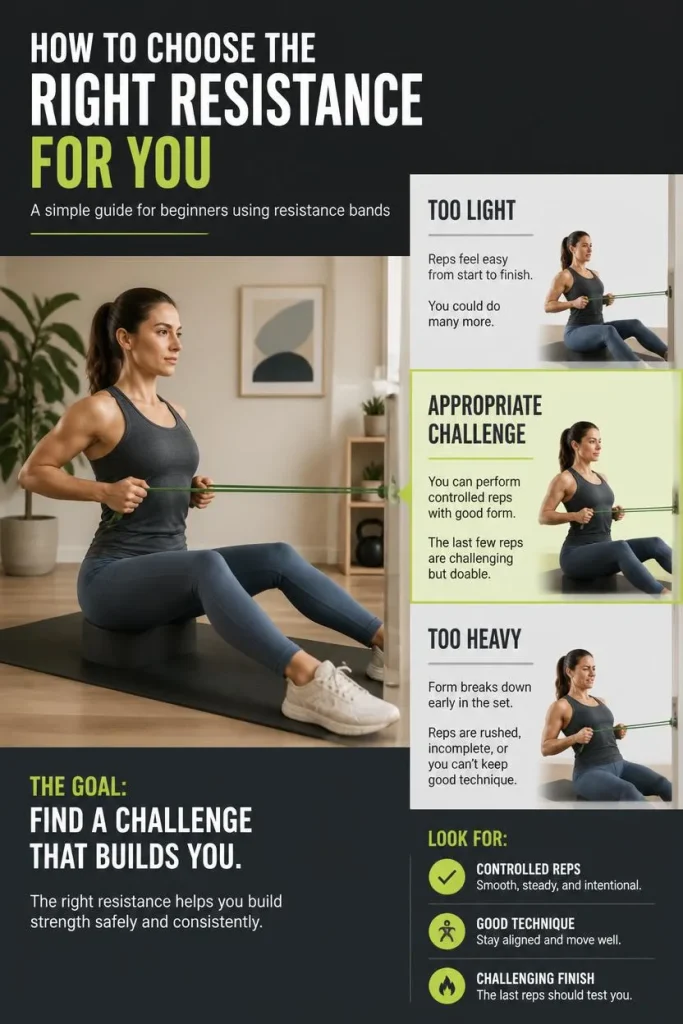
A band is appropriate when you can:
- Set up the exercise correctly.
- Move through a comfortable range of motion.
- Maintain control throughout the repetition.
- Complete your planned repetitions without your technique breaking down.
- Feel that the final repetitions are challenging without turning the movement into a struggle.
You want enough resistance to make the exercise meaningful, but not so much that you cannot control it.
How to Choose the Right Resistance Level
Rather than asking, “What resistance should a beginner use?” ask:
“What resistance can I control for this specific exercise?”
The answer can differ considerably between exercises.
For example, the resistance you can handle for a band row may be different from what you can control for a lateral shoulder exercise.
A simple beginner test
Before committing to a particular band, try the exercise for several controlled repetitions.
The band is probably too heavy if:
- You cannot complete the movement through a comfortable range.
- You have to jerk the band to start the repetition.
- Your posture changes dramatically.
- You cannot control the return phase.
- You compensate by swinging or twisting.
It may be too light if:
- The movement remains extremely easy.
- You finish your set without feeling that the working muscles had to do much.
- You can perform substantially more repetitions without the exercise becoming challenging.
You can also change difficulty without buying another band by adjusting your position, grip, band length, or leverage when the exercise allows it.
Why Band Resistance Feels Different From Dumbbells
Resistance bands do not behave exactly like dumbbells.
With a dumbbell, gravity provides the primary resistance. With an elastic band, resistance generally increases as the band stretches.
That means the exercise can feel different from beginning to end.
For some movements, the hardest part may occur later in the range of motion as the band becomes more stretched.
This is one reason you should not judge a band solely by how easy the first part of a repetition feels.
Instead, evaluate the whole movement.
Your Beginner Resistance Band Buying Checklist
Before purchasing a set, look for these features.
1. Appropriate resistance
Choose resistance that matches your current ability rather than buying the heaviest band available.
2. Useful band length
If you want full-body exercises, a long loop provides more possibilities than a small mini band.
3. Comfortable construction
Look for a band that feels comfortable during the exercises you intend to perform.
4. Clear resistance information
A manufacturer that explains its resistance levels makes it easier to choose and progress.
5. Appropriate attachments
If you want to perform exercises with handles or anchors, make sure those accessories are actually compatible with the system.
6. Good condition
Before every session, inspect the band for visible damage, cracks, significant wear, or other deterioration.
7. Storage that encourages use
This sounds minor, but it matters. Equipment that is easy to store and retrieve is easier to incorporate into a regular routine.
Should You Buy a Resistance Band Set?
A set can be useful, but more bands are not automatically better.
A beginner may be tempted by a large kit containing:
- Multiple loop bands
- Several tube bands
- Handles
- An ankle strap
- A door anchor
- Carrying bags
- Different resistance levels
Some people will use those accessories. Others will use one or two bands and leave the rest untouched.
A better question is:
What exercises do I want to perform?
If your goal is a basic full-body home workout, you may only need a small selection.
If you want to build a more varied routine over time, having multiple resistance levels can make progression easier.
Long Loop vs Mini Loop vs Tube Bands
If you are still unsure, use this simple decision guide.
Choose a long loop if you want:
- Full-body workouts
- Pulling and rowing exercises
- More exercise variety
- A compact alternative to several pieces of equipment
Choose a mini loop if you want:
- Glute exercises
- Hip strengthening movements
- Lower-body circuits
- A very small and simple piece of equipment
Choose tube bands with handles if you want:
- A familiar grip
- Rows and presses
- Curl and triceps variations
- A setup that feels closer to traditional resistance equipment
Choose fabric bands if you want:
- Lower-body exercises
- A wider band around the legs
- An alternative feel to thin elastic bands
How to Start Training With Resistance Bands
You do not need a complicated program when you first begin.
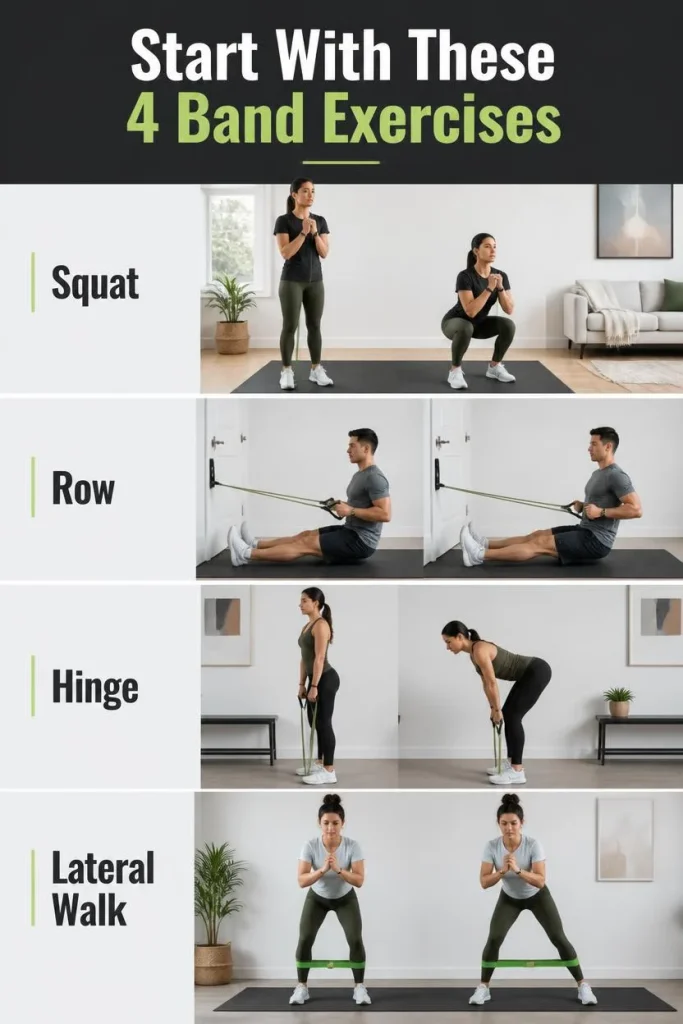
Start by learning a handful of basic movement patterns.
A simple beginner session could include:
| Movement | Example |
|---|---|
| Squat | Band squat |
| Hinge | Band Romanian deadlift |
| Pull | Band row |
| Push | Band chest press |
| Hip work | Lateral band walk |
| Core | Controlled anti-rotation or stability exercise |
Start with a resistance level that allows controlled repetitions.
The CDC lists resistance-band exercises among activities that count as muscle-strengthening work and recommends adults perform muscle-strengthening activity on at least two days each week, working the major muscle groups.
That does not mean you need to jump immediately into a demanding two-day program. If you are new to exercise, build up gradually.
How to Progress With Resistance Bands
Progression is one of the most important parts of strength training.
If you perform exactly the same exercise with exactly the same challenge indefinitely, there may be little reason for your body to continue adapting.
With resistance bands, progression can happen in several ways.
Increase the resistance
Move to a stronger band when your current resistance becomes manageable.
Increase repetitions
If your technique stays controlled, gradually performing more repetitions can increase the challenge.
Add a set
Instead of making the band heavier immediately, you can sometimes add another set.
Change the leverage
Changing your body position or band setup can alter the difficulty of an exercise.
Improve control
Slowing down the movement, particularly the return phase, can make an exercise more demanding without immediately needing a heavier band.
Increase range of motion when appropriate
A larger controlled movement can change the challenge of an exercise.
The key is to change one variable at a time when practical rather than making several major increases simultaneously.
ACSM’s current resistance-training guidance emphasizes gradual progression and consistency rather than complicated techniques.
Common Resistance Band Mistakes
Mistake 1: Buying the heaviest band immediately
Why it can be a problem:
A very heavy band can make it difficult to learn the movement properly.
Better approach:
Choose a resistance you can control and progress from there.
Mistake 2: Assuming colors are universal
Why it can be a problem:
Resistance levels and color systems vary between manufacturers.
Better approach:
Check the manufacturer’s resistance specifications rather than relying on color alone.
Mistake 3: Using momentum
Why it can be a problem:
Swinging or jerking can reduce your control over the movement.
Better approach:
Use a smooth, controlled tempo and adjust the resistance if necessary.
Mistake 4: Ignoring the return phase
Why it can be a problem:
The band can pull you back toward its starting position quickly.
Better approach:
Control the band as it returns rather than letting it snap back.
Mistake 5: Never checking the band
Why it can be a problem:
Repeated stretching and storage can contribute to wear.
Better approach:
Inspect your bands before use and replace equipment that shows significant damage.
Mistake 6: Treating every band exercise as a maximum-effort workout
Why it can be a problem:
Beginners often benefit more from learning technique and building consistency than from making every session exhausting.
Better approach:
Start at a manageable effort and progress gradually.
Resistance Band Safety Tips for Beginners
Resistance bands are simple, but they still deserve the same attention to setup and technique as other exercise equipment.
Before exercising:
- Inspect the band for damage.
- Make sure your setup is stable.
- Follow the manufacturer’s instructions for any anchors or attachments.
- Keep the band away from sharp edges.
- Avoid overstretching beyond the manufacturer’s guidance.
- Keep your movements controlled.
- Make sure the band cannot unexpectedly strike you or another person.
- Stop if you experience significant pain, dizziness, or unusual shortness of breath.
If you have a chronic health condition, disability, or another concern that could affect exercise, the CDC recommends discussing appropriate types and amounts of activity with a healthcare professional.
A Simple Beginner Buying Decision
If you want to make the decision quickly, use this checklist:
I want full-body workouts:
→ Start with a long loop band.
I mainly want glute and lower-body exercises:
→ Consider a mini loop or fabric band.
I prefer handles:
→ Consider tube bands.
I’m unsure about resistance:
→ Choose a lighter-to-moderate option you can control and progress from.
I want maximum exercise variety:
→ A small set with multiple resistance levels may be more useful than one very heavy band.
I have limited storage:
→ Choose a compact band that covers the exercises you actually plan to perform.
What a Practical Beginner Setup Looks Like
You do not need to recreate a commercial gym at home.
A simple setup might consist of:
- One long loop resistance band
- One mini loop band
- Exercise mat, if useful for floor exercises
- Enough open floor space to move safely
From there, add equipment only when your workouts give you a clear reason to do so.
FitVibe’s guide to Best Home Workout Equipment for Beginners: What You Actually Need takes the same minimalist approach to building a practical home setup.
If you are brand new to structured exercise, What to Do on Your First Day Working Out at Home can help you establish the basics before adding resistance.
For a broader beginner routine, 1-Month Beginner Fitness Plan: A Simple 4-Week Workout Guide provides a gradual framework that can accommodate optional resistance-band work.
Frequently Asked Questions
Are resistance bands good for beginners?
Yes. Resistance bands can provide a practical form of resistance training and can be used for many upper- and lower-body exercises. Research has found elastic resistance training can improve muscular strength, with some studies finding similar strength outcomes to conventional resistance training.
The important factor is choosing an appropriate resistance and learning the exercises correctly.
What resistance band should I buy first?
For general home strength training, a long loop band is a versatile starting option. If you mainly want lower-body exercises, a mini loop may be more appropriate.
The ideal resistance depends on your current strength and the exercise.
Are thicker resistance bands always better?
No. A thicker or heavier band is not automatically a better choice.
The appropriate band is the one that provides a useful challenge while allowing you to maintain control and good technique.
How many resistance bands do I need?
You can start with one useful band. Over time, having different resistance levels can make progression easier.
There is no requirement to buy a large set immediately.
Can resistance bands replace weights?
They can be an effective resistance-training option, but they do not have to completely replace weights.
Elastic resistance and conventional resistance can both be useful tools. The best choice depends on your goals, preferences, available space, and the exercises you want to perform. Research has found comparable strength outcomes between elastic and conventional resistance in several studied populations and protocols.
How often should beginners use resistance bands?
Resistance-band workouts can be incorporated into a broader strength-training routine. Current U.S. guidance recommends muscle-strengthening activity on at least two days per week for adults.
Beginners can build toward that level gradually rather than trying to maximize training volume immediately.
Should I use a light or heavy resistance band?
Use the resistance that allows you to perform the exercise with controlled technique while still making the movement meaningfully challenging.
Because different exercises require different amounts of resistance, you may eventually want more than one level.
The Bottom Line
Choosing your first resistance band does not need to be complicated.
Start with the exercises you want to perform, choose a band that lets you control those movements, and treat resistance as something you can gradually increase rather than something you need to maximize on day one.
For many beginners, a long loop band provides the greatest versatility. A mini loop or fabric band is useful for lower-body work, while tube bands with handles can be appealing for pressing and pulling exercises.
Most importantly, choose equipment that fits your space, budget, abilities, and routine. A simple setup you use consistently is more valuable than a large collection of equipment you rarely touch.
If you’re ready to begin, start with a few basic movement patterns, learn the technique, and progress gradually.
Save This Guide: Resistance Band Quick Reference
Long loop: full-body versatility
Mini loop: hips, glutes, and lower body
Tube with handles: rows, presses, curls
Fabric band: comfortable lower-body training
Resistance: choose based on the exercise, not color alone
Progression: increase resistance, repetitions, sets, leverage, or control gradually
Safety: inspect bands and keep every movement controlled
Sources & Further Reading
- American College of Sports Medicine — 5 Things to Know About Creating an Effective Resistance Training Plan — 2026 resistance-training guidance emphasizing consistency, individualization, gradual progression, and home-based options such as resistance bands.
- CDC — Adult Activity: An Overview — current adult physical-activity and muscle-strengthening recommendations.
- PubMed — Effects of training with elastic resistance versus conventional resistance on muscular strength — systematic review and meta-analysis comparing elastic and conventional resistance training.
- PubMed — Effects of Elastic Resistance Exercise on Muscle Strength and Functional Performance in Healthy Adults — systematic review and meta-analysis of elastic resistance exercise in healthy adults.